From the early 19th century through the early 20th century, thousands of Americans gathered regularly at remote campgrounds amidst the trees and grass of a still mostly rural nation, pitching tents to hear revival preachers at meetings that often lasted for several days and sometimes continued for weeks. During these gatherings, crowds enthusiastically participated in prayer meetings, baptisms (and sometimes weddings), listened to sermons and hymns, and reconnected with distant friends and family.
Accounts of the origins of camp meetings in America differ, but most scholars trace the movement to revival gatherings that began in the southern and southeastern United States during the early 19th century, adapted from the “open air” preaching tradition popularized during the Great Awakening. Although camp meetings drew participants from many denominations, some were more prevalent, especially Presbyterians, Baptists, and Methodists. Because of their existing tradition of circuit riders and outdoor worship, Methodists became particularly associated with the early camp meeting movement.
Across sparsely populated rural America, families traveled as far as 40 miles to attend the meetings. For those who lived in communities without an established church, camp meetings offered a rare opportunity for both religious and social fellowship. Amid the revival preaching and festive atmosphere, emotions could run high, and accounts frequently described expressive forms of worship, including spontaneous fainting, shouting, and dancing.
Later 19th century author Edgar M. Levy recounts one description of a radical camp meeting in his Illustrated History of Douglas Camp Meetings: “…A remarkable revival of religion…swept over the State of Georgia in 1824, resulting in the addition of from fifteen to twenty thousand souls to the Baptist churches alone. This work of salvation originated in an open-air meeting held by the Antioch Church, in Morgan County. During a sermon preached by Rev. Adiel Sherwood of Connecticut, the Holy Spirit fell first upon the preacher and then upon the people, and nearly four thousand sinners cried out in great anguish of soul. The scene was beyond description and the result of this baptism of the Holy Ghost and of fire were realized by the churches of all denominations in the State for many years.”
While some early Americans experienced camp meetings as deeply transformative, others viewed them with concern and skepticism, criticizing their emotive nature and questioning their lasting value. In an 1820s pamphlet held by the Wheaton Archives, Camp Meetings Described and Exposed, an anonymous writer argues, “The whole strain of preaching, of exhortation, of praying circles, and of tent praying, is a direct and powerful action upon the minds and fears of the awakened, producing an excitement, which rises higher and higher, till, from this state, they must be brought out into – something – probably, into false hope, false joy, high self-confidence and certainty, that their sins are forgiven, and that they are happy.”
Despite disagreements over form and purpose, camp meetings remained a prominent part of early American religious life throughout the 19th century. However, by the end of the century and increasingly into the 20th, these temporary gatherings gradually became more institutionalized. On formerly rustic campgrounds, organizers constructed permanent tabernacles, cabins, and other facilities. The extended informal camp format gradually gave way to annual Bible conferences or denominational meetings. Some campgrounds eventually evolved into resorts, with limited or no religious programming.
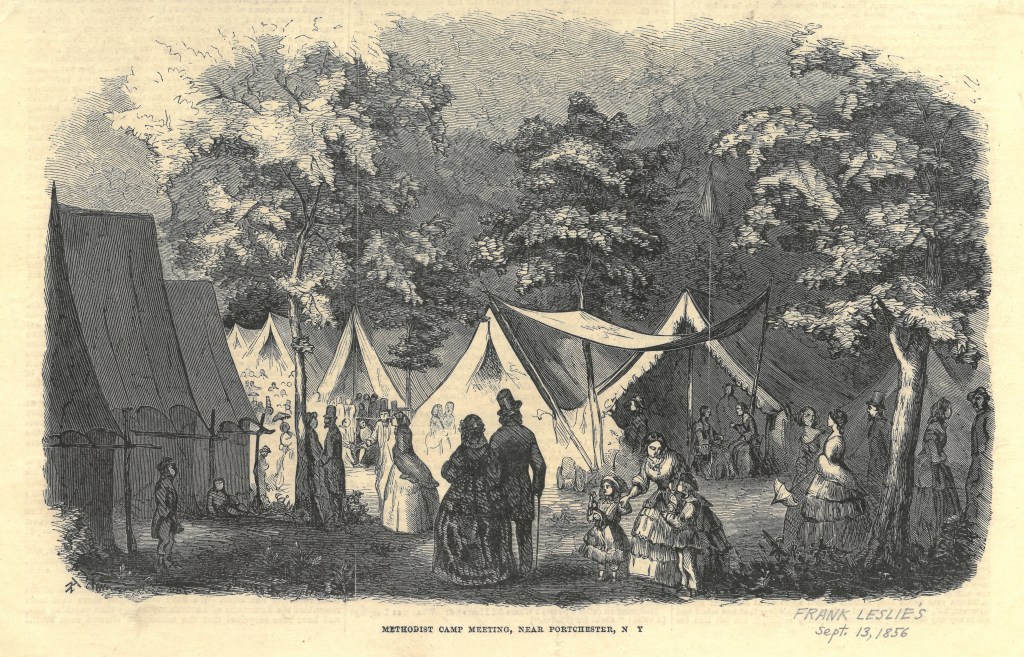
Throughout the evolving history of American camp meetings, these gatherings were frequently depicted in paintings, etchings, and prints, as well as featured in popular illustrated magazines. Organizers of camp meetings also created promotional materials to advertise the meetings, including handbills, posters, and postcards. Wheaton Archives & Special Collections holds dozens of these images and pieces of print ephemera in SC233: Sacred Arts Collections. Below, we highlight a few selections from the collection:
Paintings & Lithographs
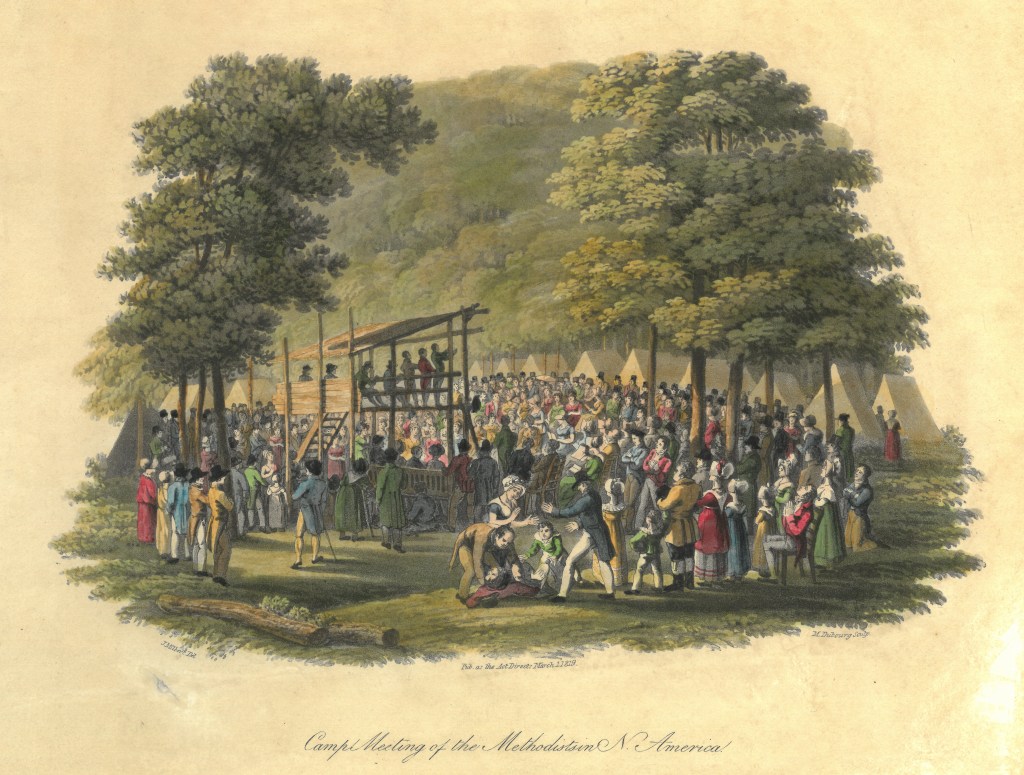
“Camp Meeting of the Methodist in N. America,” hand-colored aquatint print, c. 1819. Illustrated by the French artist Jacques Gérard Milbert (1766-1840), who sketched several scenes of American religious life and camp meetings, and engraved by Matthew Dubourg, who worked as an engraver and aquatinter in London from 1808-1838. The colorful scene appears to capture the crowd during a time of worship. Music at camp meetings often centered around “call and response” hymns, where simple choruses from the crowd alternated with more elaborate verses from leaders. While drawn intently to the central platform, the crowd appears mostly composed. However, the scene of the man fainting in the foreground hints at some of the more spectacular religious responses attributed to camp meetings.
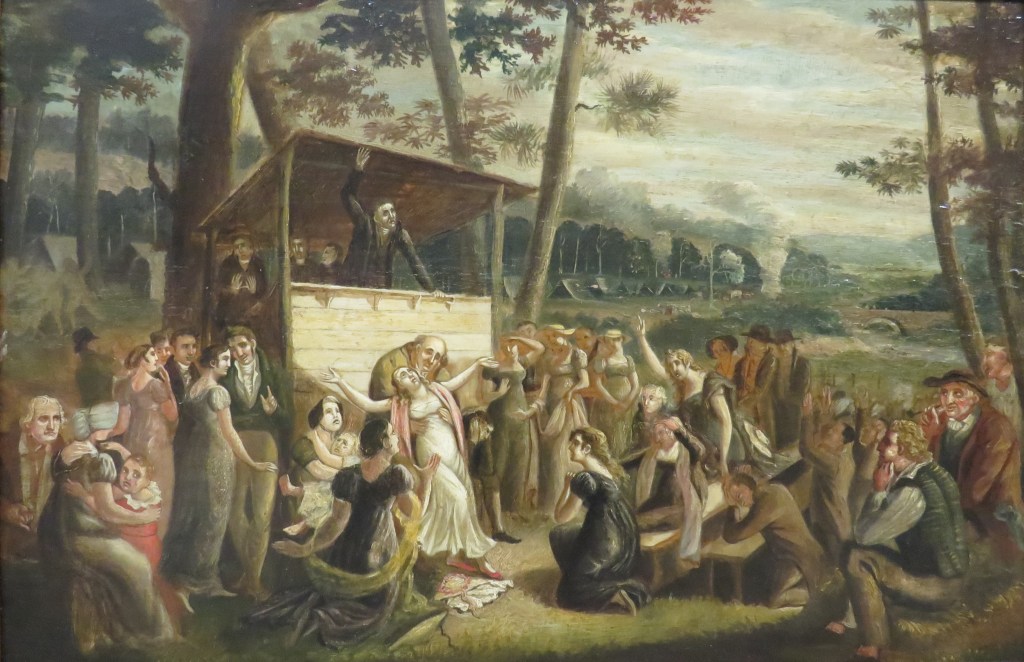
Oil painting of a camp meeting on pine panel with lacquered finish, c. 1832. An unsigned work, the painting has been generally attributed to the Swiss-born artist and engraver Alexander Rider, who arrived in America in the early 1800s and worked primarily around Philadelphia. In contrast to the 1819 print, this work prominently centers the camp meeting as a scene full of emotional fervor.
Illustrated Magazines
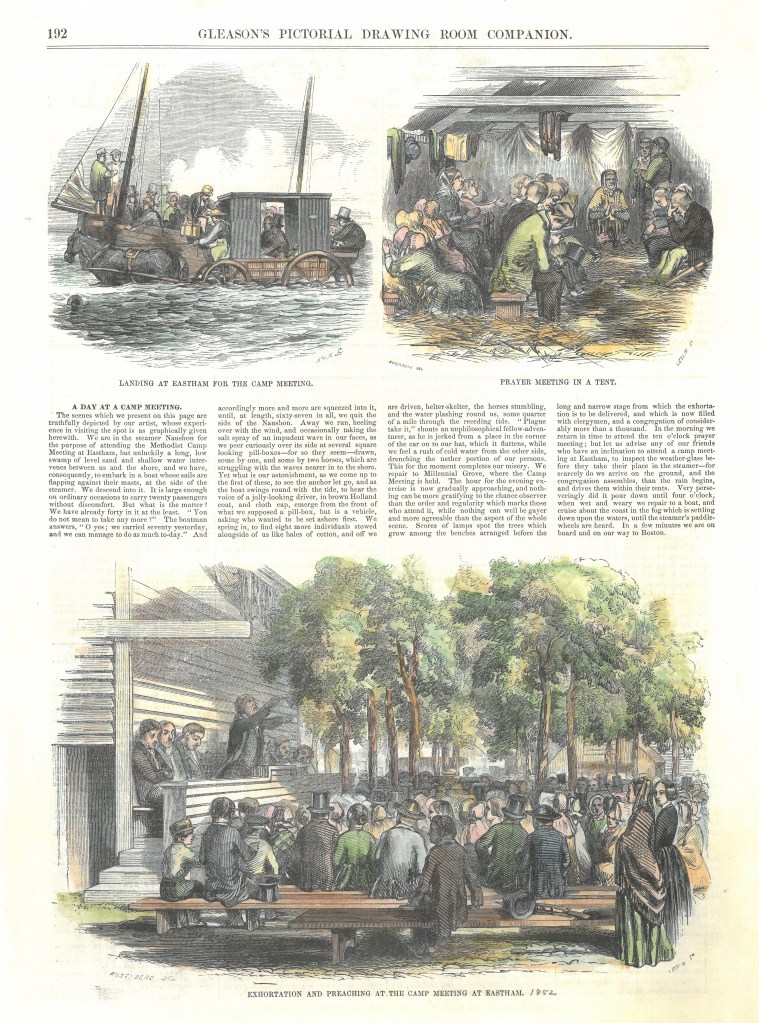
A page from Gleason’s Pictorial Drawing Room Companion (1851-1859) featuring hand-colored wood engravings of scenes from a 1852 Methodist camp meeting at Eastham, Massachusetts. Illustrations include “Exhortation and Preaching at the Camp Meeting at Eastham,” “Landing at Eastham for the Camp Meetings ” and “Prayer Meeting in a Tent.” The accompanying account offers a positive view of a more established camp meeting: “The hour for the evening exercise is now gradually approaching, and nothing can be more gratifying to the chance observer than the order and regularity which marks those who attend it, while nothing can well be gayer and more agreeable than the aspect of the whole scene. Scores of lamps spot the trees which grow among the benches arranged before the long and narrow stage from which the exhortation is to be delivered, and which is now filled with clergymen, and a congregation of considerably more than a thousand.”
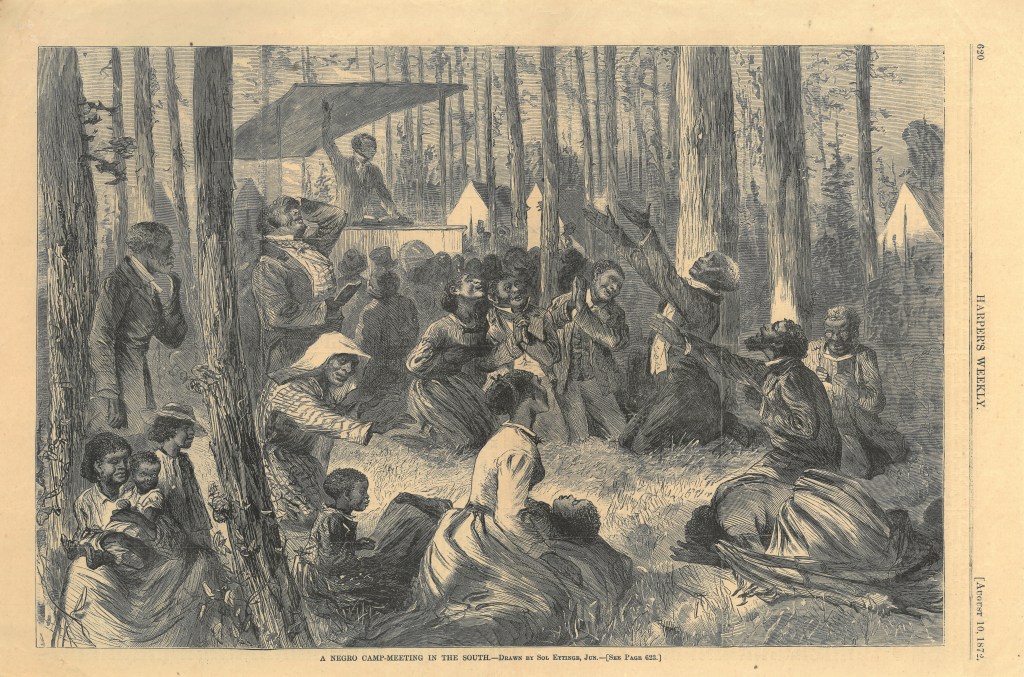
Print of “A Negro Camp-Meeting in the South,” published in Harper’s Weekly, August 10, 1872. The scene was drawn by Solomon Eytinge, Jr. (1833-1905), an American illustrator who regularly contributed drawings for Harper’s and was particularly known for his pictorial exploration of poverty in America. Although there is evidence that some camp meetings of the early 19th century were integrated, by the mid-century the norm was for segregated or even entirely separate meetings. The accompanying article to the illustration, while displaying many of the racial prejudices of the day, also notes the continued danger and mistreatment faced by many Black Americans in seeking to exercise their right to gather and worship in the Reconstruction era South.
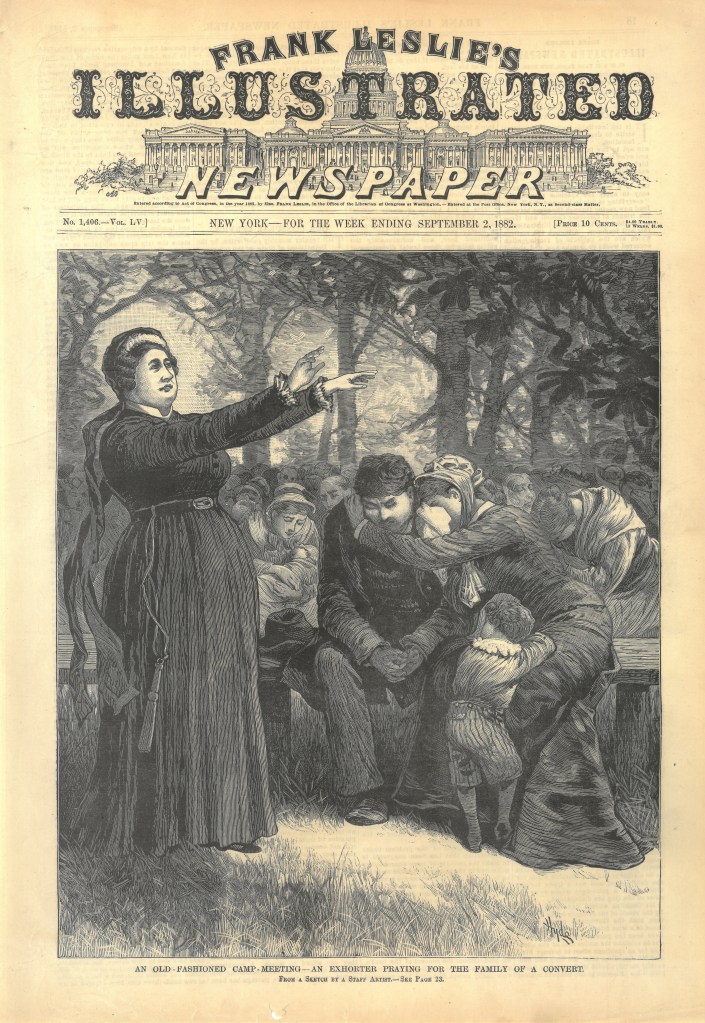
Print of “An Old-Fashioned Camp-Meeting – An Exhorter Praying for the Family of a Convert,” published as the cover image of Frank Leslie’s Illustrated Newspaper, September 2, 1882. The accompanying article identifies the camp meeting as the recurring Neelytown camp-meeting in Orange County, New York, led in 1882 by the Widow Van Cott, the first woman licensed to preach in the Methodist Episcopal Church. The writer’s account of the story behind the illustration reflects the commingling of the religious and the carnival that came to characterize some of the popular camp meetings: “Many of the types of rural characters at Neelytown gave Mrs. Van Cott opportunity for bringing about these dramatic situations in which she so much delights, as in suddenly stretching out her hands over a worshiper somewhat under the influence of the local tipple, who was present with this wife and child, and asking for the divine blessing on his head. A few minutes later this same worshiper was on the outskirts of the camp wanting to bet a friend ten dollars that he had a ‘bay horse that could jest git away with any company o’ hosses there was down to Neelytown at this meeting.'”
Prints & Handbills
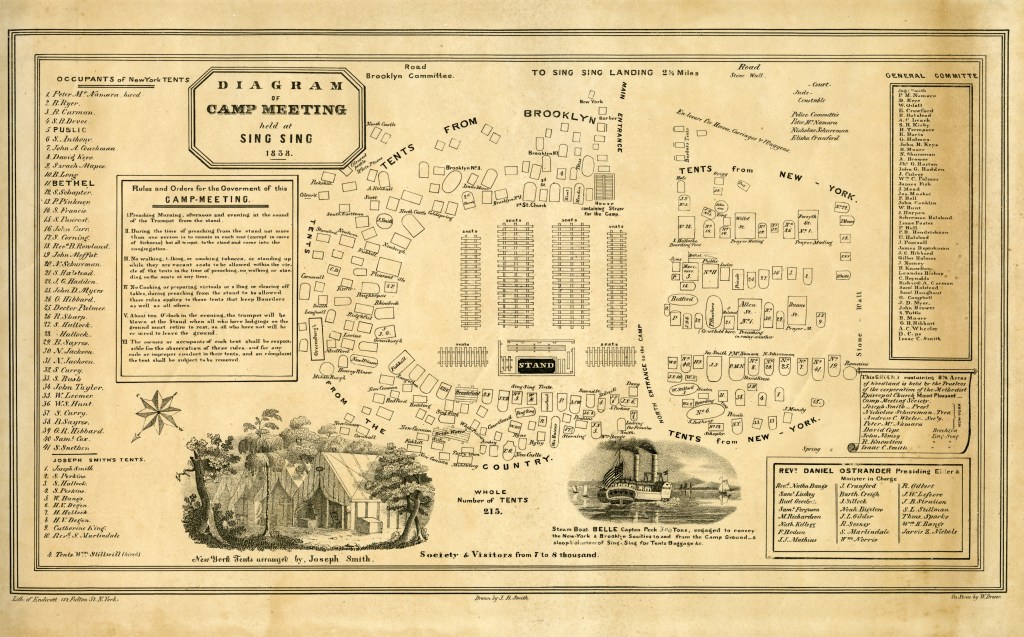
Large print of “Diagram of Camp Meeting held at Sing Sing, 1838.” Drawn on stone by W. Dreser after a sketch by Joseph B. Smith. “Drawing on stone” was a printing method which involved the artist using grease-based materials (like crayons) to draw images directly onto polished limestone before applying ink for prints. This method allowed for detailed images that could be more easily mass produced. Along with a diagram of the layout of the camp meeting and two images of camp meeting tents and the steam boat used to carry passengers to the camp ground, the print includes a list of rules governing the camp. Seeking to provide guardrails to the crowds of thousands, the camp restricted the use of tents during services and imposed a 10 o’clock curfew for all attendees.
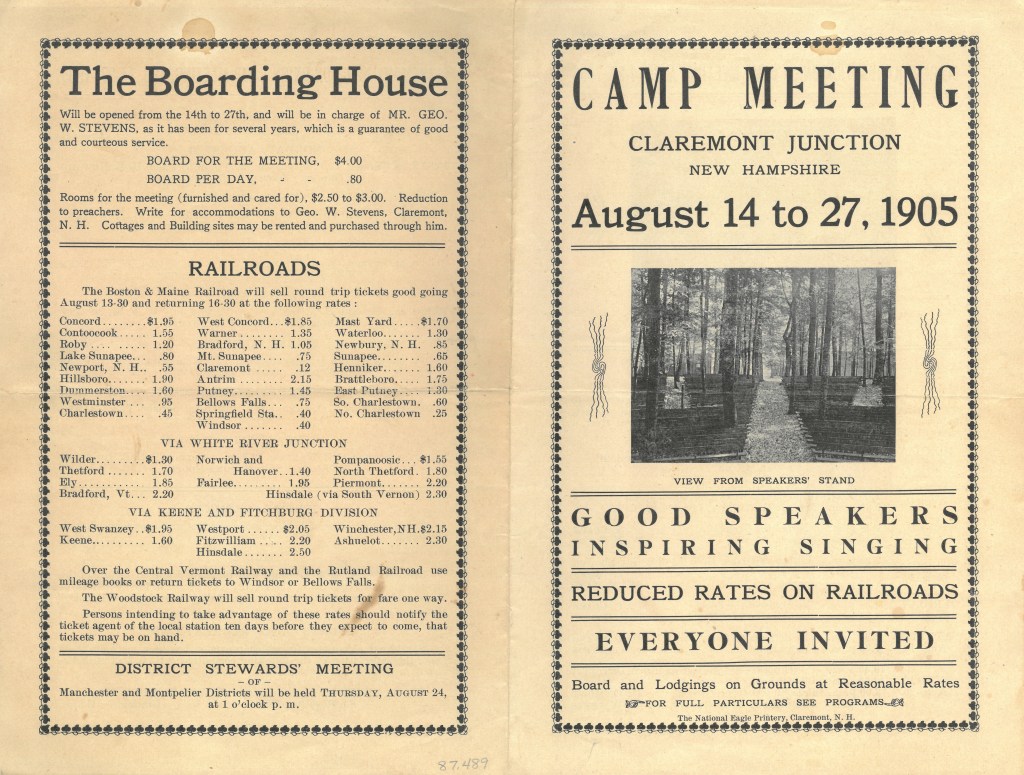
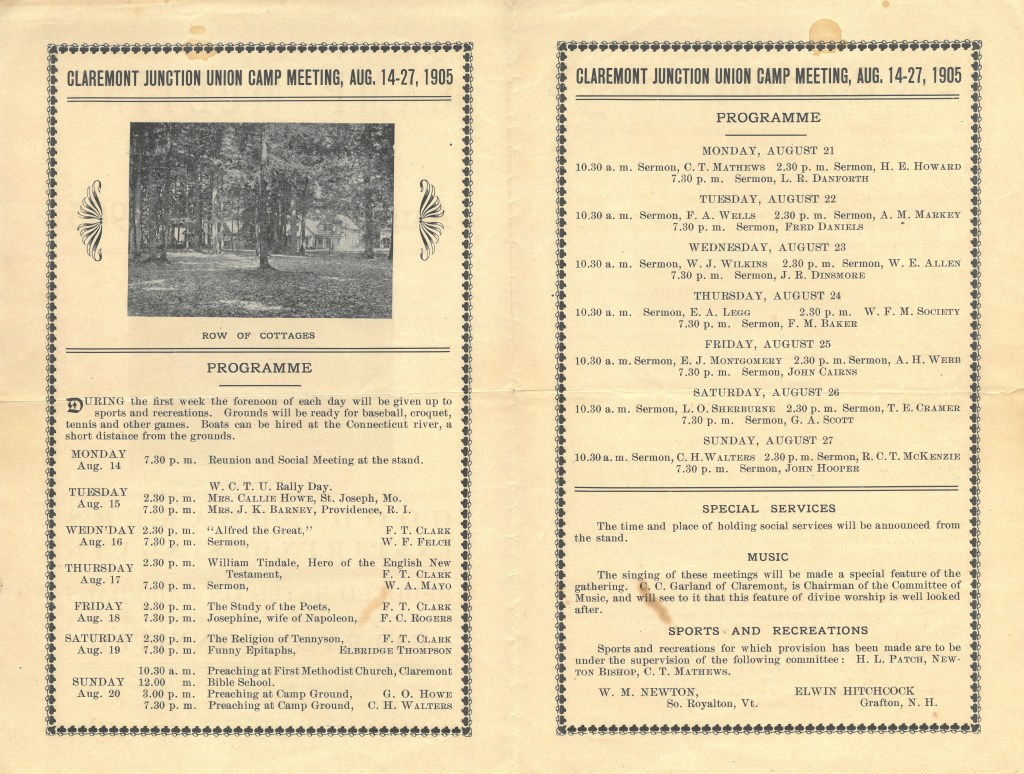
An informational program for an August 1905 Methodist camp meeting at Claremont Junction, New Hampshire. Unlike the early tent meetings of the 19th century, the rates and information for the boarding house attached to the camp meeting illustrate the development of permanent structures and infrastructure, even as the services still remained tied to nature and the outdoors. The elements of socialization and recreation that had always been an important part of camp meeting are also here institutionalized, with grounds prepared for baseball, croquet, and tennis, and scheduled social meetings.
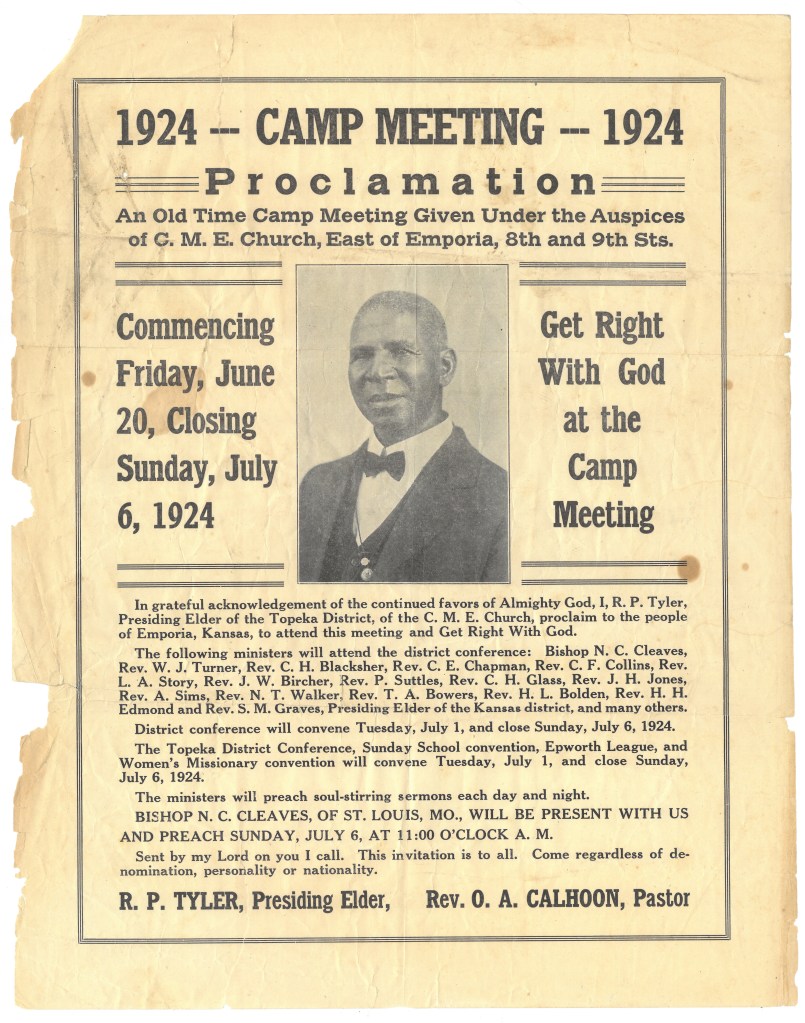
Handbill for a 1924 camp meeting of the Christian Methodist Episcopal Church near Emporia, Kansas. A predominately African American denomination, the Christian Methodist Episcopal Church (formerly “Colored Methodist Episcopal Church”) was organized in 1870 in Jackson, Mississippi by former enslaved members of the Methodist Episcopal Church. Harkening back to the camp meeting as source of religious revival and fervor in the 19th century, the flyer promotes the “old time camp meeting” as the perfect opportunity to “get right with God.”
Postcards
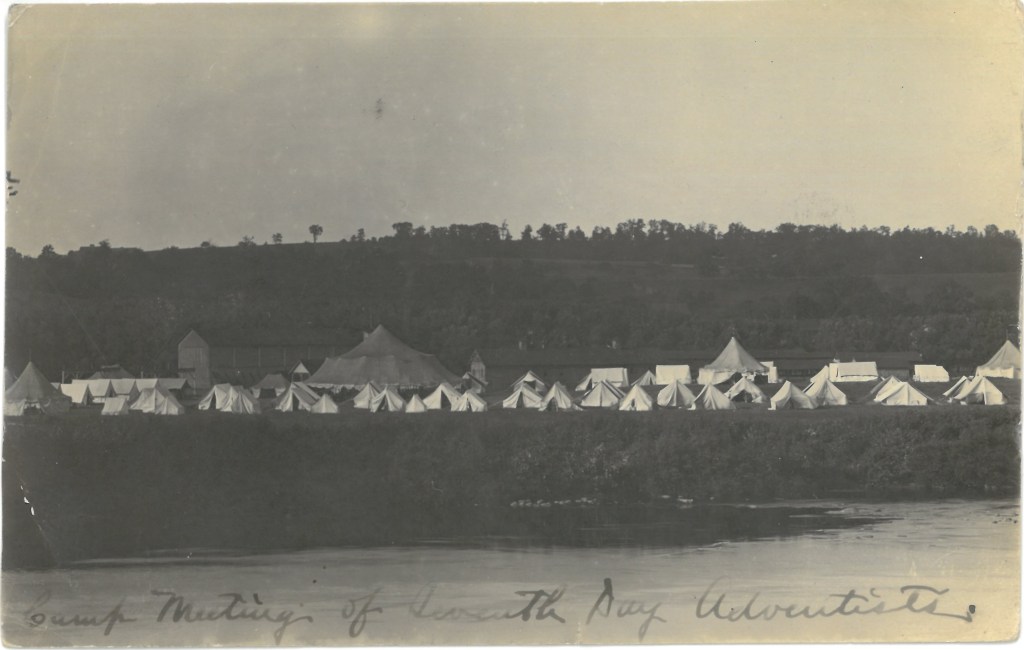
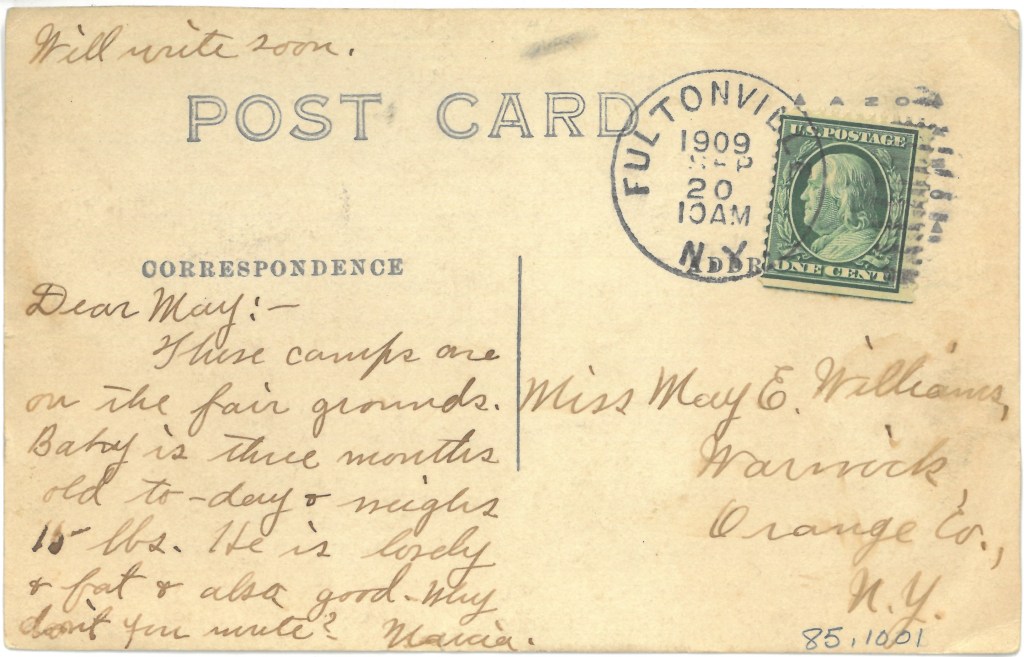
Postcard of a “Camp Meeting of Seventh Day Adventists” with photograph of tents viewed across a lake. Postmarked September 20, 1909 in Fultonville, New York. By the early 20th century, many camp meetings, especially in the Northeast, had transitioned to more permanent camp grounds. However, some of the newer Christian denominations that had emerged towards the end of the 19th century, including the Seventh-Day Adventists, continued the older tradition of tent-based gatherings, reflecting the still enduring legacy of the 19th-century revival movements.
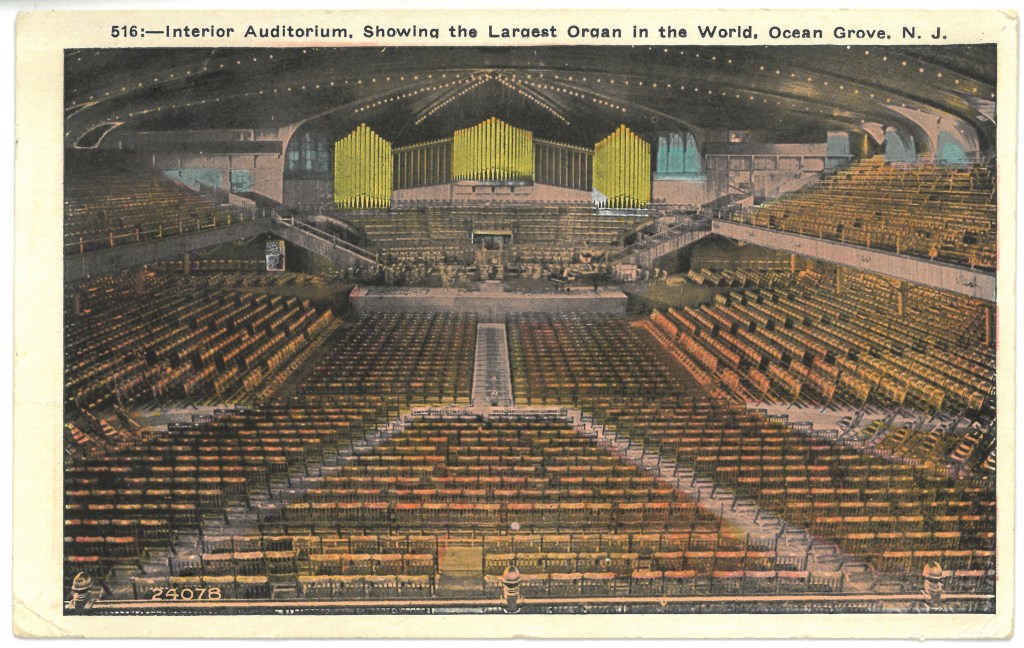
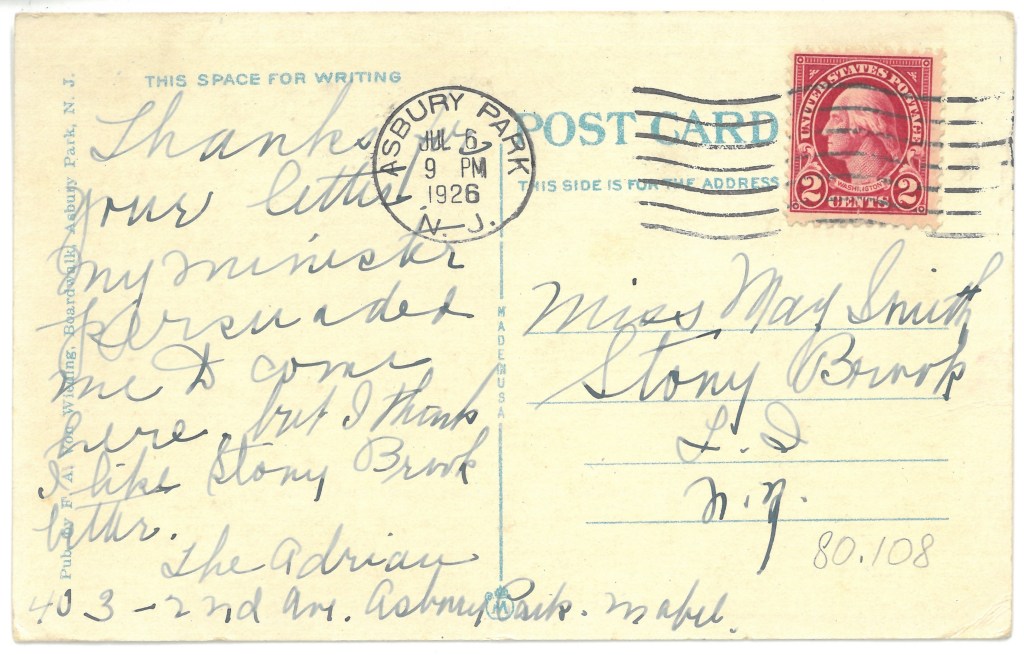
Postcard of the interior auditorium of the Ocean Grove Camp in New Jersey. Postmarked July 6, 1926 in Asbury Park, N.J. The text of the postcard promotes the auditorium as having the “largest organ in the world.” The sender of the postcard, “Mabel,” writes, “My minister persuaded me to come here but I think I like Stony Brook better.” First used for camp meetings in 1869, the property at Ocean Grove soon underwent further development, with the “Great Auditorium” finished in 1894. The Ocean Grove Camp Association maintains its Wesleyan-Holiness identity and still operates as a religious retreat. The Stony Brook Assembly retreat was established on the north shore of Long Island by Presbyterian ministers in 1906, but closed in 1958.
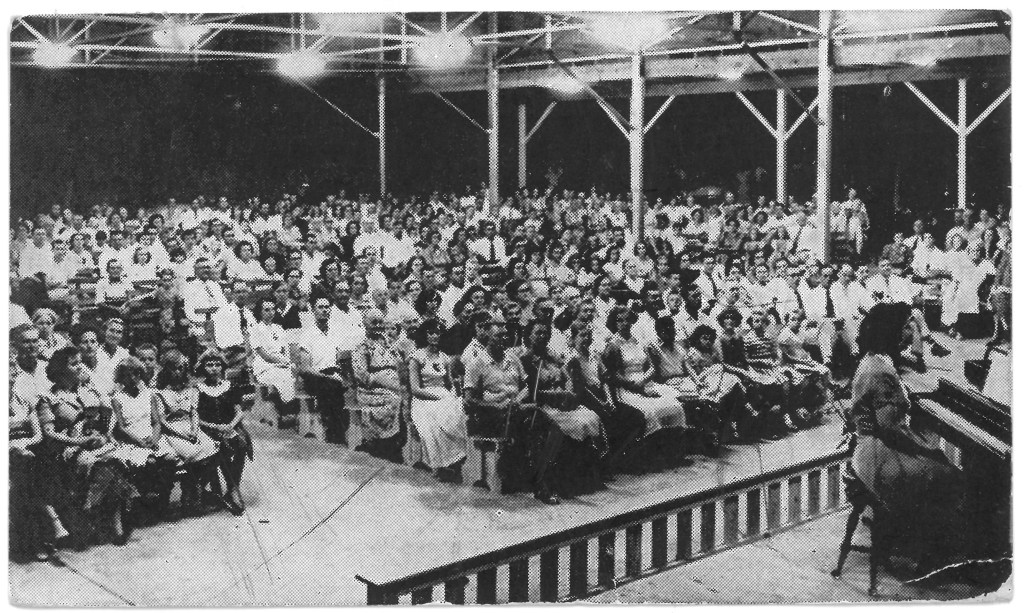
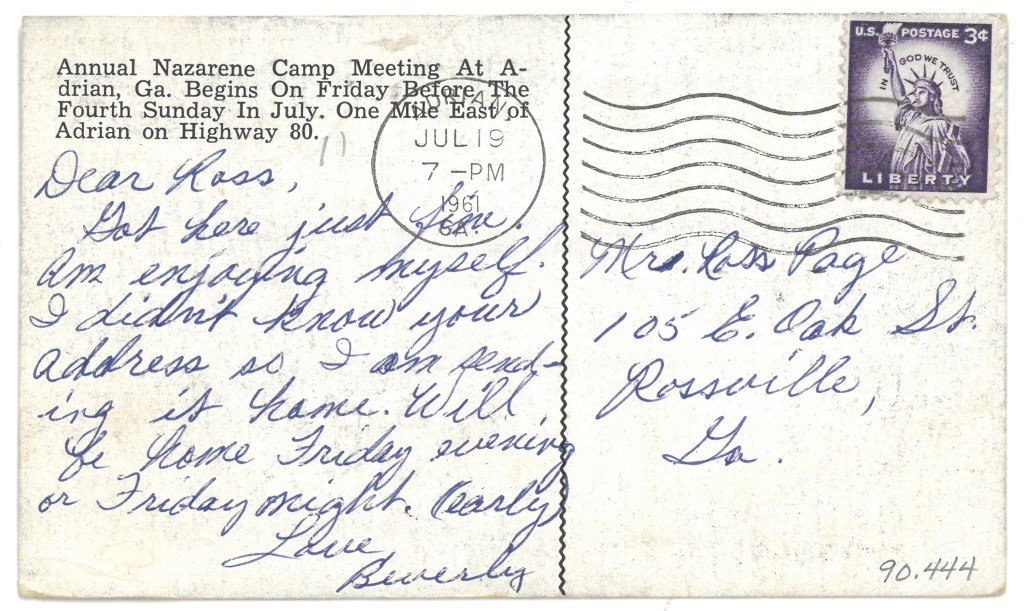
Postcard of a Nazarene Camp Meeting with inscription, “Annual Nazarene Camp Meeting at Adrian, GA. Begins on Friday before the fourth Sunday in July. One mile east of Adrian on Highway 80.” Postmarked July 19, 1961. Many of the Holiness and Pentecostal Christian denominations continued the camp meeting tradition long after it fell out of fashion for the Methodist and other mainline denominations, although often on developed campgrounds with cabins and other facilities.
Explore more materials and collections held by Wheaton Archives & Special Collections through our archival database at archives.wheaton.edu.

