The Wheaton Archives & Special Collections and the Marion E. Wade Center are pleased to announce new additions to their archival holdings donated from the estate of Ralph Blair. Dr. Blair collected widely in the areas of American evangelicalism and British Christianity. Earlier this spring, several boxes containing artifacts from the Blair collection arrived at Wheaton College for campus archival staff to add to our rich collections. These items will soon be available for research, and a few highlights from the collections are featured below. We are grateful for these donations!
Continue readingMonth: May 2026
Capturing the Camp Meeting
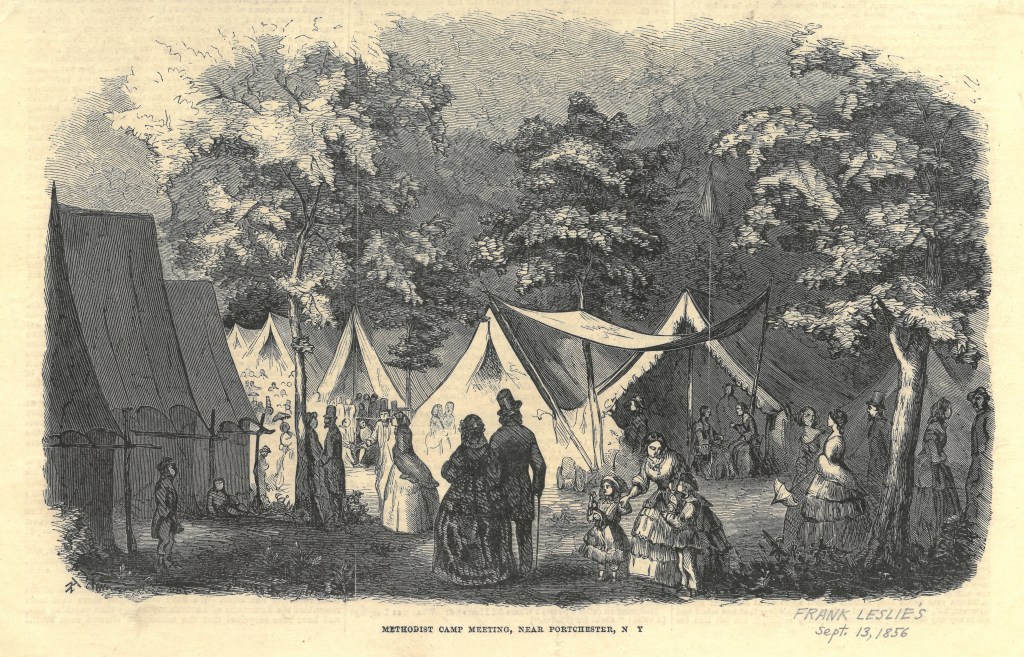
From the early 19th century through the early 20th century, thousands of Americans gathered regularly at remote campgrounds amidst the trees and grass of a still mostly rural nation, pitching tents to hear revival preachers at meetings that often lasted for several days and sometimes continued for weeks. During these gatherings, crowds enthusiastically participated in prayer meetings, baptisms (and sometimes weddings), listened to sermons and hymns, and reconnected with distant friends and family.
Accounts of the origins of camp meetings in America differ, but most scholars trace the movement to revival gatherings that began in the southern and southeastern United States during the early 19th century, adapted from the “open air” preaching tradition popularized during the Great Awakening. Although camp meetings drew participants from many denominations, some were more prevalent, especially Presbyterians, Baptists, and Methodists. Because of their existing tradition of circuit riders and outdoor worship, Methodists became particularly associated with the early camp meeting movement.
Across sparsely populated rural America, families traveled as far as 40 miles to attend the meetings. For those who lived in communities without an established church, camp meetings offered a rare opportunity for both religious and social fellowship. Amid the revival preaching and festive atmosphere, emotions could run high, and accounts frequently described expressive forms of worship, including spontaneous fainting, shouting, and dancing.