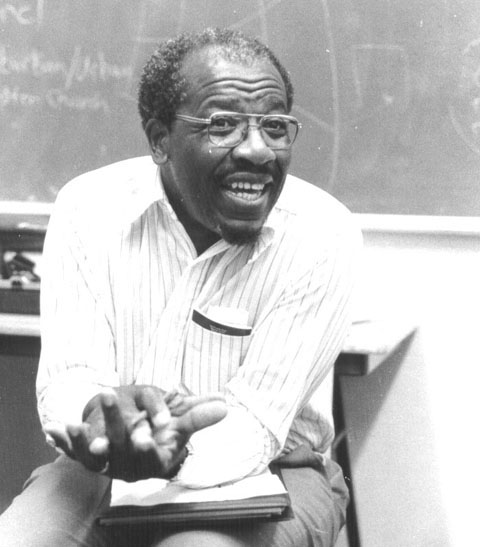
In celebration of Black History Month this February, Wheaton Archives & Special Collections highlights the transformational work of the Voice of Calvary Ministries, founded in Mendenhall, Mississippi by John M. Perkins – pastor, writer, and civil rights advocate.
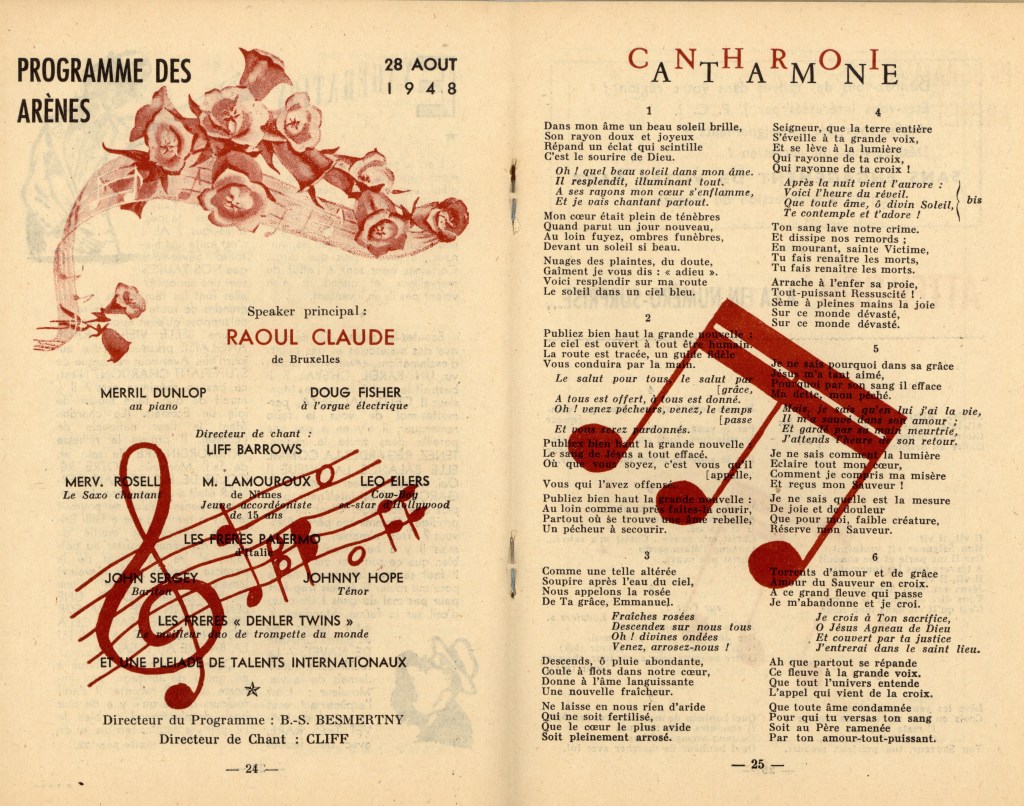
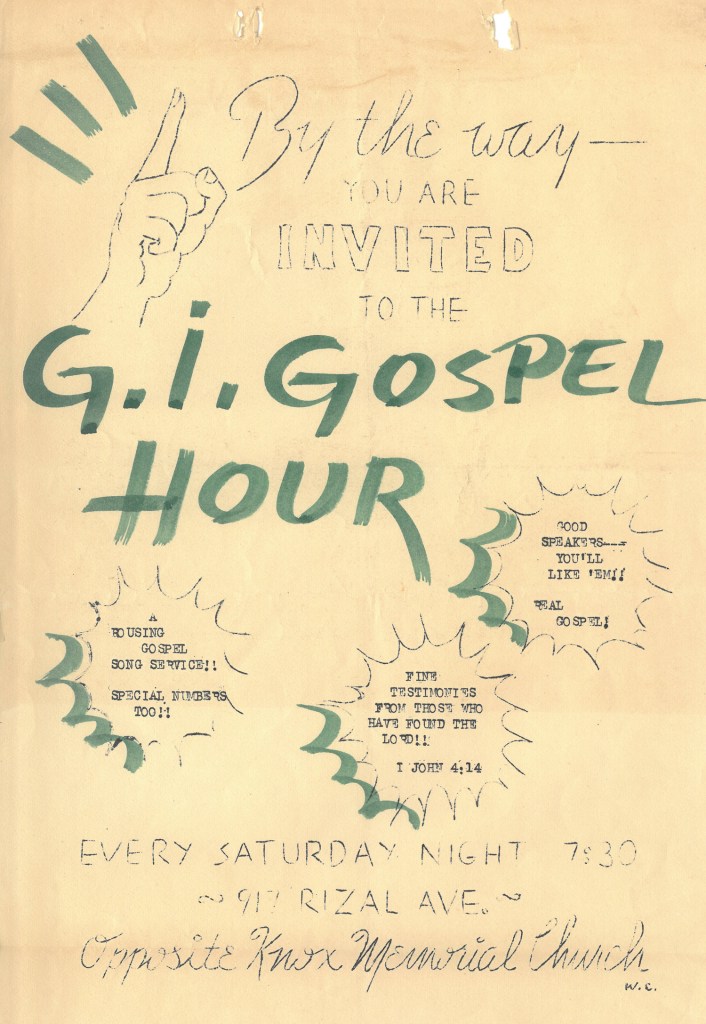
Advertisement for GI Gospel Hour in Manila, Philippines, 1945. (CN 406 Folder 2-18)
World War II not only commanded the world’s attention and shaped international politics but also proved to be a decisive moment for North American missions’ history. Young American men and women military personnel traveled the world, saw the war’s devastation, and came face-to-face with the spiritual needs of the local populations. Their war experiences shaped the college educations they returned to the U.S. to complete and the futures they later stepped into.
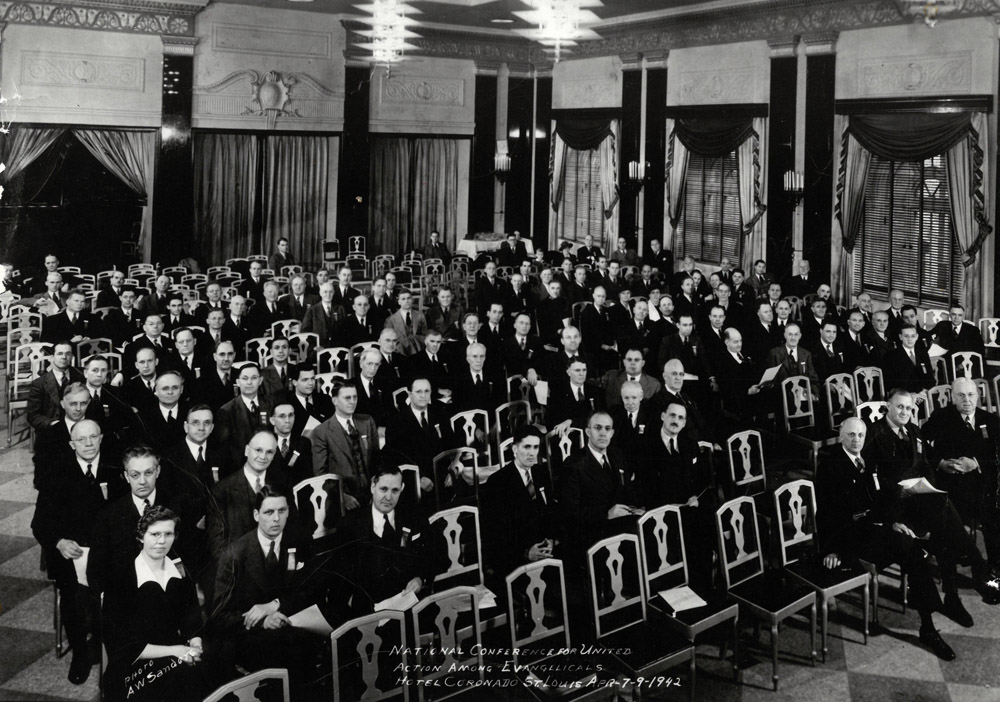
But the context they returned to was also evolving. American Evangelicals were emerging from their isolation following the Fundamentalist-Modernist controversy of the 1920s to take a more active role in church, politics, entertainment, education, and business. The National Association of Evangelicals was formed, the roots of Billy Graham’s ministry were already taking hold, Inter-Varsity Christian Fellowship, Navigators, and Campus Crusade for Christ were established on college and university campuses, and Youth for Christ was on the move among American high school students. Out of this convergence of factors grew new mission agencies, including the Far Eastern Gospel Crusade (FEGC), now known as SEND International.
As circulation and movement slowly returned, life approached closer to normal in Wheaton Archives & Special Collections, as elsewhere, in 2021.
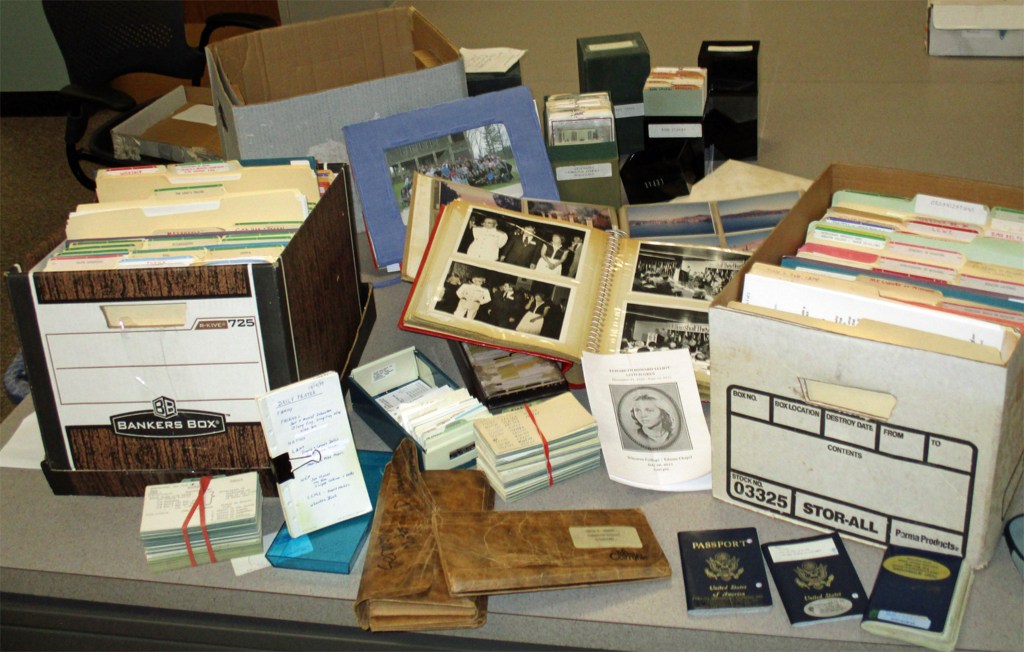
The first accession of 2021: 21-01 the papers of David Howard, described below.
Most of the staff worked from the office for almost the entire year and with proper precautions researchers could once more be seen reading in the Reading Room. Normalcy (to borrow President Harding’s term from just over a century ago) could be seen in other areas too. In 2020, the Archives acquired 16 accessions, totaling a little more than 9 cubic feet. In 2021 there were 45 accessions, totaling 119 cubic feet.
One of the joys of archives and archival work is the opportunity the collections offer to explore the great variety of human invention and artistry across both time and space, as well as the ways in which common ideas and images endure through different cultures and generations.
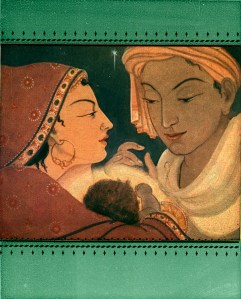
Collection 177, Folder 8-12
As people all around the world begin their celebrations of Advent, this month we delve into the many intriguing variations in our collections on one of the most enduring of Christmas images – the Nativity.
From the origins of the story of Jesus Christ’s birth in the world of first century Palestine, to Western Europe and North America, and across the globe in India, China, and the Philippines, a review of just a few of the images of the nativity held by the Wheaton Archives & Special Collections demonstrates the many ways the Christmas story has been reflected and reimagined in a myriad of different times and places.
Was Wheaton, IL once a headquarters for cinema in the Midwest? Well, perhaps not quite. But it is true that in the middle decades of the 20th century, Wheaton was the center for the regular production of dozens of films, pioneered by the Scriptures Visualized Institute, also know as the C. O. Baptista Film Mission and C. O. Baptista Films, among other names.
Embracing their central slogan, “The Old Gospel in Modern Technique,” C.O. Baptista films represented one effort among many by Christians in the 20th century to use the possibilities of ever advancing new technologies – from recorded sound on wax cylinders to instantaneous communication via the internet – as new channels for the gospel.
The records of the Baptista Film Mission, including selections of its film catalog, are available and open for research at the Wheaton College Billy Graham Center Archives.
On October 15, 1956, 65 years ago today, Christianity Today published their first issue. Explaining the place of the new magazine in an editorial titled “Why Christianity Today?”, the editors stated, “evangelical Christianity needs a clear voice, to speak with conviction, and love, and to state its true position and its relevance to the world crisis.” Employing that clear voice to wide effect, the first printing was sent to more than 250,000 pastors, seminary students, and evangelical Christian leaders across the world.
An autographed copy of the first issue, as well as correspondence, board meeting minutes, financial reports, memos, photographs, audio tapes, and other material mostly relating to the founding of the magazine and a wide range of religious, social, and political issues can be found in Collection 8: Records of Christianity Today, held here at the Wheaton College Billy Graham Center Archives.
A copy of the first issue autographed by four of the magazine’s original five editors (CN8, Folder 14-1).Continue reading →
Some may look to October for the start of crisp fall weather, trips to apple orchards, and pumpkin carving, but here at the Wheaton College Billy Graham Center Archives we celebrate October as American Archives Month. Joining archives, historical societies, and special collections around the country, we take this time to highlight the place of archives in preserving and making accessible the important records of our past and present communities.
While much of the work of archives takes place behind the scenes, both with archivists in stacks and researchers in reading rooms, this month we invite the wider community into the Archives through the 2021 Archival Research Lecture, A Gospel for the Poor: René Padilla and the Reshaping of Global Evangelicalism, presented by Dr. David Kirkpatrick at Wheaton College on Thursday, October 7th.
History is all about context. Usually this means the wider circumstances, including what lead up to the events we study and the mental word of the people we seek to understand. But it has a physical aspect too – the material objects that surround people, shaped by and shaping the culture of which they are a part.
Take, for example, the letterhead – the pre-printed part of a piece of stationary that gives the sender’s name, address and other information. Any archivist or scholar who goes through hundreds or thousands of letters will find amazing variety in this simple device.
Some state their data with clipped simplicity, some overflow with the sender’s beliefs, principles, mottos, and images to such a degree that they easily dominate whatever sentences can be squeezed into the remaining white space of the page.
The ability of the physical page to communicate as well as the words upon it is illustrated by the correspondence of J. Edwin Orr (1912-1987). In 2020, the Archives opened Collection 355, the papers of Orr, an influential evangelist and scholar who exchanged thousands of letters worldwide with people over half a century of ministry. What he and his correspondents wrote to each other is fascinating, insightful, and instructive. But what they wrote upon, the stationary itself, can also be charming, illustrative, and sometimes weird, quietly (or not so quietly) conveying its own message and tone.
Maps are a common feature of archival collections, and the Wheaton College Billy Graham Center Archives is no exception. The Archives’ oversize storage cases contain a wide variety of maps—thematic, navigational, topographical, and even blueprints—used for diverse range of research topics and as a popular tool in archival instruction sessions. As primary sources, maps require a specific set of skills to “read” and interpret. Like all items held in the Archives, maps are social documents, reflecting both the intentions and abilities of their creators (cartographers) as well as the needs and expectations of their anticipated users. Maps tell stories. While a single map can capture a landscape, metropolitan grid, or continent frozen in time, a series of maps can document gradual or abrupt change, like shifting national or regional boundaries, erosion of natural landmarks, or rapid urbanization. No map, however extensive or detailed, can be entirely authoritative. They are not neutral documents—maps reveal the political and cultural perspectives and biases of their creators. They can erase as well as document borders, languages, people groups, or landmarks. Finally, maps are frequently described in purely functional terms, providing information and direction to users, but in many cases they are also highly ornamental, utilizing artistic techniques to feature specific geographical or topographical features.
Valentines in July? It is as good a month as February, actually. Although the feast day of Valentine is celebrated in the Western tradition on February 14, there is an equally strong tradition in the Eastern Orthodox Church for commemorating St. Valentine on July 6th. So this is indeed a month for valentines
Why are there valentines in the Wheaton College Billy Graham Center Archives? As mentioned in previous blogs, archives and manuscript repositories always include many unexpected odds and ends. A collection of personal papers can include a myriad of different objects and artifacts documenting the creator’s mundane daily activities as well the events, ideas, and milestones the creator is best known for. A good example of this is Elisabeth Elliot’s Memory Book. Elliot (1926-1915), a Bible translator and missionary to Ecuador, is perhaps best known as the author of several bestselling books narrating the death of her husband Jim, killed by members of the Waorani tribe in Ecuador in 1956, and her own later experiences living with the Waorani after that tragic event.
Elliot became an influential evangelical writer, speaker, and teacher in the second half of the 20th century. But her Memory Book in the Archives precedes her famous ministry, when she was just Elisabeth Howard, known to her friend and family as Betty or Bets. The scrapbook reflects the interests of a young girl in her pre-teen and teen years. Its contents includes letters, photos, postcards, hair curls, paper dresses, maps, early writings, and much more, covering the period of approximately to 1938 to 1943 as well as comments Elliot later wrote in the book as an adult . A map of the 1939 New York World’s Fair contained in the Memory Book was featured in a previous blog post. And among all this wonderful memorabilia are Valentine cards Elliot received at school on February 14, 1940, when she was 13 years old.