O Holy Night

One of the joys of archives and archival work is the opportunity the collections offer to explore the great variety of human invention and artistry across both time and space, as well as the ways in which common ideas and images endure through different cultures and generations.

Collection 177, Folder 8-12

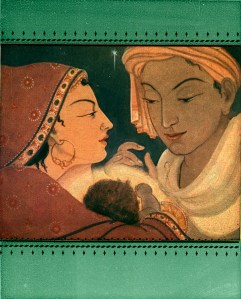
As people all around the world begin their celebrations of Advent, this month we delve into the many intriguing variations in our collections on one of the most enduring of Christmas images – the Nativity.

From the origins of the story of Jesus Christ’s birth in the world of first century Palestine, to Western Europe and North America, and across the globe in India, China, and the Philippines, a review of just a few of the images of the nativity held by the Wheaton Archives & Special Collections demonstrates the many ways the Christmas story has been reflected and reimagined in a myriad of different times and places.

Continue reading

Little Hollywood on the Prairie

Was Wheaton, IL once a headquarters for cinema in the Midwest? Well, perhaps not quite. But it is true that in the middle decades of the 20th century, Wheaton was the center for the regular production of dozens of films, pioneered by the Scriptures Visualized Institute, also know as the C. O. Baptista Film Mission and C. O. Baptista Films, among other names.

Embracing their central slogan, “The Old Gospel in Modern Technique,” C.O. Baptista films represented one effort among many by Christians in the 20th century to use the possibilities of ever advancing new technologies – from recorded sound on wax cylinders to instantaneous communication via the internet – as new channels for the gospel.

The records of the Baptista Film Mission, including selections of its film catalog, are available and open for research at the Wheaton College Billy Graham Center Archives.

Continue reading

The Form & the Message: Letterheads in the Archives

History is all about context. Usually this means the wider circumstances, including what lead up to the events we study and the mental word of the people we seek to understand. But it has a physical aspect too – the material objects that surround people, shaped by and shaping the culture of which they are a part.

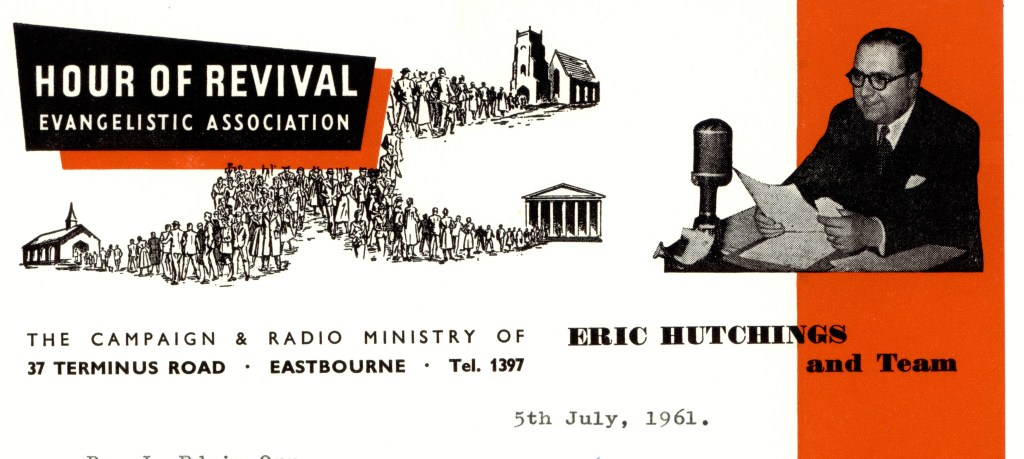
Take, for example, the letterhead – the pre-printed part of a piece of stationary that gives the sender’s name, address and other information. Any archivist or scholar who goes through hundreds or thousands of letters will find amazing variety in this simple device.

Some state their data with clipped simplicity, some overflow with the sender’s beliefs, principles, mottos, and images to such a degree that they easily dominate whatever sentences can be squeezed into the remaining white space of the page.

The ability of the physical page to communicate as well as the words upon it is illustrated by the correspondence of J. Edwin Orr (1912-1987). In 2020, the Archives opened Collection 355, the papers of Orr, an influential evangelist and scholar who exchanged thousands of letters worldwide with people over half a century of ministry. What he and his correspondents wrote to each other is fascinating, insightful, and instructive. But what they wrote upon, the stationary itself, can also be charming, illustrative, and sometimes weird, quietly (or not so quietly) conveying its own message and tone.

Continue reading

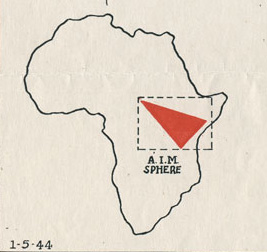
Mapping History: Tracing 125 Years of Africa Inland Mission

Maps are a common feature of archival collections, and the Wheaton College Billy Graham Center Archives is no exception. The Archives’ oversize storage cases contain a wide variety of maps—thematic, navigational, topographical, and even blueprints—used for diverse range of research topics and as a popular tool in archival instruction sessions. As primary sources, maps require a specific set of skills to “read” and interpret. Like all items held in the Archives, maps are social documents, reflecting both the intentions and abilities of their creators (cartographers) as well as the needs and expectations of their anticipated users. Maps tell stories. While a single map can capture a landscape, metropolitan grid, or continent frozen in time, a series of maps can document gradual or abrupt change, like shifting national or regional boundaries, erosion of natural landmarks, or rapid urbanization. No map, however extensive or detailed, can be entirely authoritative. They are not neutral documents—maps reveal the political and cultural perspectives and biases of their creators. They can erase as well as document borders, languages, people groups, or landmarks. Finally, maps are frequently described in purely functional terms, providing information and direction to users, but in many cases they are also highly ornamental, utilizing artistic techniques to feature specific geographical or topographical features.

Continue reading

Valentines in July

Valentines in July? It is as good a month as February, actually. Although the feast day of Valentine is celebrated in the Western tradition on February 14, there is an equally strong tradition in the Eastern Orthodox Church for commemorating St. Valentine on July 6th. So this is indeed a month for valentines

Why are there valentines in the Wheaton College Billy Graham Center Archives? As mentioned in previous blogs, archives and manuscript repositories always include many unexpected odds and ends. A collection of personal papers can include a myriad of different objects and artifacts documenting the creator’s mundane daily activities as well the events, ideas, and milestones the creator is best known for. A good example of this is Elisabeth Elliot’s Memory Book. Elliot (1926-1915), a Bible translator and missionary to Ecuador, is perhaps best known as the author of several bestselling books narrating the death of her husband Jim, killed by members of the Waorani tribe in Ecuador in 1956, and her own later experiences living with the Waorani after that tragic event.

Elliot became an influential evangelical writer, speaker, and teacher in the second half of the 20th century. But her Memory Book in the Archives precedes her famous ministry, when she was just Elisabeth Howard, known to her friend and family as Betty or Bets. The scrapbook reflects the interests of a young girl in her pre-teen and teen years. Its contents includes letters, photos, postcards, hair curls, paper dresses, maps, early writings, and much more, covering the period of approximately to 1938 to 1943 as well as comments Elliot later wrote in the book as an adult . A map of the 1939 New York World’s Fair contained in the Memory Book was featured in a previous blog post. And among all this wonderful memorabilia are Valentine cards Elliot received at school on February 14, 1940, when she was 13 years old.

Continue reading

Remembering the Other Elliots

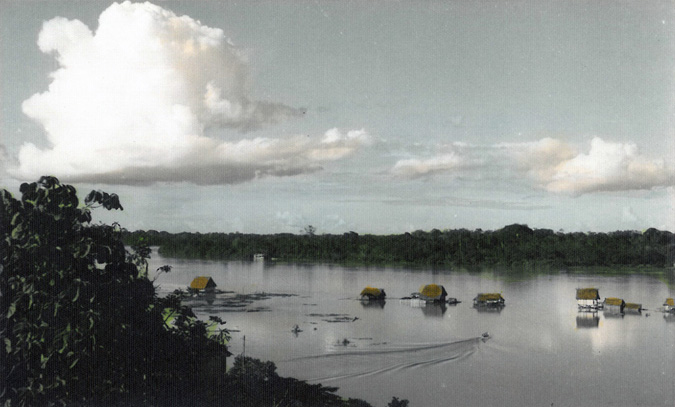
The above photograph was taken in Yurimaguas, a port town in the Amazonian rainforests of northern Peru where Bert and Colleen Elliot ministered for over thirty years. The river depicted is either the Río Huallaga or Río Paranapura. Undated

Earlier this year, the Wheaton College Billy Graham Center Archives marked the 65th anniversary of the death of Wheaton alumnus Jim Elliot and four other American missionaries in Ecuador at the hands of Waorani tribe members in January 1956. The shocking event became an instant media sensation among evangelicals and the general public in the United States. The five missionaries—particularly Jim Elliot—were praised as examples of heroic dedication to Christian evangelism following their deaths, due in large part to the literary efforts of Jim’s widow, Elisabeth Elliot, who chronicled the now-famous story in Through Gates of Splendor (1957) and secured her husband’s place in post-war missionary mythology through the publication of his journals, Shadow of the Almighty, in 1958. The Archives’ digital exhibit To Carry the Light Further explores this fascinating narrative of missionary martyrdom through photographs, newspaper clippings, letters, and diary entries held in the Archives’ collections.

The death of the five men remains a perpetually fascinating story in American evangelical circles today, and the Elliot papers are among the most popular collections in the Archives’ holdings. Archival materials relating to the other Ecuador martyrs have also found their way to the Archives over the years, adding new dimensions to the story of the Waorani. Those collections include the papers of Peter Fleming’s brother Kenneth, and widow Olive, as well as Ed and Marilou McCully. Just this year, the Archives opened Collection 721, a recent donation of papers containing significant correspondence from Jim Elliot to his parents, Fred and Clara, and their own response in the wake of his shocking death.

Continue reading

The Language of Flowers: Clippings from Lives of Shared Ministry

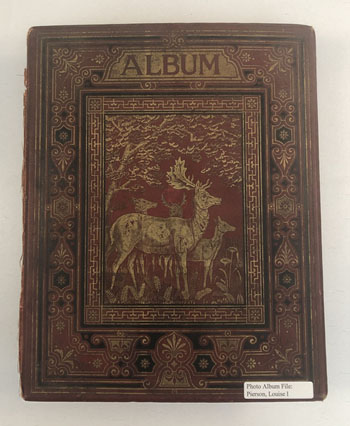
Intricately detailed front cover of Louise Pierson’s Photo Album in Collection 720: Papers of Louise H. Pierson.

Across the wide distances of global missions, a key relationship for many missionaries remains that of their connection to their homeland, supporting churches, and missionary societies. Even as missionaries forge new ties on the mission field they also reach back to the old – to share successes and failures, the wonders and terrors of new lands, and key to their work, elicit financial and spiritual support for their mission. Many materials in the Wheaton College Billy Graham Center Archives document the important ties between the mission field and the homeland, from prayer letters, to missionary cards, to photographs and films.

This month we highlight the dynamic interplay between missionaries and supporters at home by featuring a new collection added to the Archives this spring, Collection 720: The Papers of Louise H. Pierson, composed of a single scrapbook with flower pressings, pictures, newsletters, and other memorabilia from the world and work of Louise Pierson and other women missionaries in South and East Asia during the late nineteenth century.

Continue reading

“Are We Electing Our Last President?”: The Chicago Convention Campaign

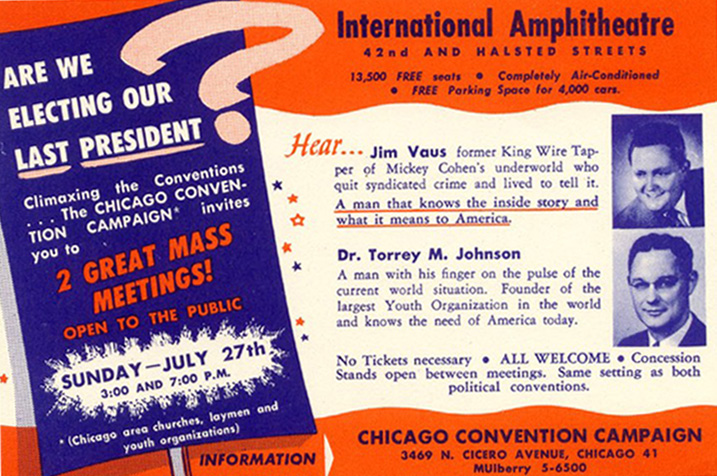
The event of a lifetime has become the opportunity of a lifetime!” So claimed the flashy mass marketing letter inviting one and all to the Chicago Convention Campaign. Spearheaded by Torrey Johnson, the tireless president of Youth for Christ, and drawing widespread support from churches and religious leaders across the Upper Midwest, the 1952 Convention Campaign offers a glimpse into mid-century mass evangelism efforts, particularly the potent combination of evangelistic and patriotic fervor.

Continue reading

“To Show Kindness to Israel”: William Blackstone’s Memorial

This July, the Wheaton College Billy Graham Archives highlights the evangelistic ministry of William Eugene Blackstone (1841-1935), a self-educated American businessman, evangelist, and author, perhaps best known as the creator of the Blackstone Memorial, a petition calling for the creation of a Jewish homeland in Palestine.

A fervent dispensationalist, Blackstone’s belief in the imminent return of Jesus Christ spurred his interest in Jewish evangelism and commitment to Christian Zionism. Blackstone played a prominent role in founding the Chicago Hebrew Mission (later American Messianic Fellowship) and became its first superintendent in 1889. He also served as the sole trustee of the Milton Stewart Evangelistic Fund, which financially supported Jewish evangelism efforts in far-flung corners of the globe. Recipients of the Milton Fund include Bible colleges, seminaries, and parachurch organizations, stretching from Poland to Palestine and New York City to Korea. Blackstone’s correspondents included professors, evangelists, missionaries, and administrators serving with the likes of the American Bible Society; All Russian Union of Evangelical Christians; Barbican Mission to the Jews; China Inland Mission (Blackstone’s parents were missionaries to China); Mount Carmel Bible School, Haifa; New York Gospel Mission to the Jews; and Women’s Bible Institute, Korea, among many others. In addition to his evangelistic efforts, Blackstone also authored multiple works, including Satan: His Kingdom and its Overthrow, The Millennium, and the the best-selling Jesus is Coming, which was translated into multiple languages.

Blackstone’s personal papers are described in Collection 540: Papers of William Eugene Blackstone. and include a variety of materials, including correspondence, sermons, manuscripts, reports, and periodicals.
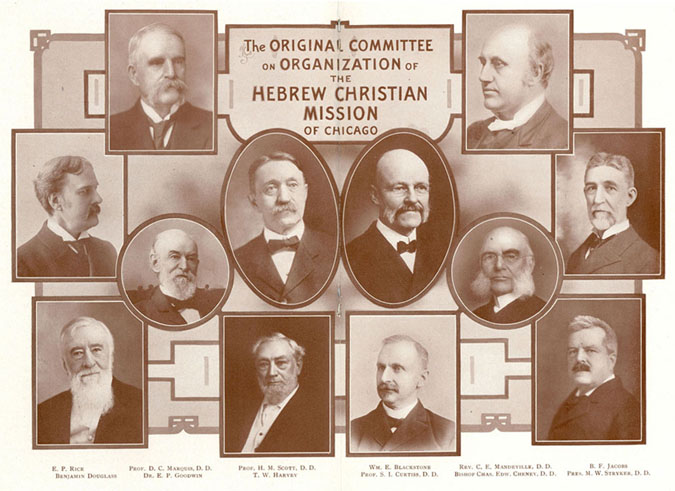
Founders Montage

The photograph montage above of the founders of the Chicago Hebrew Mission (1887) illustrates Blackstone’s central place in the organization. He is in the center right oval, wearing spectacles. The image is found in “Twenty-Five Years of Blessing,” a commemorative pamphlet published in 1913. From Collection 540, Box 1, Folder 1.

Continue reading

Adventures in Storytelling Evangelism: “The Story of a Nail”

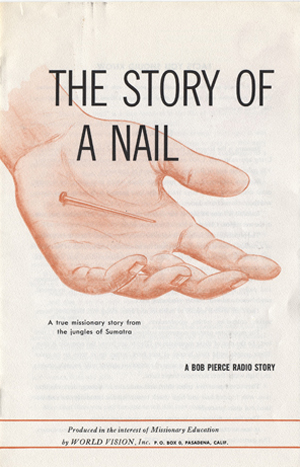
Cover
The cover of a well-used copy of “The Story of a Nail” curriculum, n.d. (Small Collection 113).

Storytelling is a ubiquitous tool in evangelism efforts—The Archives’ collections are replete with examples of evangelists, missionaries, and lay preachers wielding the power of simple narratives to explain the Christian gospel. While the most famous example of storytelling evangelism might be The Jesus Film (1979), sponsored by Campus Crusade for Christ, many parachurch organizations have developed their own curricula for communicating biblical stories or theological concepts with dance, music, puppets, posters, flannelgraph, mime, and more.

This May, the Archives features “The Story of a Nail,” an evangelism kit using a simple narrative and illustrations to present the story of the crucifixion. Originally developed for radio broadcast by Bob Pierce, founder of both Samaritan’s Purse and World Vision, “The Story of a Nail” was later published as a pamphlet with eight illustrated panels. The pamphlet includes tips and techniques for presenting “The Story of a Nail” to Sunday school classes, Vacation Bible School audiences, and other groups using the “flash card” method to match the colorful panels to narrative cues. Presenters are encouraged to memorize the KJV scripture verses in advance and to maintain eye contact throughout the story.

Continue reading