What’s To Do in the Archives?: The Annual Archival Research Lecture

Some may look to October for the start of crisp fall weather, trips to apple orchards, and pumpkin carving, but here at the Wheaton College Billy Graham Center Archives we celebrate October as American Archives Month. Joining archives, historical societies, and special collections around the country, we take this time to highlight the place of archives in preserving and making accessible the important records of our past and present communities.

David Kirkpatrick

While much of the work of archives takes place behind the scenes, both with archivists in stacks and researchers in reading rooms, this month we invite the wider community into the Archives through the 2021 Archival Research Lecture, A Gospel for the Poor: René Padilla and the Reshaping of Global Evangelicalism, presented by Dr. David Kirkpatrick at Wheaton College on Thursday, October 7th.

Continue reading →
The Form & the Message: Letterheads in the Archives

History is all about context. Usually this means the wider circumstances, including what lead up to the events we study and the mental word of the people we seek to understand. But it has a physical aspect too – the material objects that surround people, shaped by and shaping the culture of which they are a part.

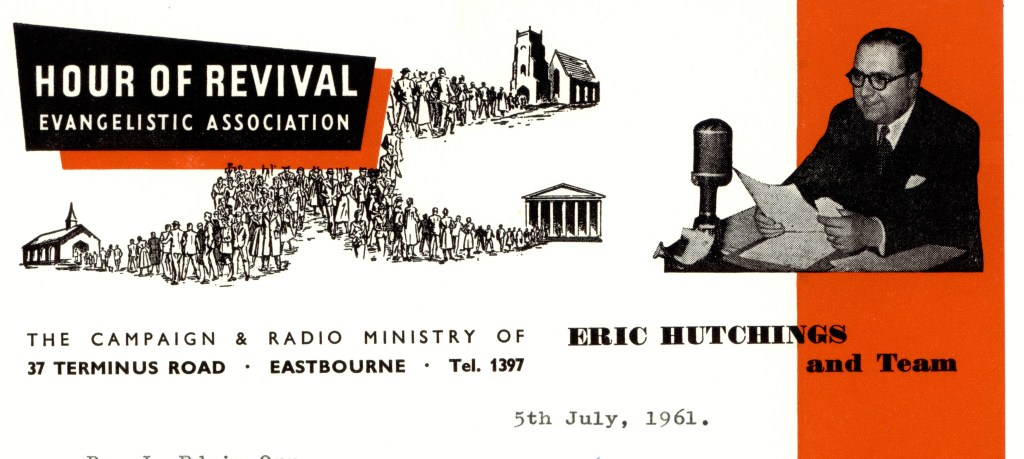
Take, for example, the letterhead – the pre-printed part of a piece of stationary that gives the sender’s name, address and other information. Any archivist or scholar who goes through hundreds or thousands of letters will find amazing variety in this simple device.

Some state their data with clipped simplicity, some overflow with the sender’s beliefs, principles, mottos, and images to such a degree that they easily dominate whatever sentences can be squeezed into the remaining white space of the page.

The ability of the physical page to communicate as well as the words upon it is illustrated by the correspondence of J. Edwin Orr (1912-1987). In 2020, the Archives opened Collection 355, the papers of Orr, an influential evangelist and scholar who exchanged thousands of letters worldwide with people over half a century of ministry. What he and his correspondents wrote to each other is fascinating, insightful, and instructive. But what they wrote upon, the stationary itself, can also be charming, illustrative, and sometimes weird, quietly (or not so quietly) conveying its own message and tone.

Continue reading →