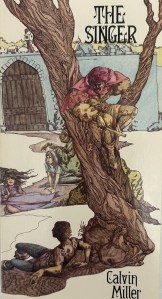
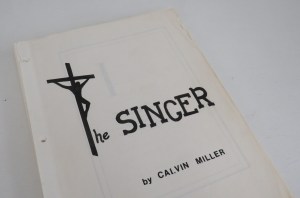
April is National Poetry Month! To celebrate, Wheaton Archives & Special Collections features archival artifacts from Calvin Miller’s The Singer, a poetic allegory of the life of Christ, published by InterVarsity Press in 1975.
Along with original manuscripts of The Singer, SC 24: The Calvin Miller Papers includes extensive correspondence and other records that highlight Miller’s life and work as a pastor, artist, author, and professor.
Building on the rich Christian tradition of allegorical writing—from Medieval morality plays and Dante’s Divine Comedy to John Bunyan’s Pilgrim’s Progress, Hannah Hurnard’s Hinds’ Feet on High Places, and C. S. Lewis’ Chronicles of Narnia—The Singer offers a vivid retelling of the Gospel story as a longform narrative poem.
Opening with the line, “In the beginning was the song of love,” Miller weaves a tale of a troubadour sent by a loving Earthmaker to sing the lost star-song to a creation warped and tormented by the World Hater:
All birth was but the prelude
unto death.
And every cradle swung above
a grave.
The sun made weary trips from
east to west.
Time found no shore, and
culture screamed and raved.
The world in peaceless orbits,
sped along
And waited for the Singer
and
his song.
Born 1936 in Enid, Oklahoma, Calvin Miller pursued ministry training at Oklahoma Baptist University and Midwestern Baptist Seminary. In 1966, he and his wife, Barbara Joyce Hamon, moved to Omaha, Nebraska, where he began pastoring the small Westside Baptist Church.
The idea for The Singer came to Miller during a time of conflict with an elder at the church. Feeling stressed and hounded, Miller sought refuge in the Bible and the escape offered by his imagination and creative pursuits.
In an August 1985 Wittenberg Door interview, Calvin reflected, “The Singer is my own love song to God. When I wrote it, I desperately needed God… In my arrogance I would like to say that The Singer came from God. But in the case God doesn’t want credit for it, I would rather not force Him into that part. Fiction can move people to see the truth. I hope that The Singer has at least done that.”
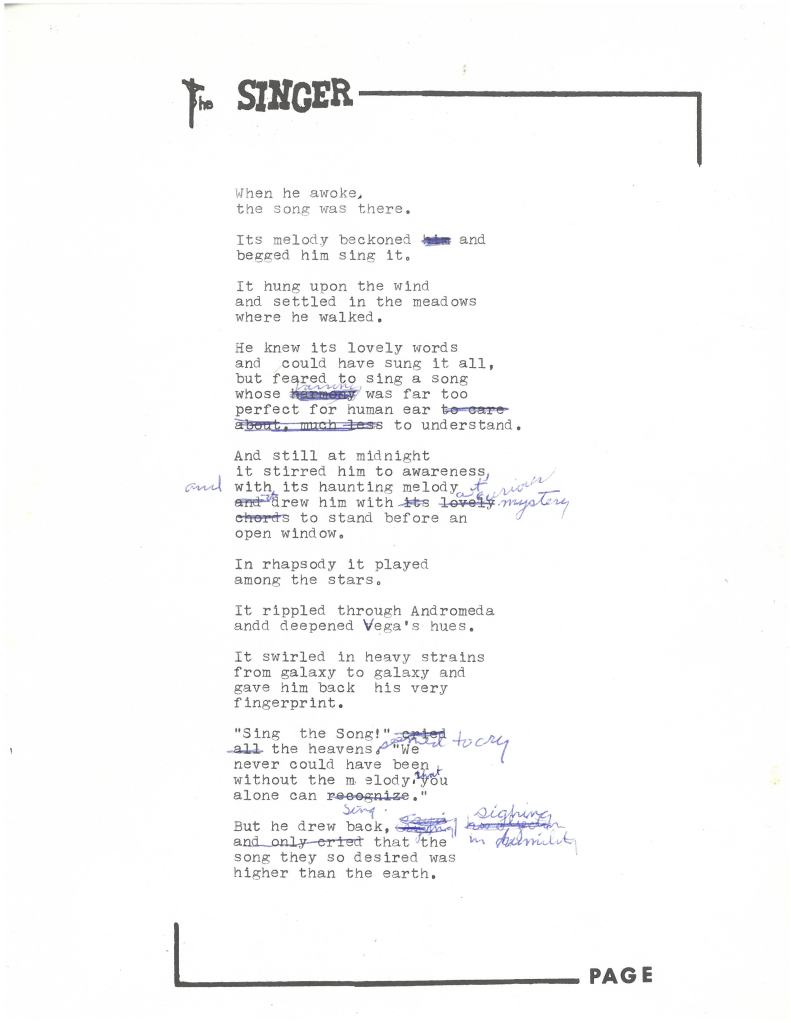
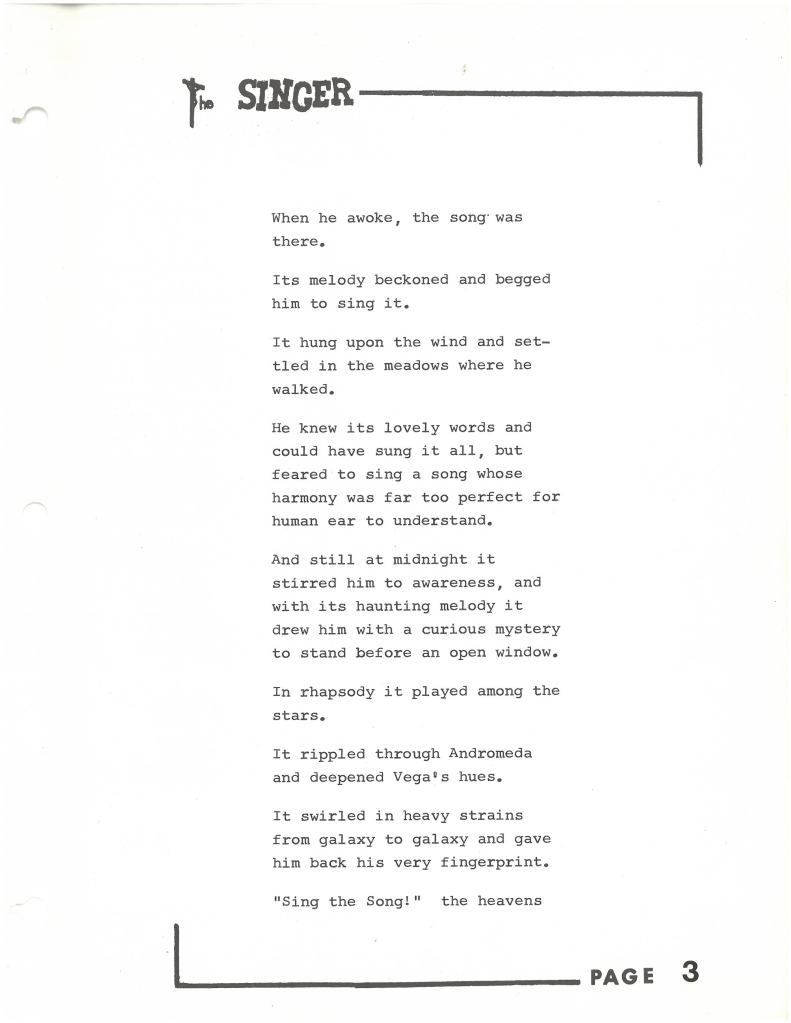
Although the poetic novel received mixed critical reviews, The Singer was a surprise hit, selling more than 350,000 copies in its first ten years and regularly remaining one of IVP’s top-20 best sellers through the 1980s. It also became a rich source for further creative projects, including musical dramas, an audio book edition with orchestral arrangements, a multimedia live concert production, and, in 1988, a feature film project from Light Productions.

Calvin Miller followed The Singer with a reimagining of the Book of Acts in The Song (1977) and Revelation in The Finale (1979). In 1990, InterVarsity Press republished the three poetic novels as The Singer Trilogy.
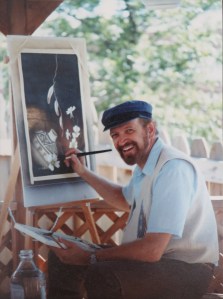
While The Singer thrived during the 1970s cultural revival of Christian music, art, and literature—and amid a nationwide boom in faith-based bookstores—Calvin Miller also voiced criticism of the growing Christian music and publishing industries, cautioning against the narrow practice of dividing art into “Christian” and “non-Christian” categories.
As he argued in the 1985 Wittenberg Door interview: “If the product is the only justification for art, then nothing can have value merely because it is beautiful. So, if a person paints a picture or writes a poem that isn’t about Jesus – even though it’s beautiful – it doesn’t count.”
Calvin sought creative inspiration from the natural world and read widely, listing his poetic and literary influences as Dylan Thomas, Emily Dickinson, and Gerard Manley Hopkins, alongside the contemporary writers Virginia Stem Owens, Walter Wangerin, Madeleine L’Engle, and Frederick Buechner.
Following the success of The Singer Trilogy, Miller authored more than 40 books over the next four decades, producing a diverse flow of novels, children’s literature, non-fiction, apologetics and a memoir, Life is Mostly Edges. In 1999, he also joined Beeson Divinity School at Samford University as a Professor of Preaching and Pastoral Ministry. He died on August 19, 2012.
To explore the collection, review the finding aid at SC-024: Calvin Miller Papers. Wheaton Archives & Special Collections also holds several additional collections related to Christian authors and literature, including papers from James Johnson, Robert Siegel, Luci Shaw, Madeleine L’Engle, Frederick Buechner, and Lilias Trotter.

