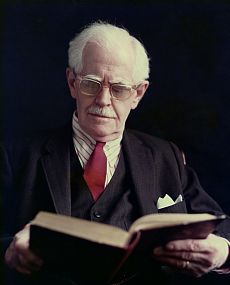
In this day of technology, AI, and rapid information growth many decry the extinction of the printed book. But when someone handles a fine rare book, one does not easily look to its demise. Books are wonders. They are thoughts distributed to the world. They are invitations to new possibilities and new horizons.
Wheaton Archives & Special Collections has many wondrous examples of the power of the book – as presenter of ideas and as art. Special Collections’ foundational rare book collection, SC-01, was a gift from collector William Sanford Akin. The collection numbers over 2,000 monographs, with a special emphasis on British literature, including James Boswell, Samuel Johnson, Lewis Carroll, and John Bunyan.
To paraphrase the joys of William Sanford Akin’s life would be say that he collected books. Akin’s interest in books began as a teenager. He recalled with a note of humor that it all started when “someone hit him over the head with a first edition.” But elsewhere he recounted that he first became interested in Samuel Johnson when he was fourteen because he was told to read Beauties of Johnson as “penance for his sins,” during his service as an acolyte for St. Luke’s Episcopal Church in Evanston.
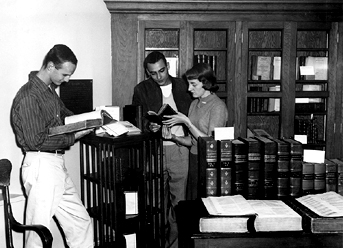
Finishing school, he entered the newspaper business like his father, William James Akin, first as a copy editor then as a reporter for the InterOcean, an early Chicago newspaper, and the Chicago Tribune. Later he worked as an advertiser’s representative at the Chicago Daily News. Eventually he moved from newspapers to industrial and trade publications, employed as a publisher’s representative for over twenty-five years. His work took him around the world, including frequent trips to Canada where, of course, he also visited bookstores.
As he traveled and collected, Akin held membership in several prestigious book lovers’ organizations, including the Union League club; the Caxton club; the Dickens Fellowship; the Isaac Walton league, the Johnson Society of Litchfield, England; the Johnson Society of the Midwest; and a life member and honorary vice president of the Auchenleck Boswell Society in Scotland.
Ultimately, Akin knew “of nothing more gratifying, physically, mentally, or spiritually, than to sit down to a cup of tea and browse among [his] books until [he found] something to satisfy [his] need at the moment.” During the 1940s, he attempted to minimize his compulsion, divesting himself of his entire collection. However, all to no avail. Soon he was again collecting, now with such vigor that “on one occasion, his publisher wanted to reach him in an emergency and did so by leaving messages at four well-known rare books stores.”
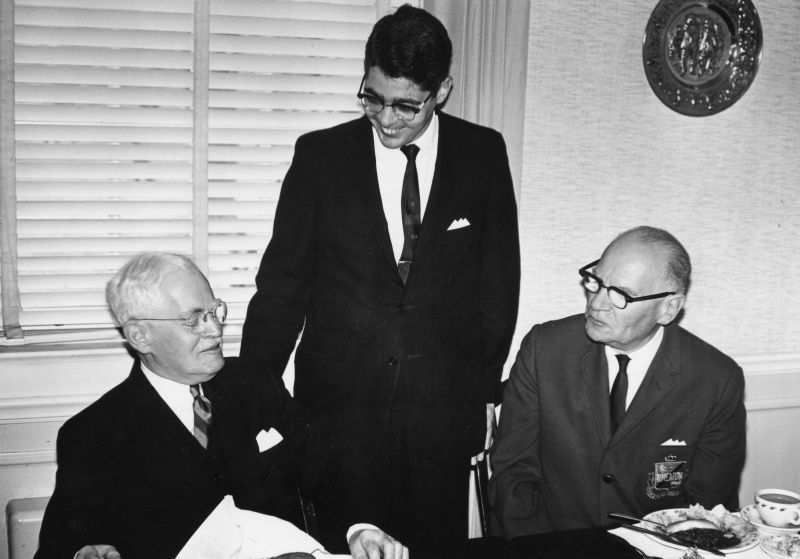
The connection between William Akin and Wheaton College began when Akin developed a friendship with Wheaton president V. Raymond Edman’s brother who was a member of Chicago’s Union League. During the 1960s, Akin periodically spoke at Wheaton as a guest lecturer on 17th and 18th Century Bibliography. In 1965, selections from Akin’s book collection were placed on loan at the College. After V. Raymond Edman’s sudden death in 1967, William Akin donated a large portion of his personal library (SC-01) to Wheaton College as a memorial.
Along with his collecting, Akin was a lively, occasionally insightful critic, issuing monthly book reviews during the 1950s for Union League Men and Events, the official newsletter of his beloved “and famously exclusive” Union League Club, located in Chicago’s Loop. “To me,” he wrote of the club’s library, “it is a bit of heaven on earth.” As chairman of its library committee, he expertly acquired world-class literature from a far-flung network of booksellers, universities and publishers.
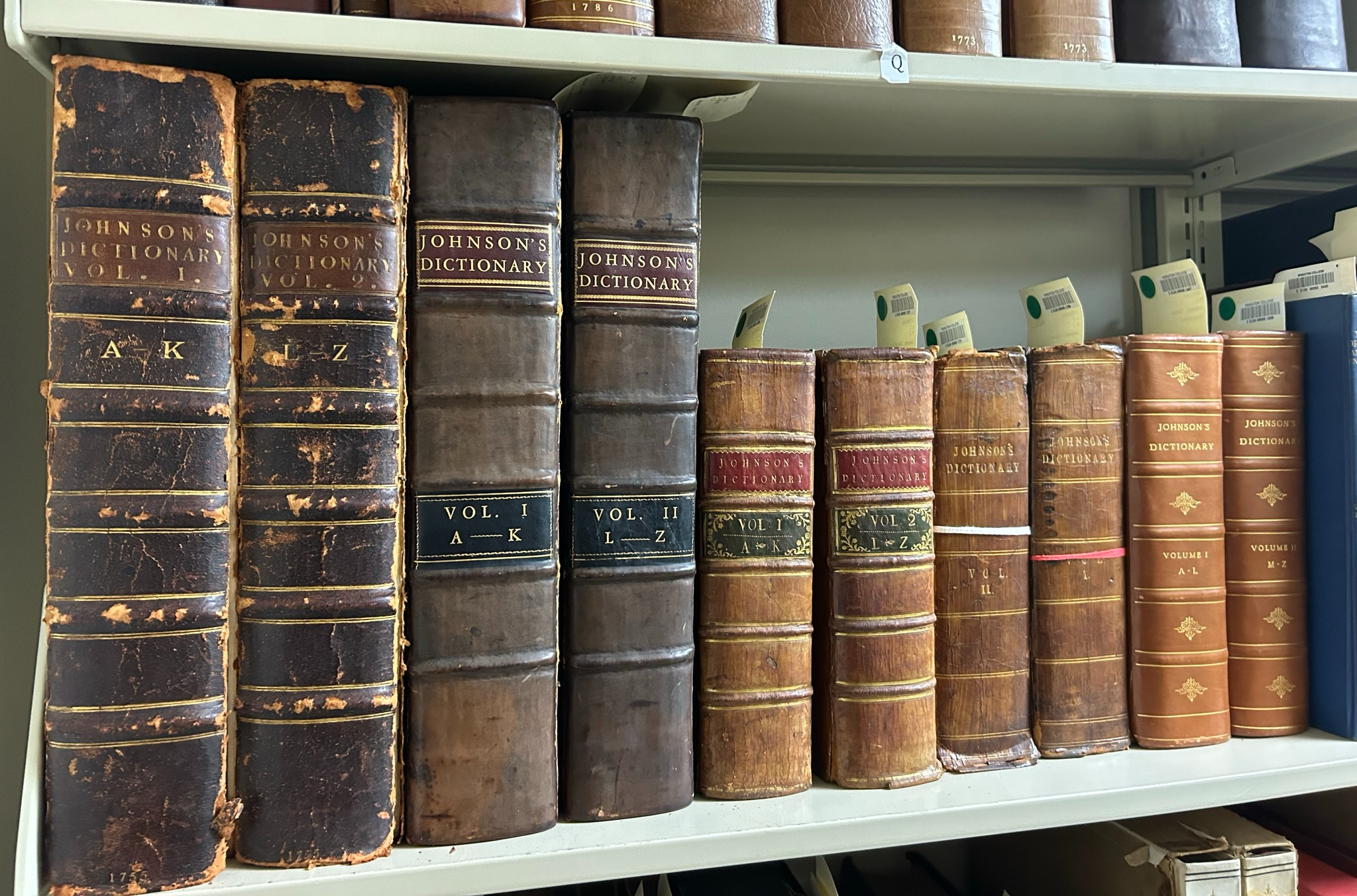
Following his boyhood passion, one of Akin’s major areas of collecting interest was Samuel Johnson and James Boswell. Akin’s Johnsonian collection became quite significant, eventually containing the first thirteen editions of Johnson’s A Dictionary of the English Language.
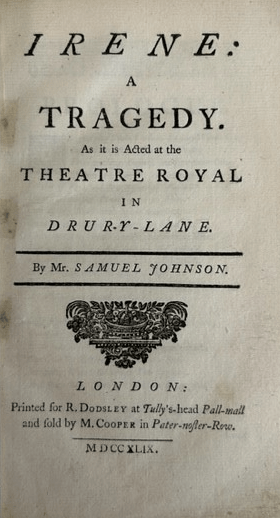
However, the oldest Johnson item in the collection is not his famous diary, but his first and only published play, Irene. In 1737, Johnson determined to take his chances as a writer in London. With a draft of a tragic drama complete, he set out with one of his former pupils David Garrick. Finally, in 1749 with Garrick’s assistance (now manager of a theatre in Drury Lane), Irene was performed with modest commercial success. Although Irene would be Johnson’s most financially lucrative work besides his famous Dictionary, it was a critical flop and viewed by Johnson as one of his greatest literary failures.
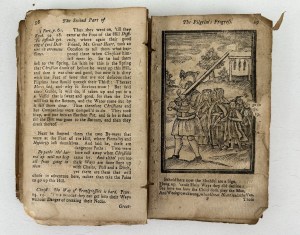
Along with his interest in Johnson and Boswell, Akin grew fond of illustrated editions of John Bunyan’s Pilgrim’s Progress. In many homes of the 18th and 19th century, particularly in America, Pilgrim’s Progress ranked second only to the Bible in importance. The third edition of The Pilgrim’s Progress, published in 1679, appears to have been the first printing with any illustration, which have always played a key role in the story of Christian as he journeys from the City of Destruction to the Celestial City. The earliest edition in Akin’s collection is from 1687. This text is one of dozens of printings, revisions, and adaptations of the famous work in the collection, ranging from the 17th to the 20th century. Many of the Bunyan volumes in the collection originated from the library of Rev. John Timothy Stone, longtime pastor of Chicago’s Fourth Presbyterian Church.
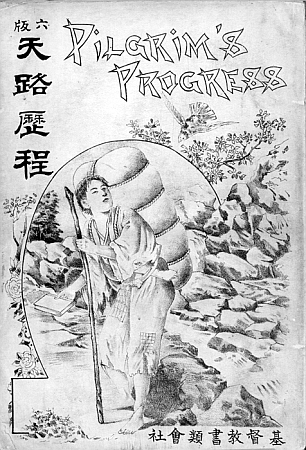
As Pilgrim’s Progress became a part of the evangelical canon, missionaries around the world took Bunyan’s Christian along with them. Akin’s collection also holds several translations of the famous text, from Algonquian to Swahili. This 1903 Japanese edition includes translation of both the text and imagery, with illustrations that draw upon traditional Japanese art and mythology.
In addition to Johnson’s Dictionary and Pilgrim’s Progress, Akin collected broadly across British literature from the 17th to 20th centuries, including early editions of Pepy’s Diary, Evelina, and The House at Pooh’s Corner, as well as many works from Jonathan Swift, Daniel Defoe, Charles Dickens, and Kenneth Grahame.
Besides the extensive holdings focused on English literature and commentary, the Akin collection contains dozens of monographs related to early American history and culture, including History of the Life and Voyages of Christopher Columbus (1835), Around the World with General Grant (1879), and the first British edition of Lewis and Clark’s Journal (1807), among other texts.
All the monographs in SC 01: William S. Akin Rare Book Collection can be viewed in the Manuscripts Reading Room at Wheaton College.
 From the Vault
hello friends i have enjoyed the vaults every month. bible reference book
that is sometimes overlooked is the Treasury of scripture knowledge
samuel bagster. london england came out late 1800-80 its in print now but the
samuel bagster would be worth focusing from the vault sometime! thank you
LikeLike
thank you look forward hearing from you day by day appreciate it
LikeLike