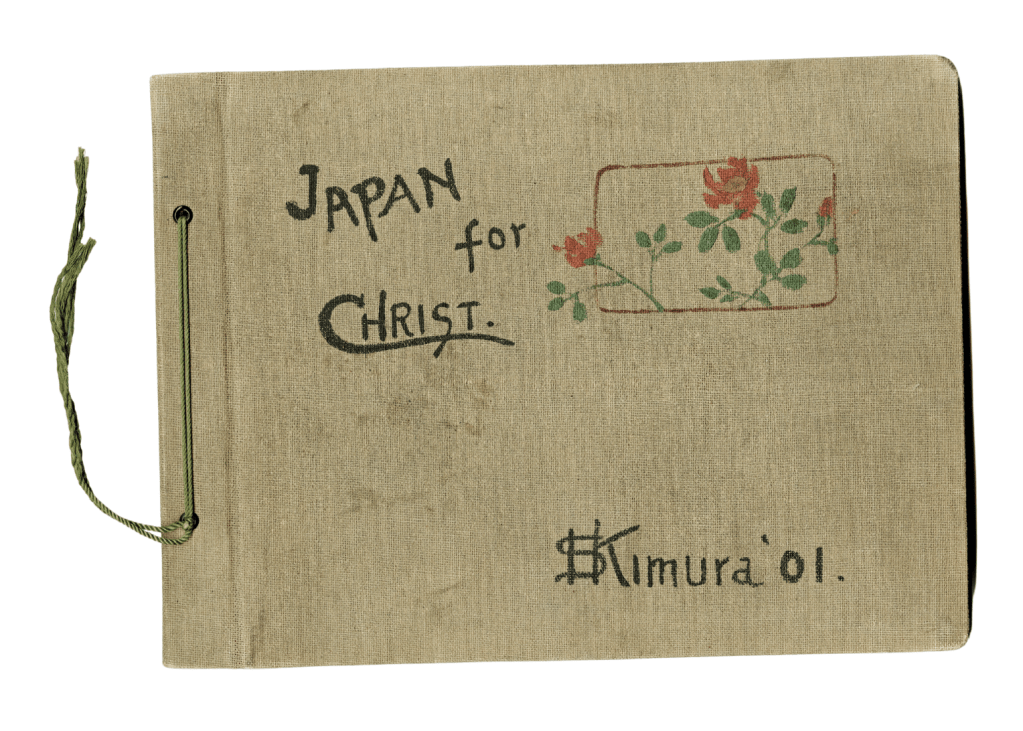
Kimura Kiyomatsu (木村 清松), known in the United States as Henry Seimatsu Kimura, was born in 1874 to a family of sake brewers in Gosen City, Niigata Prefecture. At seventeen Kimura was baptized during an evangelistic service held by Teiichi Hori in Niigata. His conversion to Christianity led to conflict within his family, especially with his father, who disowned him; although both his parents and his two brothers eventually became Christians.
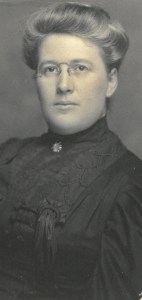
Portrait photo of Virginia Asher, 1905. Photo File: Asher, Virginia.
Scattered throughout the Evangelism & Missions Archives are paper fragments that tell the story of a remarkable woman – Virginia Healey Asher.
Virginia Healey was born to Irish parents in Chicago in 1869. Although her family was Catholic, she attended the church that had grown out of Dwight L. Moody’s Sunday School class and there gave her life to Christ during an evangelistic meeting when she was eleven. Her future husband, William Asher, was saved at the same meeting. When a few years later D. L. Moody called for workers, she volunteered. He assigned her to outdoor street meetings in Chicago where she sang and witnessed. She planned to go to Moody’s school in Northfield, Massachusetts when William, who had also volunteered for evangelism ministry, proposed. She was a teenage bride when they married on December 14, 1887.
Along with hundreds of collections on global missions and evangelism, Wheaton Archives & Special Collections also holds records documenting the history of Chicagoland, from institutions like the historic Moody Church, Chicago Gospel Tabernacle and the Chicago Sunday Evening Club to individuals like William Leslie, Herbert J. Taylor, Vaughn Shoemaker, and Harold “Red” Grange. This month, Wheaton Archives & Special Collections features one such collection, the papers of hymn singer and radio broadcaster Everett Mitchell, best known for his memorable opening line, “It’s a beautiful day in Chicago!”
Wheaton Archives & Special Collections is pleased to announce that writer Lucy S. R. Austen will be our speaker for the annual Fall Archival Research Lecture! In anticipation of her upcoming visit, this month we feature a conversation with Lucy about her time researching for Elisabeth Elliot: A Life, her biography of missionary, speaker, and public evangelical Elisabeth Elliot, published by Crossway last June.
When and how were you first introduced to Archives & Special Collections?
I actually discovered the Archives & Special Collections through a Google search! In 2009, I was working on a mini-biography of missionary and author Elisabeth Elliot for a high-school English textbook featuring American Christian writers, and when I went looking for critical biographies of Elliot to learn more about her life, I was startled to discover that there were no full-length biographies of her in existence. Essentially the only published information about her life dealt with a small portion of the decade she spent in Ecuador as a young woman, working to reduce unwritten languages to writing for the purposes of Bible translation. In the process of digging around for any source material I could lay my hands on, I discovered the webpage for Elliot’s papers at Wheaton. I wasn’t able to visit the Archives at that time, but I relied on the biographical information and the list of “Exceptional Items” from the page for her papers, along with other sources, as I completed my project.
March is Women’s History Month! In celebration, the Wheaton Archives & Special Collections spotlights the stories, voices, and legacies of women who blazed trails as medical workers, linguists, preachers, evangelists, educators, CEOs, and more found in our collections. Today, we highlight missionary Joy Ridderhof (1903-1984), founder and director of Gospel Recordings, whose pioneering work in portable sound recording captured thousands of indigenous languages in remote corners of the globe. Today, these Gospel Recordings represent the preservation of oral cultures around the world and contain high research value for historians, missiologists, linguists, and anthropologists studying these cultures.
Joy Ridderhof’s story has been told in biographies like Phyllis Thompson’s Count It All Joy, and institutional histories of Gospel Recordings, like Faith by Hearing, but many of Ridderhof’s personal papers remain untouched in the archives’ holdings, and many of the documents and images featured here are located in unprocessed portions of the Gospel Recordings Records.
Last September, Wheaton Archives & Special Collections hosted Dr. Devin Manzullo-Thomas for the annual Archival Research Lecture, where he presented “Exhibiting Evangelicalism: Exploring the History of Christian Museums in the United States.” This month, we feature an interview with Dr. Manzullo-Thomas, delving into his archival exploration of how evangelical communities engage with and commemorate their histories.
When and how were you first introduced to Archives & Special Collections?
I first visited the Archives and Special Collections at Wheaton in 2013 or 2014, to conduct research related to my denomination, the Brethren in Christ Church. (Several Brethren in Christ leaders are either alumni of Wheaton College or are otherwise represented in Archives & Special Collections materials.) While there, I also visited the Billy Graham Museum on the first floor of Billy Graham Hall, and my interest was piqued. Because of my training as an archivist/public historian and my scholarly work on the history of my own denomination, I’ve long been interested in how religious communities present their history in museums and historic sites. I started wondering: “How have other evangelical groups and institutions represented the past in public spaces?”
February is national Black History Month, and in celebration the Wheaton Archives & Special Collections offers a glimpse into the lives of Wheaton College’s first African American students: Mary Barker, Edward Sellers, and William Osborne. To trace these stories, archivists delved into the institutional records held in the College Archives and other sources to explore and uncover the unique voices and experiences of these pioneering students.
How did Mary Barker, Edward Sellers, and William Osborne pursue higher education at Wheaton College at a time when even few middle-class, white Americans could boast about holding a college degree? What challenges and obstacles did these individuals encounter on their educational journey? After completing their studies at Wheaton College, where did their paths lead, and what professional endeavors did they pursue?
This year marks the 150th anniversary of Oswald Chambers’ birth on July 24, 1874, in Aberdeen, Scotland. Chambers’ best known work, My Utmost for His Highest, has remained in print since its first publication in Britain in 1927. The daily devotional has been translated into over forty languages and ranks in the top ten of religious bestsellers in the United States, with millions of copies sold since the first American edition was published in 1935.
Once again at the start of the new year we pause to reflect on the acquisition and processing of the previous year. “New Collections” are those materials which have been fully processed, arranged, described, conserved and made available to users. “New Accessions” are materials we received and which will eventually be processed into collections.
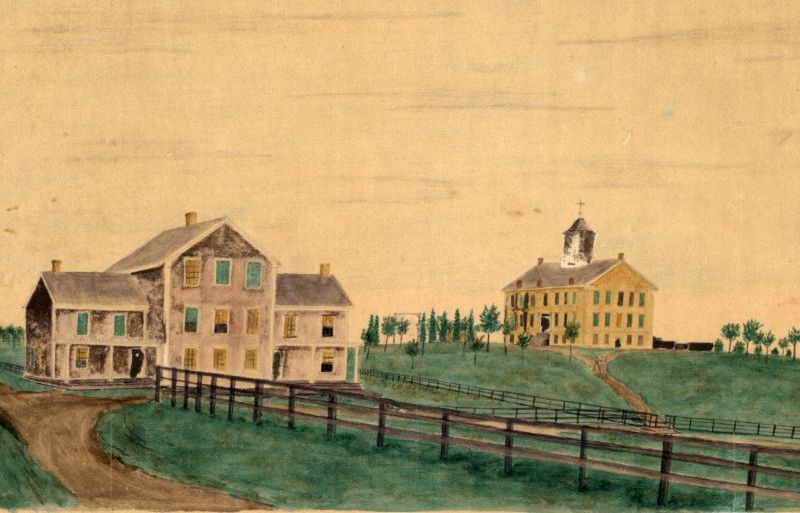
While December signifies the year’s end, this last month also marks a significant point of beginning for the stories of the fledging Illinois Institute of 1853 and the emerging Wheaton College of 1860.
On December 14, 1853, one-hundred and seventy years ago, the first classes of the Illinois Institute were held in the basement of a incomplete stone building atop a hill in Section 16, Township 39, DuPage County. Only a small town on the Illinois prairie in the close of 1853, the location in the new Milton Township offered the advantage of legislation common to many Midwest townships that enabled the special use of land in section 16 for schools.
Sketch of ‘Main and White House,’ c. 1863. College Archives Photograph #CA-B14012Continue reading →
 From the Vault