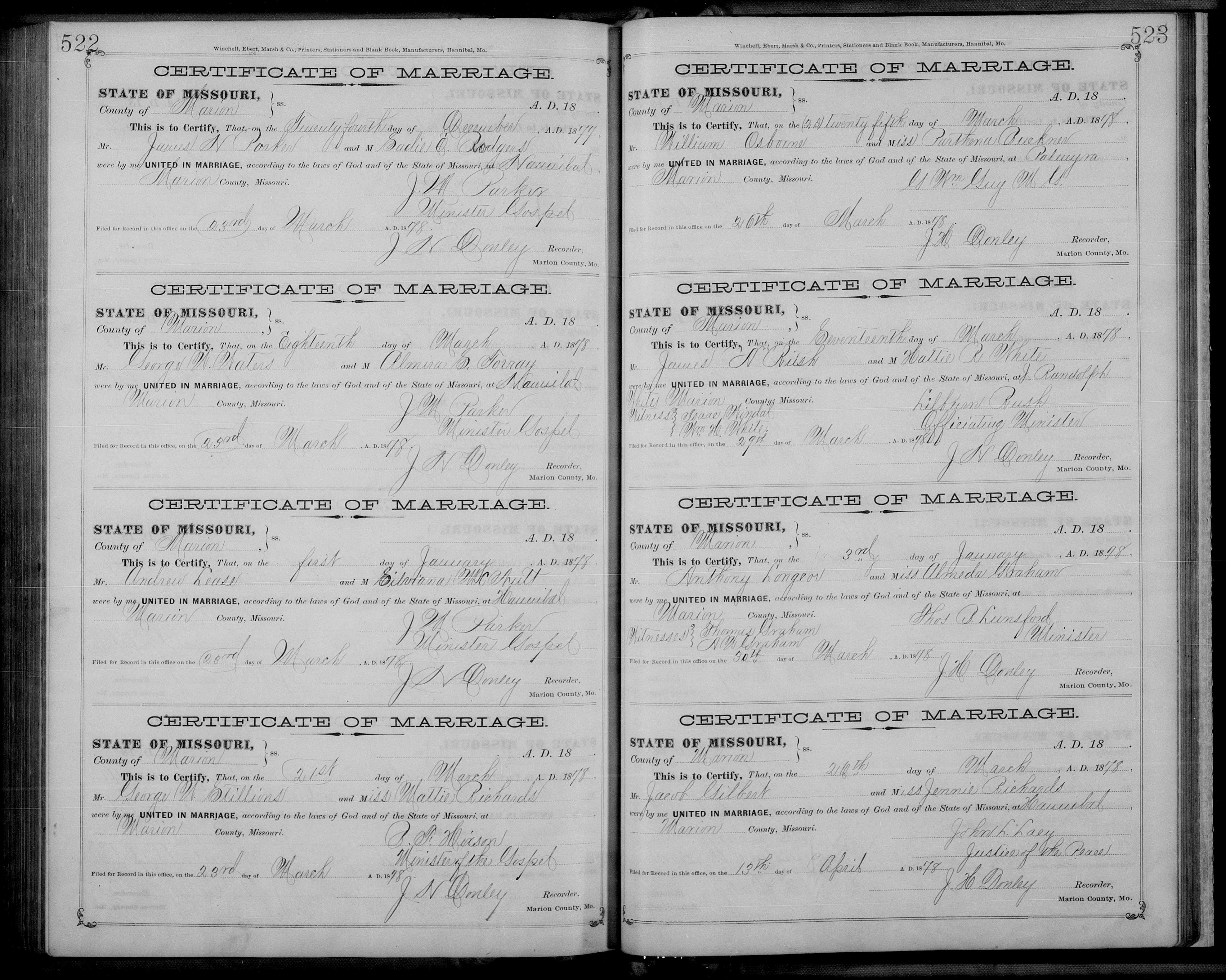
February is national Black History Month, and in celebration the Wheaton Archives & Special Collections offers a glimpse into the lives of Wheaton College’s first African American students: Mary Barker, Edward Sellers, and William Osborne. To trace these stories, archivists delved into the institutional records held in the College Archives and other sources to explore and uncover the unique voices and experiences of these pioneering students.
How did Mary Barker, Edward Sellers, and William Osborne pursue higher education at Wheaton College at a time when even few middle-class, white Americans could boast about holding a college degree? What challenges and obstacles did these individuals encounter on their educational journey? After completing their studies at Wheaton College, where did their paths lead, and what professional endeavors did they pursue?
The fragmentary nature of the historical record in the mid-nineteenth century and the scarcity of personal records can make these difficult questions to answer. Establishing even the most basic details about these Wheaton alumni involved combing through federal census and land records, reviewing Wheaton College catalogs, newspapers, and other publications, and following the breadcrumbs of additional documents and publications from church records, digitized books, and other archival collections.
Even after significant research efforts, much remains unknown about Mary Barker, Edward Sellars, and William Osborne. Census documents and college catalogs can provide the outline of a story but few details about the daily life or interior world of these Wheaton alumni. Perhaps fuller stories remain to be discovered in unknown diaries or letters, but in all likelihood, much of their histories will be left to the realm of the imagination.
Mary Barker
In 1857, Mary H. Barker became the first identified African American student to attend Wheaton College. Raised in southern Illinois, she left her home at the age of nineteen to accomplish what was unusual for a woman of this era, let alone a Black woman: obtain an advanced education.
Mary Barker was raised in Hardin County, one of the southernmost Illinois counties on the Ohio River. In the 1860-1861 Wheaton College Catalogue, she lists her residence as Cave-in-Rock, just across the Ohio River from Kentucky. Based on state land sale records, the section in which her family’s farm was located can be pinpointed.
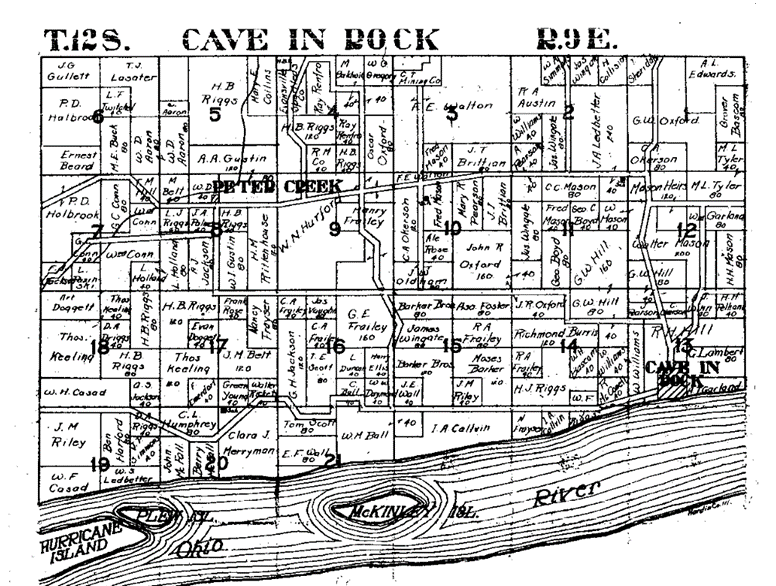
As the 1860 census indicates, Moses Barker, Mary’s father, was a farmer whose property value of $4,600 made him one of the wealthiest men in the county. Reviewing the census data, the extended Barker family appear to be the only African Americans in their immediate community (see the “B” in their census entry), although the neighboring Gallatin County’s Shawneetown had one of the largest populations of African American settlers in Illinois. The slash marks in the far-right columns of the census also indicate that neither of Mary’s parents could read or write.

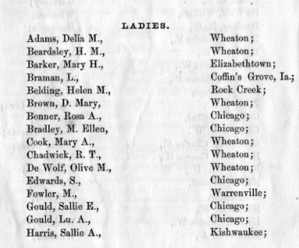
From 1857 to 1860 (except for the 1858-1859 school year), Mary Barker was enrolled in the Academic Department of the Illinois Institute (Wheaton College’s predecessor). The Academic Department was the largest course at the new Institute, and included a focus on English studies, as well as other subjects that could provide the foundation for enrollment in the College Preparatory or Collegiate Departments. The Academic Department course was also often sought as preparation for a teaching position. In the 1850s, the cost for a semester’s tuition in the Academic Department was $15.00. When the Illinois Institute became Wheaton College in 1860 under the leadership of president Jonathan Blanchard, Mary continued her studies until 1864. She never enrolled in the Collegiate Department.
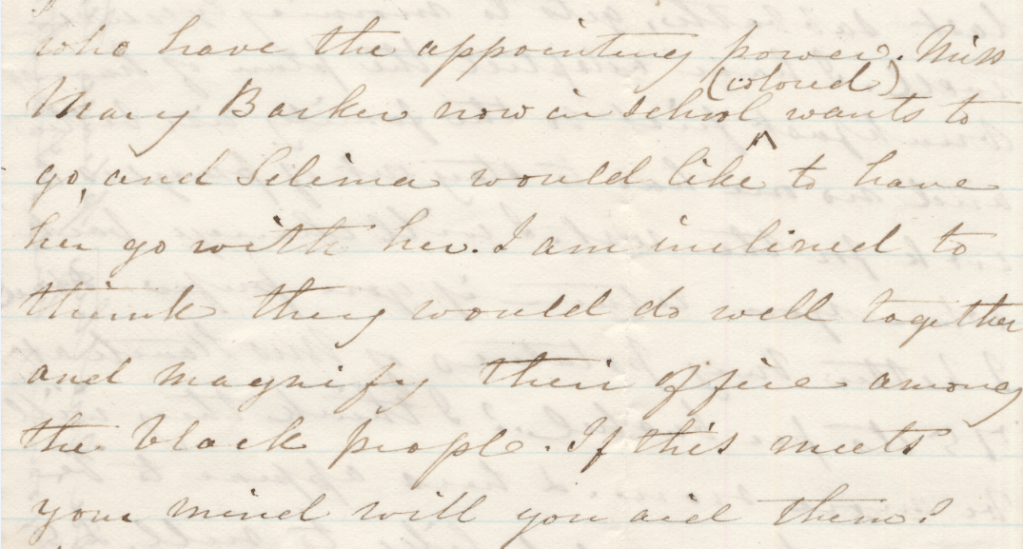
Of Mary’s ambitions after her education, we have only a secondhand record. In an 1863 letter to her husband, Jonathan, Mary Blanchard mentions that Mary Barker desires to be a missionary in the South: “By the way Selima [Blanchard] told me last Sabbath after Mr. Markham’s sermon (which was pretty good) that she has always wished to be a missionary and she should love to go and teach the contrabands [formerly enslaved people]. . . . Miss Mary Barker now in school (colored) [sic] wants to go with her. I am inclined to think they would do well together and magnify their office among black people.” A subsequent reply from Jonathan reported writing to family connections on the East Coast about soliciting a place for Selima Blanchard and Mary Barker to serve as teachers among the “freed blacks,” but professed his personal doubts about the chances of their employment.
Whatever became of this plan is not recorded in further letters. Later census documents reveal that instead of moving to the South, Mary Barker stayed in Wheaton and married George Morgan, a Civil War veteran, in 1867. Shortly thereafter, George and Mary moved southwest to Quincy, Illinois in Adams County. She became a schoolteacher, and they remained in the area until her death in 1915.

Edward B. Sellers
Edward Breathitte Sellers came to Wheaton College from Shawneetown in Southern Illinois. One of the oldest towns in Illinois and a commercial trading hub on the Ohio River, Shawneetown became a popular destination for enslaved people escaping to freedom in the North. Little record of his early or family life has been preserved, although an Edward B. Sellers of the same age appears on the 1850 census from Issaquena County, Mississippi. An 1884 Congregational Yearbook publication lists his birth place as “Andalusia Plantation (Miss.?).”

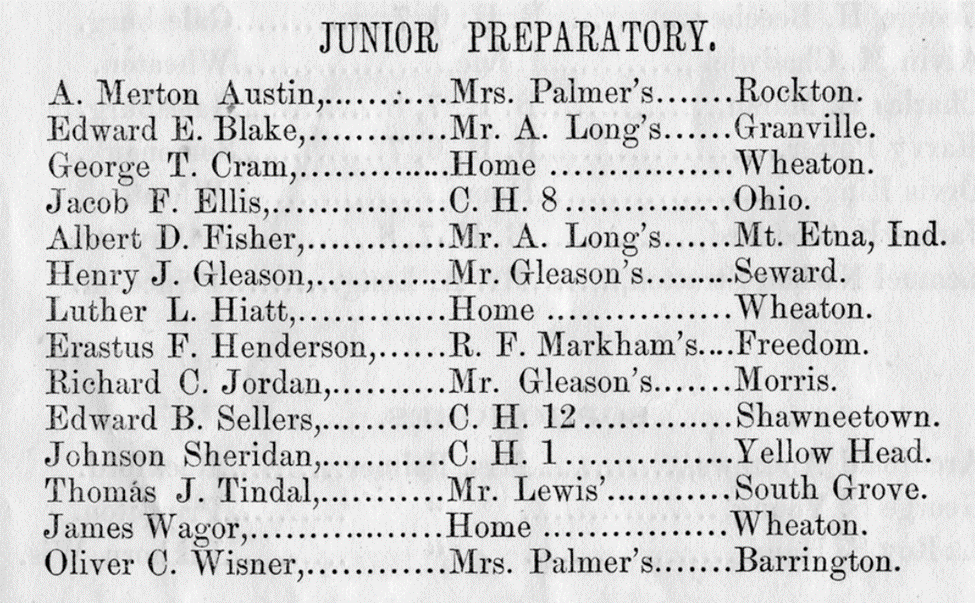
Beginning with the Wheaton College Junior Preparatory program in 1859, Edward Sellers studied in both the Preparatory and Collegiate departments and was active in student life as an officer for the Beltonian Literary Society, gaining a reputation as “one of the leading disputants” on campus. The “C.H.” listed as his residency likely refers to College Hall which would indicate that, for at least part of his education, he lived on campus.
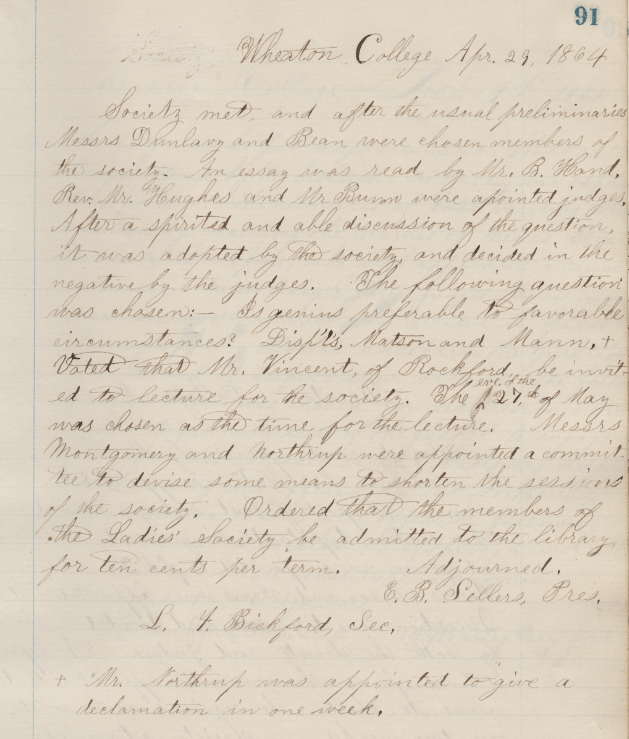
With several other Wheaton College students, Edward B. Sellers enlisted in the 132nd Illinois Infantry Division, a regiment active from 28 May 1864 to 18 October 1864. The regiment served in Paducah, Kentucky, under Colonel S. G. Hicks. The 132nd Infantry enlistees were dubbed “The Hundred Days Men,” a reference to the fact that the regiment recruited young men only for summertime service to the Union cause with the rallying cry to win the war within 100 days. The majority of these regiments never saw combat, and the 132nd’s spent several months on garrison duty, providing security, and supplying soldiers on the front lines. Fellow Wheaton enlistees were Levi Bickford, William Ferry, Albert Matson, Samuel Tate, and Joseph Tillson.
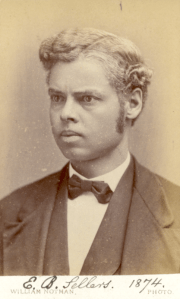
After his summer soldiering, Sellers returned to campus and graduated in 1866, the sole graduate that year. With the help of president Jonathan Blanchard, Sellers moved to Boston and enrolled at Andover Theological Seminary. He is listed in the senior class in the 1873 Congregational Quarterly, and earned his bachelor of divinity in 1874.
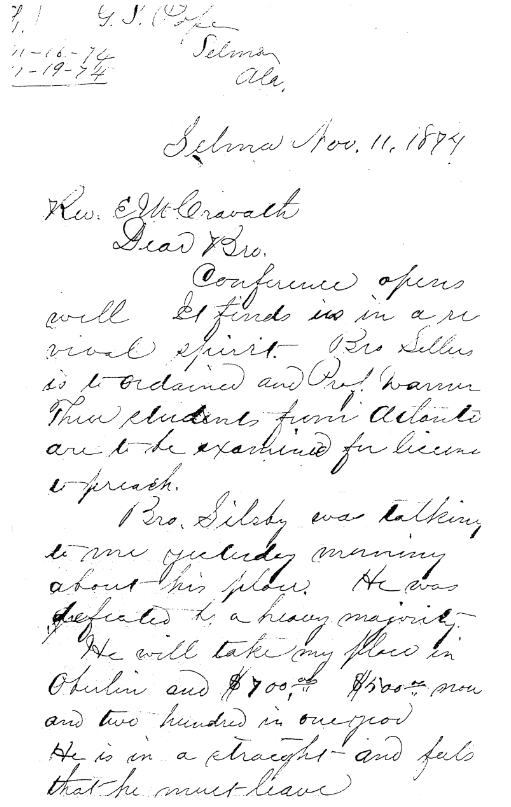
In the fall of 1874 Sellers was ordained in Selma, Alabama as a Congregational minister under the American Missionary Association (AMA). In the aftermath of the Civil War, the AMA established schools and churches throughout the South. The following letter from the AMA archives mentions Edward Sellers’ ordination, and the “revival spirit” that anticipates their imminent conference.
At the end of 1874, Sellers assumed the pastorate of the First Congregational Church of Chattanooga, TN, a church known for its racially integrated congregation. However, after two years in this position, the records detailing Sellers’ professional life become increasingly unclear. Residency records reveal that Sellers moved back to Boston for a year in 1876. From 1877-1883 he lived in Taunton and Worcester, Massachusetts, and, according to the 1880 Census, for at least part of that time, was a patient in the Tauton Lunatic Asylum. The last reports of his life record that he died of “insanity” at 41 years of age on June 4, 1883 in Worcester. On the Massachusetts’ death and birth rolls, Sellers’ death is attributed to epilepsy. He is buried in the Cedar Grove Cemetery in Worcester.
William Osborne
William Tate Osborne was born into slavery on February 12, 1855, near Monroeville, Alabama. No details are known about the first decade of Osborne’s life until he appears in the final days of the Civil War in April 1865. After Confederate forces surrendered following the Battle for Fort Blakely, the young Osborne sought out the victorious Union soldiers, who turned him over to Lt. Colonel Jonathan Merriam. Later, William took charge of Merriam’s horse, Frank, for the remainder of the Mobile Campaign. In the summer of 1865, Merriam returned to his home state of Illinois, bringing the ten-year old Osborne with him. Col. Merriam and his wife, Lucy, provided for William until he enrolled in the college preparatory course at Wheaton in 1869.
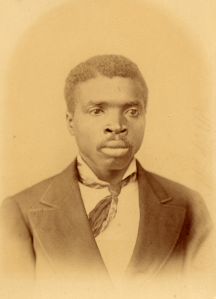
Encountering racism and barriers to William’s further education in the district schools of Atlanta, IL, W.F. Wright, also of Atlanta, wrote on behalf of Col. Merriam to Jonathan Blanchard as to the possibility of Wheaton College admitting Osborne for studies. Wright describes Osborne’s character as “unblemished,” and his desire for an education “intense.”
While at Wheaton, Osborne resided in local homes and in Blanchard Hall for his final year. Osborne became president of the Beltonian Literary Society and was remembered for his exemplary skills in oratory and fine singing voice. He received his Bachelor of Arts degree in 1876.
Upon leaving Wheaton College, Osborne briefly moved to Quincy, Illinois before crossing the Mississippi River to live in Monroe City, Missouri in 1877. The next year he married Parthena Buckner and found work as a teacher and a farmer. While residing in Monroe City, the Osbornes became connected with the African Methodist Episcopal Church and, in 1886, Mr. Osborne was ordained as a minister in the AME. For the next five decades, Rev. Osborne pastored churches in Seattle, Washington, Helena, Montana, Louisiana, Missouri, and Omaha, Nebraska.
By the 1900 U.S. Census, William and Parthena had two children, B.T. Roscoe and David M [?]. However, subsequent cemetery records show that both Parthena and B.T. Roscoe died of unknown causes in 1901.
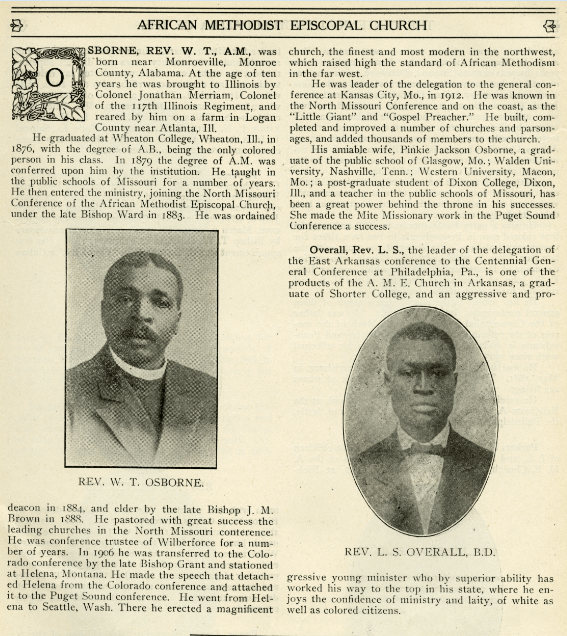
During his pastorate in Seattle, WA, the 1910 federal census reveals that Osborne had married again, to Earline Jackson (also known as Pinkie), a teacher, playwright, and stage director. After Omaha, Nebraska, the couple moved to Kansas City where Rev. Osbourne pastored the Ebeneezer African Methodist Episcopal Church. The 1920 Kansas City census informs us that the Osbornes rented their home, lived in a Black neighborhood, and he and both his parents were born in Alabama.

On January 15, 1932, Osborne died of chronic nephritis at his home in Kansas City, just shy of his 77th birthday. Today, the William Osborne Society at Wheaton College honors the legacy of this alumnus “by encouraging Black students to grow in Christ while celebrating their ethnic identities, promoting an inclusive environment, advocating for the well-being of Black students and building bridges to unify the campus body.”
The bulk of the research, documents, and description detailed above were gathered for the Wheaton College Sesquicentennial Exhibit in 2010 by Wheaton historians and archivists, including Prof. David Malone and Dr. David Maas. More information about Wheaton College’s history of race relations and early involvement in the abolitionist cause have been published in Maas’ Marching to the Drumbeat of Abolitionism: Wheaton College During the Civil War (Wheaton College, 2010) and Brian Miller and David B. Malone’s article “Race, Town, and Gown: A Christian College and a White Town Address Race” (Journal of the Illinois State Historical Society, 2019).
Explore more holdings from the Wheaton College Archives at archives.wheaton.edu.
 From the Vault