“This is My Story, This is My Song”: Celebrating Two Centuries of Fanny Crosby

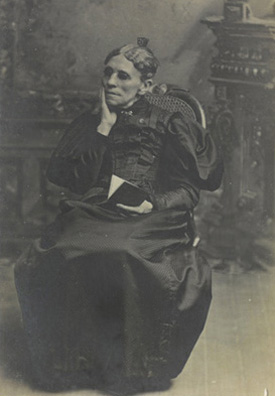
Fanny Crosby Portrait
Fanny Crosby in 1895. Accession 15-01.

When commemorating National Women’s History Month, the Wheaton College Billy Graham Center Archives could celebrate any number of extraordinary women represented in its collections: author and missionary Elisabeth Elliot, evangelist Helen “Ma” Sunday, prison preacher Rev. Consuella York, Mission Aviation Fellowship pilot Betty Greene, Holocaust-survivor and author Corrie ten Boom, faith-healer and evangelist Kathryn Kuhlman, and many others. But this March, the Archives remembers poet, hymnist, composer, social reformer, and public speaker, Fanny Crosby (1820-1915), born two hundred years ago this month.

Although she could print little more than her name, Fanny Crosby became the most prolific American hymnist of the nineteenth century, writing thousands of sacred songs, sometimes composing up to six or seven hymns a day. Her most famous works include “Blessed Assurance”, “To God be the Glory”, “Pass Me Not, O Gentle Savior”, and “Safe in the Arms of Jesus.” A household name in her lifetime, Fanny Crosby’s compositions still litter hymnals across American Protestant denominations today. Crosby’s enduring popularity is a testimony not only to the extraordinary volume of her musical corpus but also to the simplicity and power of her lyrics to convict, comfort, and inspire audiences around the globe.

In addition to photographs, song books, and memorabilia, the Archives holds nearly 2,400 original manuscripts of Crosby’s hymns and poetry, composed between 1862 and 1915. The majority of the manuscripts are numbered and dated, a helpful guide for researchers tracing Crosby’s immense literary output. The finding aid for Collection 35: Papers of Fanny Crosby provides more details about these materials.

Continue reading →

Remembering Consuella York, the “Jail Preacher”

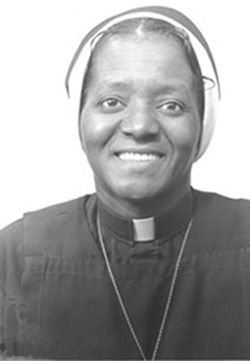
York Portrait

This February, in celebration of Black History Month, the Wheaton College Billy Graham Center Archives commemorates the life and spiritual legacy of Rev. Consuella York (1923-1995), the “Jail Preacher,” and showcases a few items from her personal papers.

Affectionately known as “Mother York,” she ministered in the Cook County correctional system for over 43 years, bringing the Christian message of love and redemption to inmates and correctional officers alike.

Born and raised in Chicago, Consuella York demonstrated an early aptitude for preaching, inherited from her Baptist preacher father. In her 1988 oral history interviews held in the Archives, York recalls winning a prize for oratory in 1948 and shortly afterward entered the Chicago Baptist Institute, where she studied advanced homiletics and pastoral theology, despite the fact that her church denomination did not ordain women as clergy members or allow them to preach. In the same oral history interview, York describes the day 1952 that changed the direction of her life:

Continue reading →

Ring in the New, Accession the Old: 2019 Edition

01a
Accession 19-31. A portion of the Elisabeth Elliot Gren papers, which were donated in 2019 by her husband, Lars Gren, with assistance from Kathy and David Reeg.

As the Wheaton College Billy Graham Center Archives greets New Year 2020, we remember with thanks the accessions of 2019. Every profession has its own special terminology, rarely used by those outside it. Architects have muntin. Archivists have accession. We share the word with libraries, museums, and some monarchs. As a verb (in archival usage), to accession or accessioning means logging a new item into our collections. As a noun, it refers to an individual addition, which might be a single photograph or hundreds of boxes of correspondence. Archivists accept diverse material from a wide variety of sources and are much more inclined to collect than divest materials (although in recent years deaccessioning has become more of a priority among institutions). For the Archives, 2019 will always be remembered as the year when the records from the Billy Graham Evangelistic Association that had been deposited in the Archives were returned to the BGEA at its request. But it was also a year that brought a variety of significant, unusual, and wonderful additions.

02a
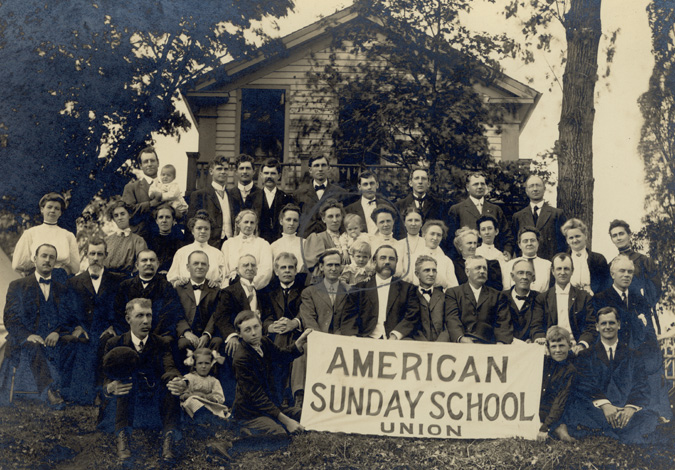
Accession 19-34. Undated photo of the staff of the American Sunday School Union. An example of the many individual items sent to us unsolicited by kind donors.

Every once in a while, acquisitions in a given year seem to follow a specific theme. In 2018 we received several large collections of private papers by prominent figures in evangelistic ministry, including Merrill Dunlop, Luis Palau, Merv Rosell, and George Beverly Shea. On the other hand, 2019 was the year of the authors. Individuals who had written significant books on evangelism and /or evangelical history contributed their research files, which included boxes and boxes of letters, transcripts, audio recordings, photos, and more that they had gathered. For example, Valarie Elliot Shepard donated the letters her parents had written to each other during their courtship, which formed the basis of her book, Devoted: The Personal Letters and Love Story of Jim and Elisabeth Elliot (2019) The gift also included Jim Elliot’s papers from his days as a Wheaton College student. The Elliots were best known for their involvement in evangelism among the Waorani people of Ecuador. The Waorani had never heard the Christian gospel, and Jim and five other men formed a project to reach them. On January 6, 1956 after an initial friendly contact, all five men were killed by members of the tribe. In October 1958, Elisabeth, along with Rachael Saint, the sister of one of the five, and three-year old Valerie traveled into the jungle to live among the Waorani and begin the work that was to bring many of them to faith in Jesus Christ.

Continue reading →

Still “Geared to the Times, Anchored to the Rock”: Celebrating 75 Years of Youth for Christ

“‘What are you doing? Can’t we do it here? How do you get started?” And we did everything we possibly could to help everybody we possibly could. And they came here, and we sent people out there, and we were busy” (CN 285, Tape 3).

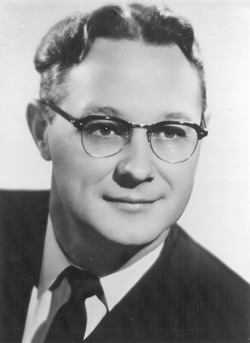
Johnson headshot
Torrey Johnson, founding member and first president of Youth for Christ.

“Busy” is how Torrey Maynard Johnson describes the explosion of interest in youth evangelism stemming from the runaway success of Youth for Christ evangelistic rallies in Chicago in 1944. In a 1984 oral history interview with Archives staff, Johnson recalls the rapid emergence of Youth for Christ during World War II, a movement that innovated evangelism practices—specifically targeting young people—launched the career of a young Billy Graham, and became an international phenomenon still ministering to young adults today.

This November, the Wheaton College Billy Graham Center Archives celebrates seventy-five years of Youth for Christ, and explores the origins and early rallies of Youth for Christ in Chicago prior to its formal establishment in November 1944.

Continue reading →

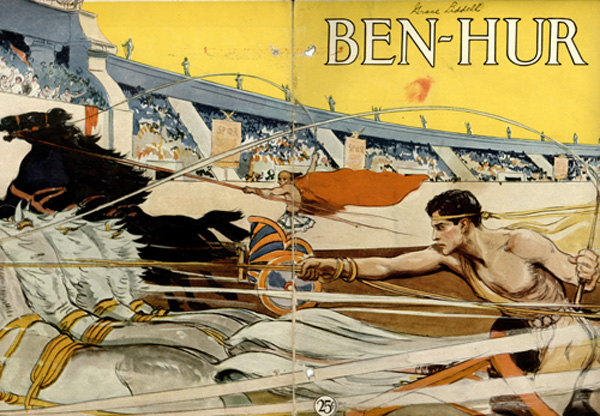
Chariot Racing in the Archives

CoversA

On any given Saturday, thousands of Americans are giving garage sales and tens of thousands, maybe hundreds of thousands are looking over these dubious treasures as they lay on card tables set up on the driveway and the lawn.  One thought that must strike anyone who has glanced over these accumulations is that one person, one family in a lifetime sure collects a lot of stuff.  Some of it is obvious – old TV guides, second best dinner settings.  Others are inexplicable – a 1300-year-old coin, a vintage Monopoly board game.  Archivists too, often have the same revelation.  When we get the papers of an individual, it is because they contain substantial information on the topic which is the Archives’ main area of interest.  But there will be other things as well that reflect all the unexpected corners one encounters when intruding in the remains of another person’s life. Continue reading →

Tibet Through Victor Plymire’s Camera

As a major research center dedicated to evangelism and global missions, the Wheaton College Billy Graham Center Archives houses a wide swath of materials from around the world – missionaries’ prayer letters from Peru, family correspondence from Iran, radio broadcasts from Monaco, church records in Swahili, travel reports from Russia, evangelistic tracts from China, maps of Tanzania, blueprints from Japan, and much more.

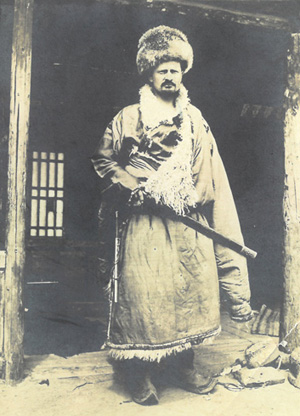
Victor Plymire in Tibet. Undated.

All missionaries, to some extent, document the culture where they serve—its people, customs, food, music, languages, landscape, and history. For many missionaries and Christian aid workers, this documentation is merely a small part of their work. It appears in throwaway line in a prayer letter to supporters at home, a handful of bullet points in the annual report for the mission headquarters, or a detailed paragraph in a personal diary entry. Together, these fragments can offer researchers today a glimpse into the experiences of past Christian workers as they encountered the new, unexpected, and often bewildering realities of missionary service around the globe.

This August, the Archives showcases one such item—a stunning photograph album created by Assemblies of God missionary Victor Plymire between 1926 and 1930. For nearly four decades, Victor Plymire (1881-1956) lived, toured, evangelized, and planted churches throughout Tibet. For much of his ministry, Plymire traveled with the Tibetan trade caravans that crisscrossed the country.

Each stop along the trade route—cities, lamaseries, temples, and remote outposts—presented an opportunity to both preach the Christian gospel and document the local culture. A gifted amateur photographer, Plymire’s photographs reveal not only his exceptional eye for detail, but also his deep fascination with the Tibetan people and landscape. His photos and silent, black and white film footage capture the bustle and vibrancy of Tibetan cities, temples, and festivals, alongside breathtaking images of lonely mountain ranges and sprawling plains.

Continue reading →

Billy Graham and the Presidential Election of 1944

Biographers of Billy Graham and scholars of American evangelicalism have long been interested in Graham’s involvement in U.S. politics, particularly his relationship with every U.S. president dating back to Harry S. Truman. While whole books have been dedicated to examining these connections, Graham’s earliest foray into presidential politics has, to date, escaped notice. This July, the Archives highlights Billy Graham’s brief, but fascinating, correspondence with presidential candidate Thomas Dewey during his 1944 election campaign against incumbent Franklin D. Roosevelt.

In August of 1944, the twenty-four year old Billy Graham was serving in his first and only pastorate, a small congregation in the Chicago suburbs. After graduating from Wheaton College the year before, Graham and his new wife Ruth accepted a call to Western Springs Baptist Church, where they ministered for the next two years. During his pastorate, Graham became increasingly involved with Youth for Christ, touring the upper Midwest and eventually coast to coast, preaching at youth rallies with Torrey Johnson and other rising YFC evangelists.

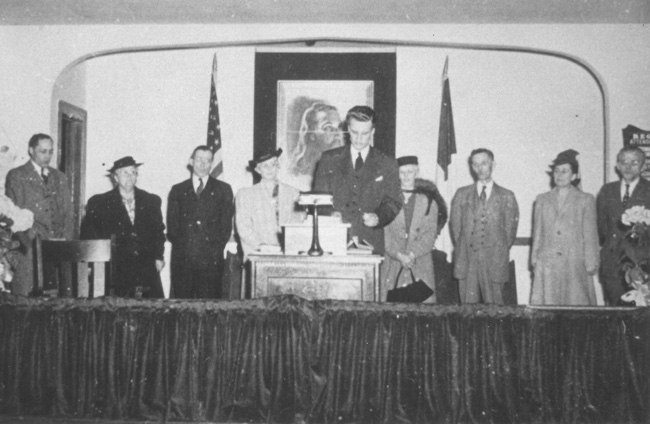
BG_Western Springs_1943.02

A rare image of Billy Graham as a young pastor, speaking at Western Springs Baptist Church in 1944.

Continue reading →

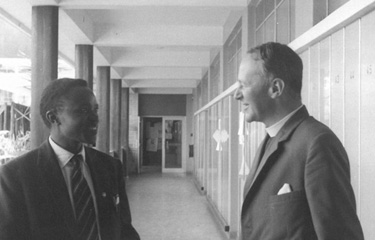
Campus Ministry and Bird Watching: John Stott’s 1962 Africa Tour

In the spring of 1962, John Stott (1921-2011) returned to the African continent for a second series of campus missions at colleges and universities at the invitation of the Pan-African Fellowship of Evangelical Students (PAFES) that was made up of English-speaking movements of the International Fellowship of Evangelical Students (IFES).

NAIROBI, KENYA. Stott with the GCU President at Nairobi.

This model of campus missions was repeated again and again in the 1960s when Stott also traveled to North America, Asia, Australia and New Zealand, and across Europe. Subsequent decades through the 1990s were marked by more travel and ministry. Known across the span of his life as an Anglican minister, Evangelical theologian, evangelist, and author, John Stott is described by his biographer, Timothy Dudley-Smith in the second volume of his two-part work, John Stott: A Global Ministry. “The start of the 1960s found John Stott an international figure in the field of student evangelism” (p. 105). During his Africa sojourn, Stott’s visits stretched from Sierra Leone to Ghana, Nigeria, Kenya, Uganda, and down to Rhodesia. Dudley-Smith captured glimpses of these stops (pp. 106-110). Stott’s first trip to the African continent in 1959 focused primarily on meetings in various cities of South Africa, but also added ministry and bird watching stops in Ruanda-Urundi, Uganda, and Kenya.)

Continue reading →

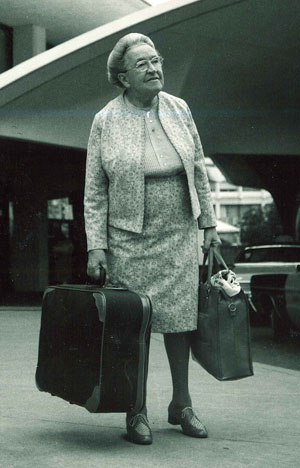
The Travels of Corrie ten Boom

Corrie on her travels, undated.

Dutch evangelist and writer Corrie ten Boom is likely best known today for her best-selling autobiography The Hiding Place. Published in 1971, The Hiding Place describes the ten Boom family’s courageous efforts, inspired by their Christian faith, to hide Jewish refugees during the Nazi occupation of the Netherlands. The book documents the ten Boom’s harrowing work in Haarlam, ultimate discovery by the Nazis, and Corrie and her sister Betsie’s experiences in Ravensbrück, a women’s concentration camp in northern Germany, where Betsie died of starvation in December 1944. To date, The Hiding Place has sold millions of copies worldwide and was adapted into a film of the same title by World Wide Pictures in 1975.

While Corrie ten Boom’s legacy of love, sacrifice, and forgiveness during the horrors of World War II is remembered and celebrated, less well-known is her Christian service after the war. Following her release—due to a clerical error—in December 1944, Corrie returned to the Netherlands where she established a home called the Schapendunien for concentration camp survivors. That same year she founded the Ten Boom Foundation (reorganized as the Corrie ten Boom Stichting in 1960) and published her first account of her wartime experiences titled Gevangene En Toch… Herrinneringen Uit Scheveningen, Vught En Ravensbruck (1946). From 1945 until she retired from active ministry in 1977, Corrie became a sought-after writer and evangelist, publishing books in multiple languages and crisscrossing the globe to speak at events sponsored by Youth for Christ, J. Edwin Orr’s Revival Fellowship Team, the International Congress on World Evangelization, and eventually under the auspices of her own Foundation, among many others.

Today, the Wheaton College Billy Graham Center Archives is home to an assortment of Corrie ten Boom materials, including family photo albums, recordings of evangelistic messages, personal correspondence, and Corrie ten Boom Stichting publications.

Continue reading →

Ruth Bell Graham and Peace With God

Archival materials find their way to the Wheaton College Billy Graham Center Archives in a myriad different ways. Some materials arrive en masse, in shipping pallets or moving trucks. Other materials wander through the Archives’ doors an item or two at a time. While most collections consist of preplanned donations, other items find their way to the Archives’ vault by way of serendipity—a chance discovery in a grandparent’s attic or secondhand bookseller.

In much the same way, this first edition copy of Billy Graham’s Peace with God traveled a circuitous road to the Wheaton College Billy Graham Center Archives. Discovered in a yard sale by a casual browser, the book’s fly leaf revealed a startling previous owner: Ruth Bell Graham.

TitlePage
The fly leaf of this first edition copy of Peace With God lists the Graham family home address in  Montreat, N.C. and contains Ruth Graham’s revisions for the second edition, published in 1984.

Not only did the slim, dark green first edition belong to Ruth Graham, its pages are riddled with her annotations. The unsuspecting yard sale browser quickly realized the unique value of the book and donated it to the Archives in 1997, where it is now housed in Collection 15: Papers of Billy Graham.

Continue reading →