“As This is our First Broadcast…”: Percy Crawford and the Birth of Televangelism

PF: Pinebrook Camp

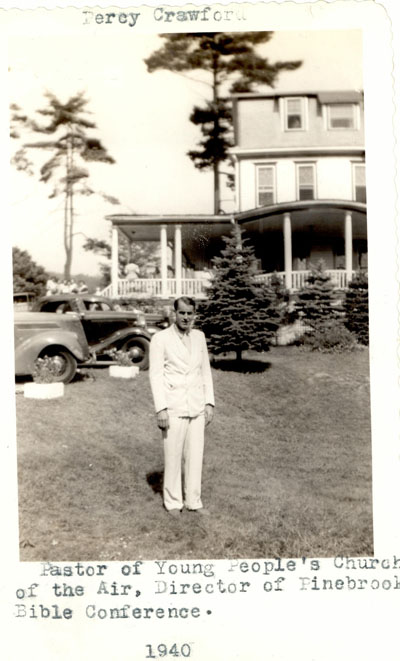
Known to friends as “The Pioneer,” Percy Crawford (1902-1960) was an American evangelist and entrepreneur, who founded, among other things, the Pinebrook Bible Conference, Pinebrook Christian camps for boys and girls, a radio ministry, King’s College, a mission, and a chain of Christian radio and televisions stations. He also produced the first nationwide evangelism television program. These were in addition to the evangelistic tours and “Youtharama” rallies he led across the United States. His restless energy, vision, and strong personality made a deep impression on those who knew or worked with him.

When Crawford committed his life to ministry at Los Angeles’ Church of the Open Door in 1923, radio was just beginning to emerge as a powerful national platform for entertainment, news, politics, and religion. Inspired by Christian radio pioneers like Paul Rader in Chicago and Walter Maier in St. Louis, Crawford began broadcasting in 1931 with The Young People’s Church of the Air. During the summer months, these broadcasts often came from Pinebrook in Pennsylvania’s Pocono Mountains.

Continue reading

“Could You Say More About That?”: Oral History as Process and Document in the Archives

This month, Wheaton Archives & Special Collections features a post from long-time Wheaton archivist, Paul Ericksen. Since joining the then Billy Graham Center Archives in 1982, Paul has interviewed more than 125 individuals and processed and transcribed dozens of oral history interviews with missionaries, evangelists, and Christian leaders.


Archivists are primarily skilled facilitators as they focus on gathering, arranging and describing primary source materials, and assisting researchers in using their collections. Through archival “finding aids,” archivists help create the intricate web of descriptions, subject headings, and box lists that guide a researcher to identify which collections will contain relevant documents for their study, and in which boxes or folders they will find these documents. While gathering existing historical documents and preparing them for optimal access and use by researchers forms the core of archival work, archivists also collaborate to create historical documents through oral history interviews. An oral record of a person’s life and career, these interviews offer a stimulating window into the unique narratives and experiences of individuals.

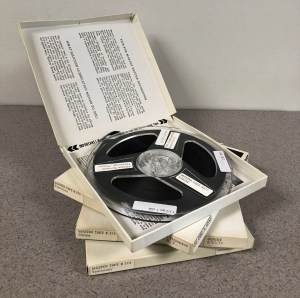
Our earliest interviews were captured on reel to reel tapes like those pictured above, using Wollensak portable recorders.

Over the course of the almost fifty years since the Billy Graham Center Archives (now the Evangelism and Missions Archives) was formed in 1975, its archivists have continuously managed an informal oral history program to further enrich its resources on global evangelism. Archivists have interviewed more than 370 individuals, compiling over 1,200 hours of sound recordings on analog reels, cassette tapes, and as digital files. Through further transcription of recordings, researchers also gain the benefit of reading or searching the full-text accounts for information on a topic, person, or location. One of the earliest of these interviews was with Andrew Wyzenbeek about his memories of Billy Sunday meetings at the turn of the century. Most recently, a few current Billy Graham Scholarship recipients were interviewed in the past year about their experience and ministry in several Asian countries.

Continue reading

Introducing the Samuel Escobar Papers

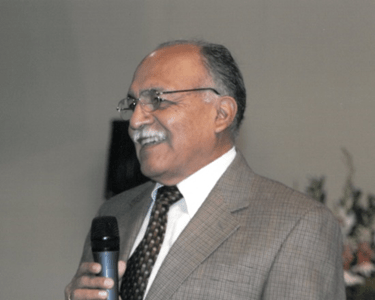
Dr. Samuel Escobar, undated. From Accession 2024-0023, Box 6.

The Wheaton Archives & Special Collections is pleased to announce the recent acquisition of a significant research collection documenting the life and ministry of Peruvian missiologist and theologian Dr. Samuel Escobar. Spanning more than five decades of Dr. Escobar’s life and ministry, the papers are a valuable addition to the Evangelism & Missions Archives and will significantly expand our collections representing the Global South, especially voices from Latin America.

Continue reading

A Centennial Crusade

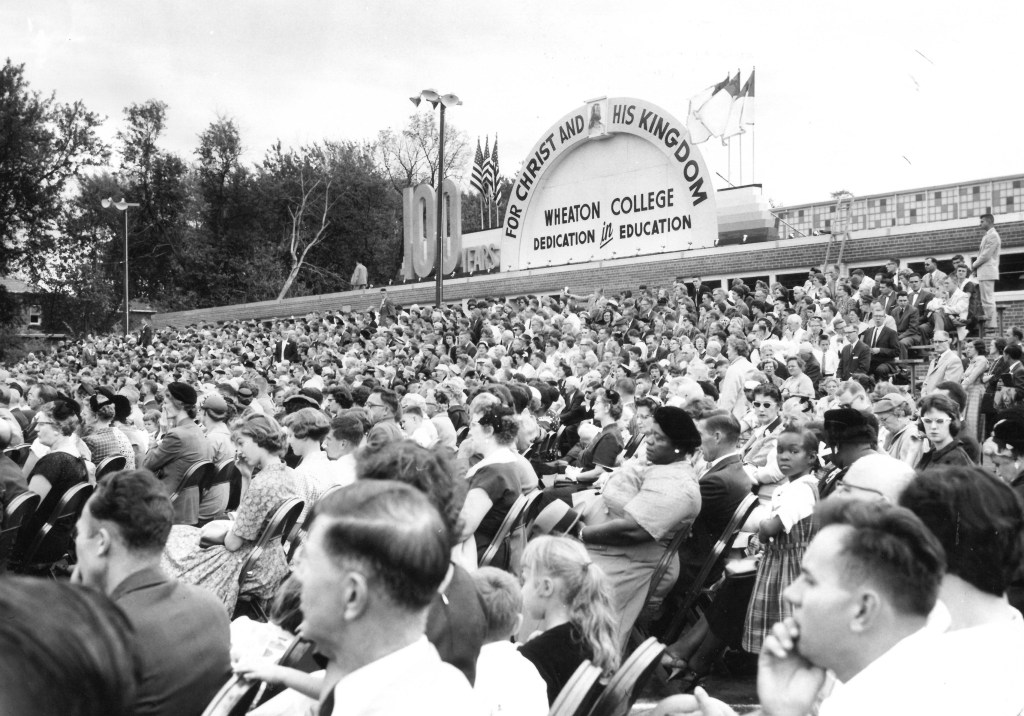
In September 1959, Wheaton, Illinois, made history as “the smallest city ever to conduct a crusade,” when it welcomed evangelist Billy Graham back to his alma mater, Wheaton College.

The crowd at one of the outdoor crusade meetings, Wheaton College’s Centennial motto “Dedication in Education” in background. College Archive Photograph #B06313.
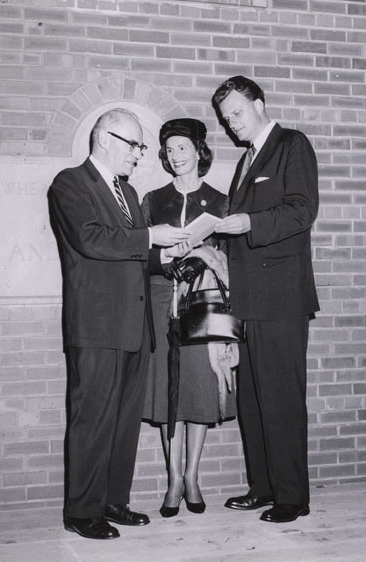
V. Raymond Edman with Ruth and Billy Graham in front of Memorial Student Center, 1959. CN 74, OS 13: 1959 Crusade Scrapbook.

To commemorate the 65th anniversary of the Wheaton crusade, Wheaton Archives & Special Collections features below recordings, photographs, and documents from this historic event.

Originally, Wheaton’s president, V. Raymond Edman, had invited Graham to lead the College’s annual fall evangelism meetings as part of its centennial year celebrations. However, at Graham’s suggestion, the scope of the event quickly expanded to a weeklong crusade that extended far beyond the campus, reaching into the surrounding suburbs and Chicago. The following letter from Billy Graham to Wheaton Chaplain Evan Welsh, held in the College’s Centennial Committee Records, outlines Graham’s growing vision for the meetings:

Continue reading

“The Truth Needs to Be Illustrated”: Gospel Posters in China

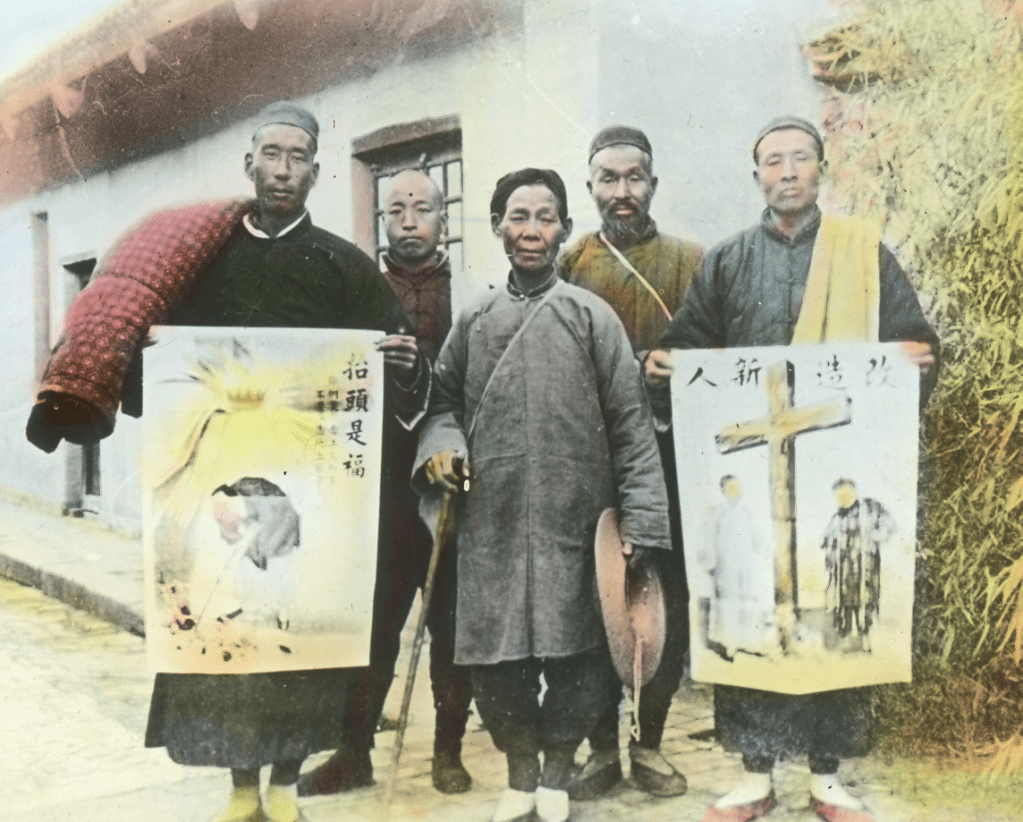
In the early 1920s, the first commercial four-color offset lithograph machines came to China. While Chinese Christian posters, tracts, and books had circulated from various presses for a century, these machines allowed for quick, inexpensive, and large-scale print production. Christian mission organizations like the Religious Tract Society and Christian Witness Press quickly capitalized on the new technology. In 1929 alone, the Religious Tract Society printed 150,000 posters in China. Joining and in some ways anticipating China’s vibrant political and commercial print culture, these colorful posters became a prevalent tool for Christian evangelization in China through the 1930s and 1940s.

Chinese Christians, possibly an itinerate preaching band, with evangelism posters, ca. 1930-1940. Collection 215, Lantern Slide Box 11.

Wheaton Archives & Special Collections holds more than fifty of these posters throughout several collections, including Collection 215: Records of Overseas Missionary Fellowship, Collection 231: Papers of Ian and Helen Anderson and Collection 706: Evangelism Posters Ephemera.

Continue reading

‘For the Evangelization of the Whole World’: Looking Back at the 1974 Lausanne Congress

Logo for International Congress of World Evangelization (ICOWE), Lausanne, 1974. Printed on Congress program.

In July 1974, 2,500 leaders from 150 countries gathered in Lausanne, Switzerland, for the International Congress on World Evangelization, better known as the Lausanne Congress. Over the course of ten days, evangelical leaders from around the world spoke in plenary sessions and workshops to consider the project of world evangelization in the modern era. An immediate outcome of the congress was the Lausanne Covenant, a statement of Christian belief and lifestyle that became a touchstone for many evangelicals around the globe.

To celebrate the 50th anniversary of the Lausanne Movement’s founding Congress, Wheaton Archives & Special Collections features highlights from Collection 46: Records of the Lausanne Movement, as well as our oral history collections with Lausanne leaders and participants.

Continue reading

Wheaton Goes to the Olympics!

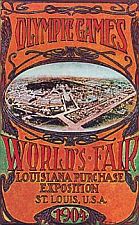
Advertisement for the 1904 Olympics
Poster for the 1904 Summer Olympics in St. Louis, Smithsonian Image Collection.

As the 2024 Summer Olympic Games are set to open this July in Paris, France, Wheaton Archives & Special Collections looks back to the 1904 Olympics held in St. Louis, Missouri, where Wheaton College sent seven student-athletes to compete for the collegiate basketball championship.

Originally planned for Chicago, the 1904 Olympics were moved to St. Louis and combined with the Louisiana Purchase Exposition after extensive political negotiations from the World’s Fair organizers. Among 38 athletic contests, including wrestling, tug-of-war, track, and croquet, St. Louis marked the first time the new sport of “basket ball” appeared in the Olympics. Held as a demonstration sport, four levels of competition were offered, with Wheaton College participating in the College-level against two teams – Hiram College of Ohio and Latter-Day Saints University of Salt Lake City.

Continue reading

Japan for Christ: The Evangelistic Travels of H. S. Kimura

Kimura Kiyomatsu (木村 清松), known in the United States as Henry Seimatsu Kimura, was born in 1874 to a family of sake brewers in Gosen City, Niigata Prefecture. At seventeen Kimura was baptized during an evangelistic service held by Teiichi Hori in Niigata. His conversion to Christianity led to conflict within his family, especially with his father, who disowned him; although both his parents and his two brothers eventually became Christians.

Continue reading

“Who Cares for the Woman Who Toils for Her Bread?”: The Ministry of Virginia Healey Asher

Portrait photo of Virginia Asher, 1905. Photo File: Asher, Virginia.

Scattered throughout the Evangelism & Missions Archives are paper fragments that tell the story of a remarkable woman – Virginia Healey Asher.

Virginia Healey was born to Irish parents in Chicago in 1869. Although her family was Catholic, she attended the church that had grown out of Dwight L. Moody’s Sunday School class and there gave her life to Christ during an evangelistic meeting when she was eleven. Her future husband, William Asher, was saved at the same meeting. When a few years later D. L. Moody called for workers, she volunteered. He assigned her to outdoor street meetings in Chicago where she sang and witnessed. She planned to go to Moody’s school in Northfield, Massachusetts when William, who had also volunteered for evangelism ministry, proposed. She was a teenage bride when they married on December 14, 1887.

Continue reading

It’s a beautiful day in Chicago!

Along with hundreds of collections on global missions and evangelism, Wheaton Archives & Special Collections also holds records documenting the history of Chicagoland, from institutions like the historic Moody Church, Chicago Gospel Tabernacle and the Chicago Sunday Evening Club to individuals like William Leslie, Herbert J. Taylor, Vaughn Shoemaker, and Harold “Red” Grange. This month, Wheaton Archives & Special Collections features one such collection, the papers of hymn singer and radio broadcaster Everett Mitchell, best known for his memorable opening line, “It’s a beautiful day in Chicago!”

Continue reading