150 Years of The Wheaton Record

In November 1875, the Literary Union of Wheaton College published the first issue of the College Record, Wheaton’s student newspaper. Over the next 150 years, the Record became both a laboratory for student writing and journalism and a living chronicle of campus life. Its pages have documented student activities, campus developments, educational changes, social movements and conflicts, political campaigns, visiting speakers, chapels and mission work, theological debates, faculty projects, and countless other moments that trace the evolving history of Wheaton College.
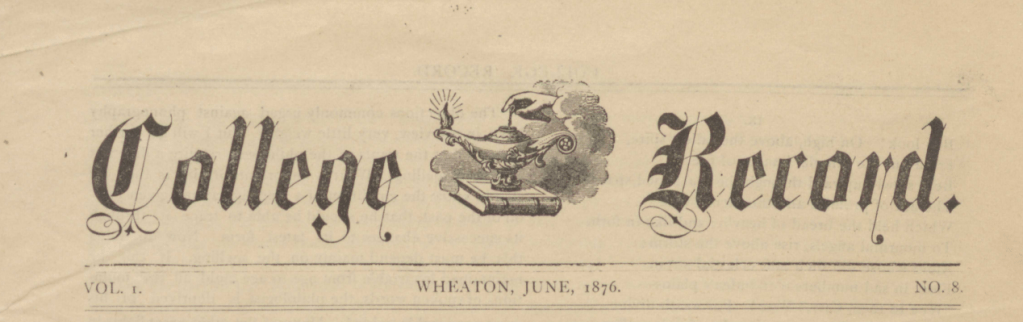
Wheaton Archives & Special Collections holds only scattered records for the first twenty years of the paper’s publication. Among these, the earliest surviving issue of the Record dates from June 1876. Although the inaugural issue of the Record is lost to history, the June 1876 editorial provides a helpful update on the paper’s first eight months, including plans for an enlargement of the paper from eight to sixteen pages. To fill this new space, the editors appealed directly to the student body, urging Wheaton students to contribute writing:

Students write for your paper. Don’t say you haven’t time to write because you are so pressed with your studies, but take a few moments each day to write and you will soon find you are the gainer by it. Of what value will your education be to you unless you learn to apply what you learn? It may, indeed, be some satisfaction to you to know that you have a college education, but certainly it will be of very little benefit to others if you know not how to use it. And in our opinion, there is no better way of putting to practical use the knowledge we have gained than by writing.

Let us, then, improve the opportunities given to us, and thus be enabled to benefit ourselves and our fellows. A college paper furnishes one of the means of improvement, and it is to be hoped that the students in future will improve the advantages thus offered to them more than they have in the past.

Continue reading

50 Years of the Billy Graham Scholarship Program

In 1974, Wheaton College and the Billy Graham Evangelistic Association embarked on an ambitious project – The Wheaton College Billy Graham Center. While the beginnings of construction on the expansive College Ave building was the most visible sign of the new plans, the purpose of the Center was fixed not in a building but in the diverse work of the global church. As a 1976 slide presentation promoting the Graham Center outlined, “The three basic goals of the Billy Graham Center are, first, to advance Biblical evangelism and to contribute to world evangelization. Second, to cooperate as widely as possible with all evangelical Christians in advancing world evangelization in every possible way, and third, to reflect and extend the evangelistic ministry of Billy Graham.”

Billy Graham Center pamphlet, c. 1980s. (Acc. 2017-042).

Integral to plans for “advancing world evangelization” at the new Billy Graham Center (BGC) was the desire to support students “who will go from the Center with the Gospel of Jesus Christ into foreign missions, evangelistic organizational leadership, humanitarian efforts, and so many, many more wonderful ministries.” This vision took tangible form through initiatives like the BGC Scholarship program, which aimed to equip international students for global ministry leadership. In the fall of 1975, international students from South Africa, Kenya, and Australia received the first BGC Scholarship funds to begin their studies in the Wheaton College Graduate School.

Continue reading

A Half Century with Perry Mastodon

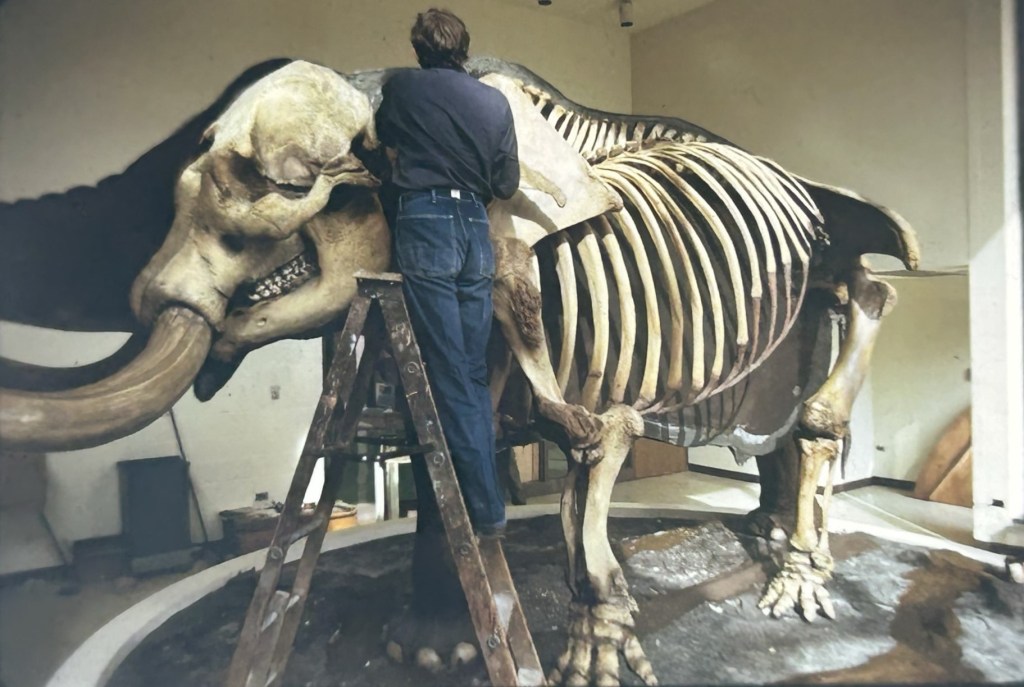
Perry Mastodon being prepared for display in Deicke Exhibit Hall in the former Armerding Science Building, ca. 1974. RG 10.02, Box 5.


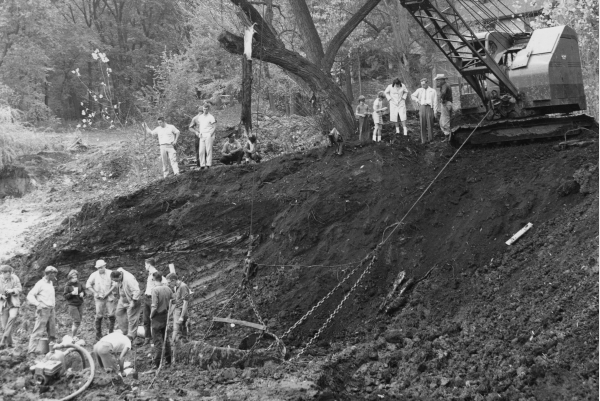
On October 16, 1963, Judge Sam Perry of Glen Ellyn, intending to merely deepen the pond on his property, received much more than he expected when diggers unearthed a prehistoric femur. Upon hearing the news, Judge Perry called for help from Wheaton College, and Dr. Douglas Block of the Geology Department took charge of the site. Judging the find to be geologically significant, the decision was made to drain the lake and excavate. Enlisting Wheaton students from the Geology Department and with technical advice from Orville Gilpin of the Chicago Field Museum, Dr. Block oversaw a strenuous eight-day dig. The muddy excavation was soon joined by hundreds of interested community members and extensive media coverage from local DuPage County and Chicago papers.

Continue reading

A Centennial Crusade

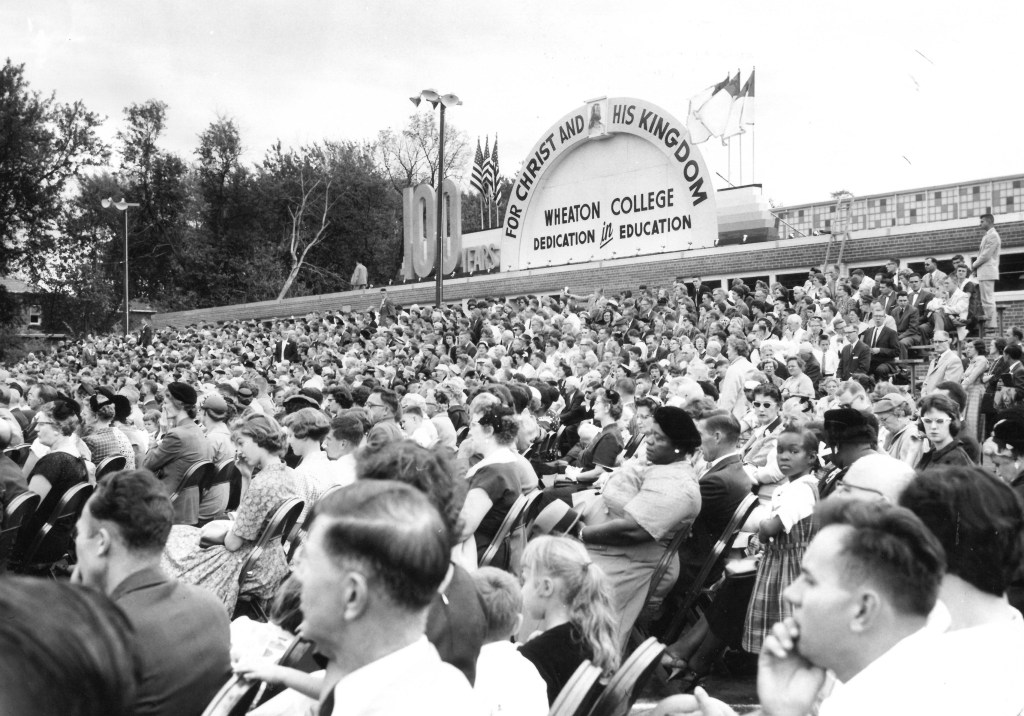
In September 1959, Wheaton, Illinois, made history as “the smallest city ever to conduct a crusade,” when it welcomed evangelist Billy Graham back to his alma mater, Wheaton College.

The crowd at one of the outdoor crusade meetings, Wheaton College’s Centennial motto “Dedication in Education” in background. College Archive Photograph #B06313.
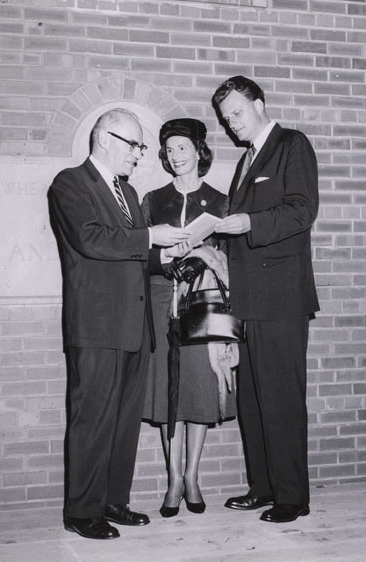
V. Raymond Edman with Ruth and Billy Graham in front of Memorial Student Center, 1959. CN 74, OS 13: 1959 Crusade Scrapbook.

To commemorate the 65th anniversary of the Wheaton crusade, Wheaton Archives & Special Collections features below recordings, photographs, and documents from this historic event.

Originally, Wheaton’s president, V. Raymond Edman, had invited Graham to lead the College’s annual fall evangelism meetings as part of its centennial year celebrations. However, at Graham’s suggestion, the scope of the event quickly expanded to a weeklong crusade that extended far beyond the campus, reaching into the surrounding suburbs and Chicago. The following letter from Billy Graham to Wheaton Chaplain Evan Welsh, held in the College’s Centennial Committee Records, outlines Graham’s growing vision for the meetings:

Continue reading

‘For the Evangelization of the Whole World’: Looking Back at the 1974 Lausanne Congress

Logo for International Congress of World Evangelization (ICOWE), Lausanne, 1974. Printed on Congress program.

In July 1974, 2,500 leaders from 150 countries gathered in Lausanne, Switzerland, for the International Congress on World Evangelization, better known as the Lausanne Congress. Over the course of ten days, evangelical leaders from around the world spoke in plenary sessions and workshops to consider the project of world evangelization in the modern era. An immediate outcome of the congress was the Lausanne Covenant, a statement of Christian belief and lifestyle that became a touchstone for many evangelicals around the globe.

To celebrate the 50th anniversary of the Lausanne Movement’s founding Congress, Wheaton Archives & Special Collections features highlights from Collection 46: Records of the Lausanne Movement, as well as our oral history collections with Lausanne leaders and participants.

Continue reading

Humble Beginnings

While December signifies the year’s end, this last month also marks a significant point of beginning for the stories of the fledging Illinois Institute of 1853 and the emerging Wheaton College of 1860.

On December 14, 1853, one-hundred and seventy years ago, the first classes of the Illinois Institute were held in the basement of a incomplete stone building atop a hill in Section 16, Township 39, DuPage County. Only a small town on the Illinois prairie in the close of 1853, the location in the new Milton Township offered the advantage of legislation common to many Midwest townships that enabled the special use of land in section 16 for schools.

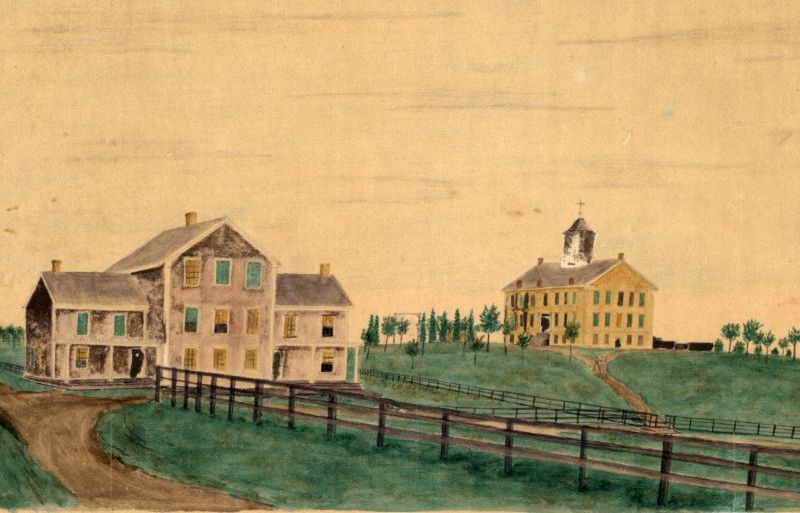
Sketch of ‘Main and White House,’ c. 1863. College Archives Photograph #CA-B14012
Continue reading

‘A Prophetic Document’: The 1973 Chicago Declaration of Evangelical Social Concern

This November, Wheaton Archives & Special Collections commemorates the 50th Anniversary of the Thanksgiving Workshop on Evangelicals and Social Concern and the resulting “Chicago Declaration.” At a time when many American evangelicals were increasingly grappling with the role of political action and social justice in American religious life, the 1973 Chicago Declaration emerged as a call for action – and a point of controversy – for a new vision of American evangelicalism grounded in social, economic, and racial justice.

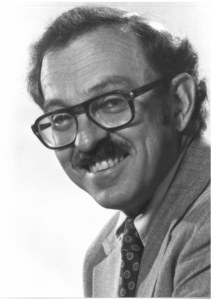
Ronald J. Sider, ca. 1980s. (Photo File: Sider, Ron).

Several collections in Archives & Special Collections document the development of this movement, including Collection 37: Records of Christians for Social Action and newly received papers from Ronald Sider (Accession 2022-053), which contain many folders of correspondence on the workshop planning, as well as the extensive discussions and disagreements surrounding the first drafts of the Chicago Declaration.

Continue reading

A Call to United Action: Commemorating 80 Years of the National Association of Evangelicals

Wheaton Archives & Special Collections holds the records of many national evangelical organizations – From Youth for Christ (CN 48) and Christianity Today (CN 08) to Christians for Social Action (CN 37) and Prison Fellowship Ministries (CN 274). These collections provide valuable and fascinating insights into the history of evangelical Christianity in the United States. But few offer as broad a view of American evangelicalism in the last half of the 20th century as the National Association of Evangelicals (SC 113), which celebrates the 80th anniversary of its founding conference this month.

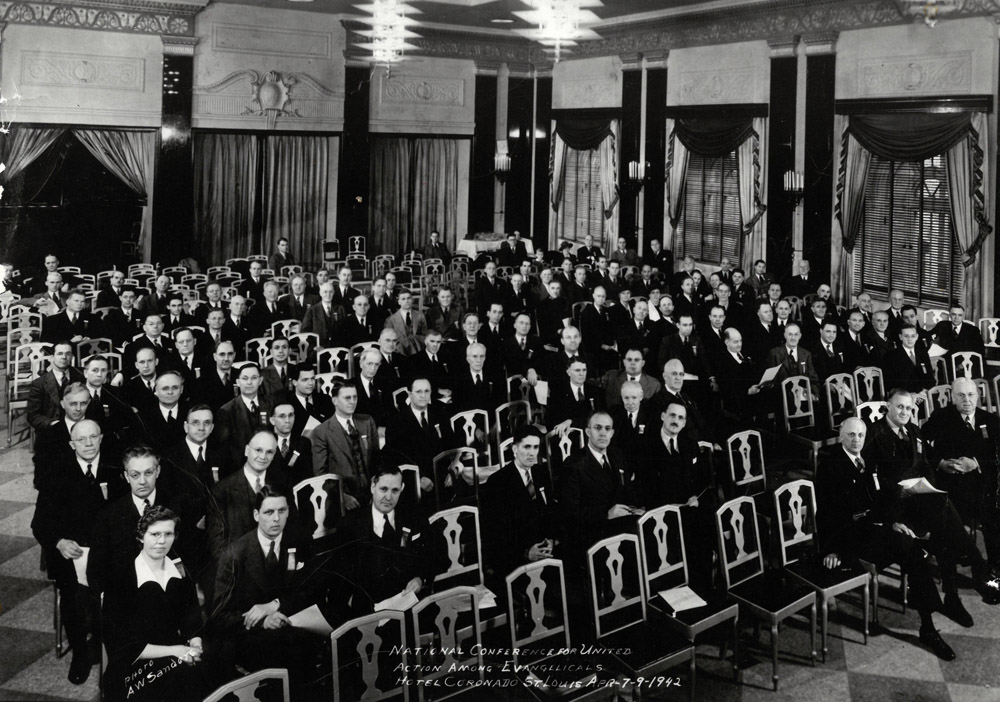
Meeting on April 7th 1942, the group of 147 evangelical pastors, leaders, and educators gathered together in St. Louis to consider the question: Who should speak for evangelical Protestantism in America?

St. Louis Conference, 1942. (SC113, Folder 10-6)
Continue reading

Out of War, An Open Door for the Gospel: Commemorating 75 Years of SEND International

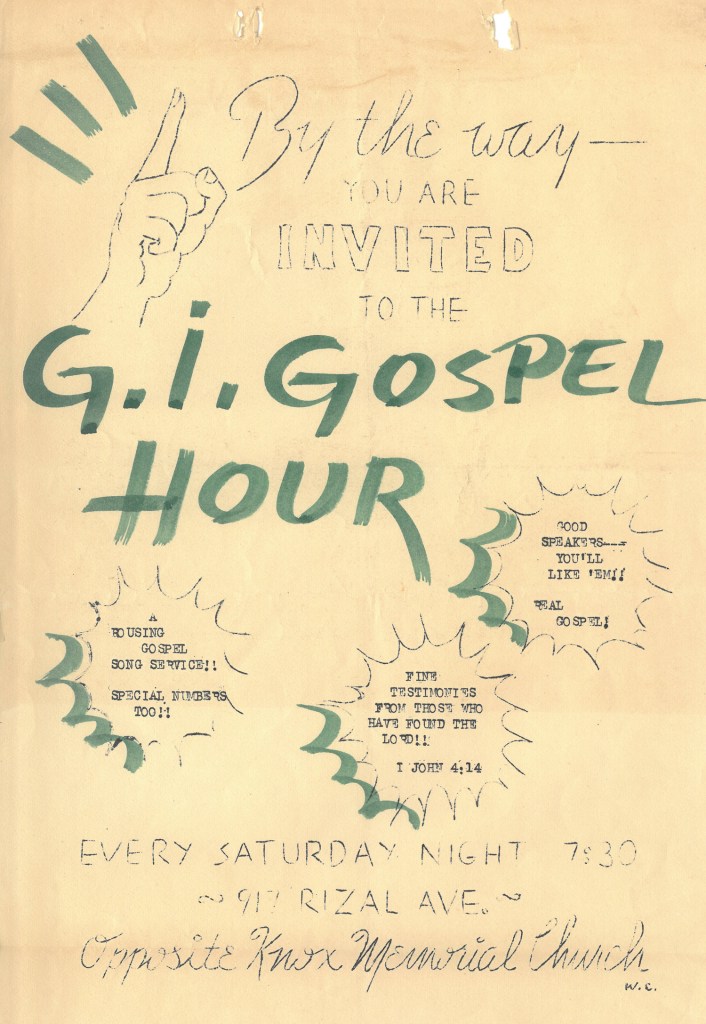
Advertisement for GI Gospel Hour in Manila, Philippines, 1945. (CN 406 Folder 2-18)

World War II not only commanded the world’s attention and shaped international politics but also proved to be a decisive moment for North American missions’ history. Young American men and women military personnel traveled the world, saw the war’s devastation, and came face-to-face with the spiritual needs of the local populations. Their war experiences shaped the college educations they returned to the U.S. to complete and the futures they later stepped into.

But the context they returned to was also evolving. American Evangelicals were emerging from their isolation following the Fundamentalist-Modernist controversy of the 1920s to take a more active role in church, politics, entertainment, education, and business. The National Association of Evangelicals was formed, the roots of Billy Graham’s ministry were already taking hold, Inter-Varsity Christian Fellowship, Navigators, and Campus Crusade for Christ were established on college and university campuses, and Youth for Christ was on the move among American high school students. Out of this convergence of factors grew new mission agencies, including the Far Eastern Gospel Crusade (FEGC), now known as SEND International.

Continue reading

Finding “A Clear Voice”: 65 Years of Christianity Today

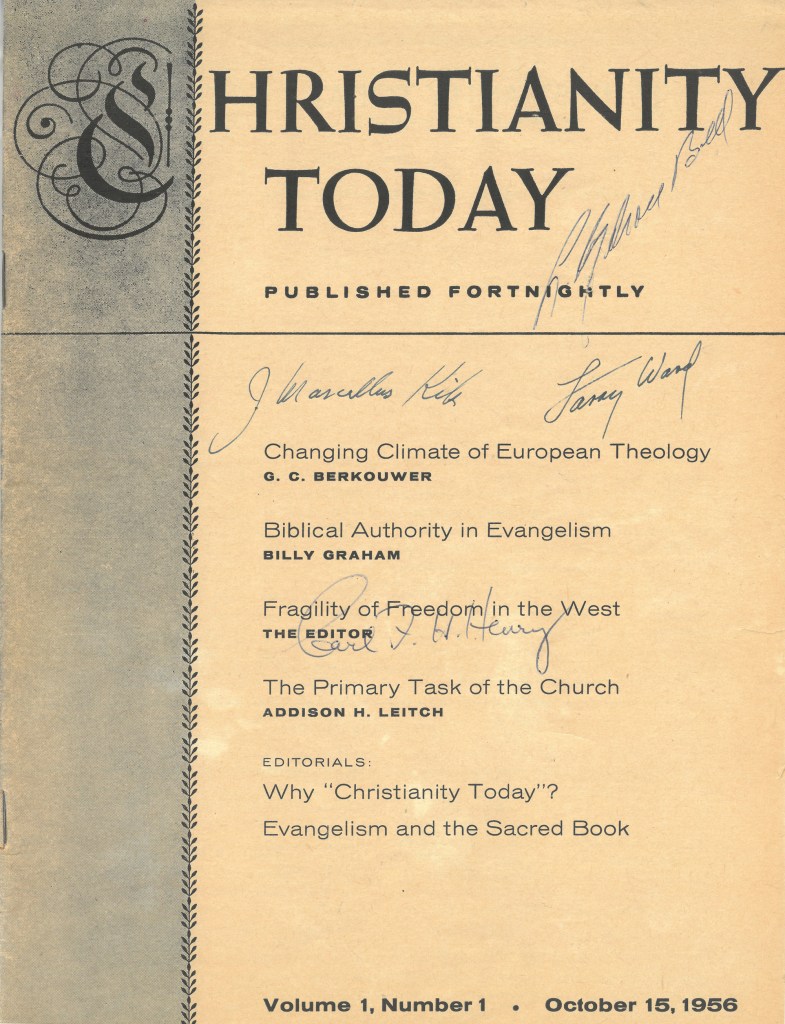
On October 15, 1956, 65 years ago today, Christianity Today published their first issue. Explaining the place of the new magazine in an editorial titled “Why Christianity Today?”, the editors stated, “evangelical Christianity needs a clear voice, to speak with conviction, and love, and to state its true position and its relevance to the world crisis.” Employing that clear voice to wide effect, the first printing was sent to more than 250,000 pastors, seminary students, and evangelical Christian leaders across the world.

An autographed copy of the first issue, as well as correspondence, board meeting minutes, financial reports, memos, photographs, audio tapes, and other material mostly relating to the founding of the magazine and a wide range of religious, social, and political issues can be found in Collection 8: Records of Christianity Today, held here at the Wheaton College Billy Graham Center Archives.  

A copy of the first issue autographed by four of the magazine’s original five editors (CN8, Folder 14-1).
Continue reading