Wheaton Archives & Special Collections holds hundreds of sermon manuscripts from evangelists and pastors like Jonathan Blanchard, William Biederwolf, Billy Sunday, Jonathan Goforth, Oswald Chambers, Aimee Semple McPherson, Torrey M. Johnson, Kathryn Kuhlman, V. Raymond Edman, Louis H. Evans, and Luis Palau.

Ranging from brief outlines and research notes to full sermon transcripts and covering a wide variety of Biblical and pastoral topics, these manuscripts showcase evangelists’ great diversity in style and approach to sharing the gospel. This December, in celebration of the Christmas season, Wheaton Archives & Special Collections features three Advent sermons from one of the most unique and charismatic communicators in our collections – Aimee Semple McPherson.
Aimee Semple McPherson (1890–1944) was a pioneering evangelist and founder of the International Church of the Foursquare Gospel. Converted at a Pentecostal tent revival in 1908, she began her ministry career as a missionary alongside her first husband, Robert Semple, before his untimely death in China. She returned to the U.S. and after a troubled second marriage, she launched an itinerant revival ministry, ultimately founding the Angelus Temple in Los Angeles in 1923. Known for her dramatic and musical preaching, she brought thousands into the Angelus Temple for multiple services every week, made several transcontinental speaking tours, and became the first woman to preach a sermon over the radio.

Services at Angelus Temple often included theatrical set pieces, where art, music, and drama brought the audience into a multi-sensory experience with the stories of Scripture. The hymn writer and evangelist Merrill Dunlop describes his experience of one such sermon at Angelus Temple in a 1979 oral history interview with the Archives:
She [Aimee Semple McPherson] always came down from the second balcony with a big bouquet of roses and spotlights on her and all that. She came down the steps all the way to the platform and it was quite something. She liked those things. She was a…very feminine in her manners, in…. Quite a beautiful woman. And she had a magnificent voice for preaching. One Sunday morning service, when she had a Communion service, I never will (neither will my wife) ever forget that magnificent service…. She had a large bunch of grapes made. I say grapes, they looked like grapes from where we sat. But actually it was a big bunch of California plums she had put together by some of her students in the art department. And she had it fixed up like a…like a big bouquet…bunch of grapes. And she had a number of points in her message when she was talking about the sacrifice of Christ and what Christ did in this aspect and what he did in that aspect. And as she made each point, she reached and up took one of those grapes, so-called grapes, out of that…and squeezed it into a container which was a little silver bucket-like thing with a spigot on it. And she squeezed that juice in that. And then she’d take her next point. And she then finally reached up and emphasized that point by squeezing another one into that bucket. And when it was all done and the message was complete, she was ready to serve the communion to the congregation. She took the first cup and opened that spigot and filled it up and said, “This is the cup….” I mean it was such a tremendous service. Her prayer and that whole service is something we will never forget.
Collection 50: Oral History Interview with Merill Dunlop, Tape T2.
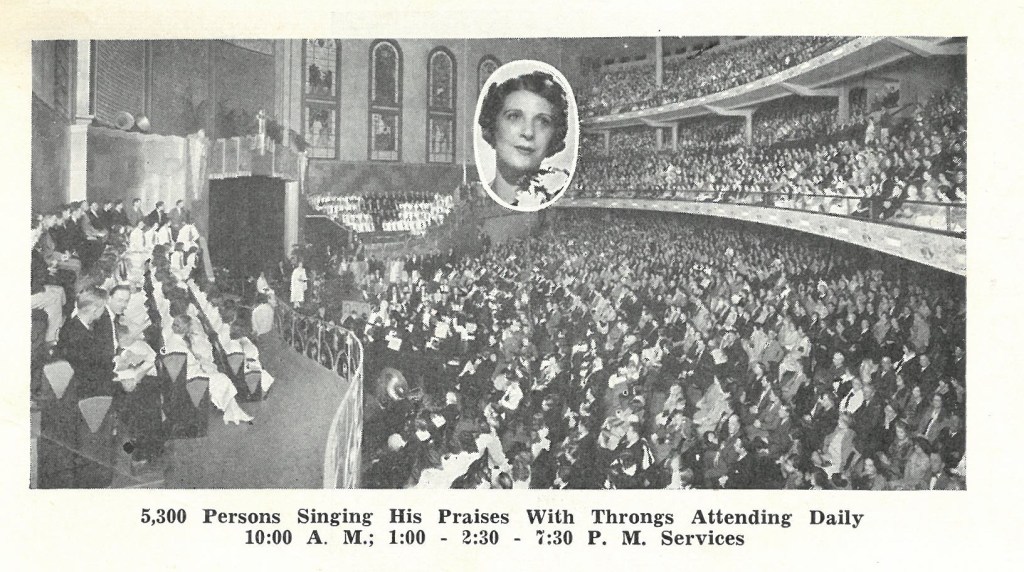
Ranging from simple scenes to elaborate costumed dramas, Aimee Semple McPherson’s “illustrated sermons” drew huge crowds and, along with her sometimes sensational personal life, made her a popular figure with the news media and American public.
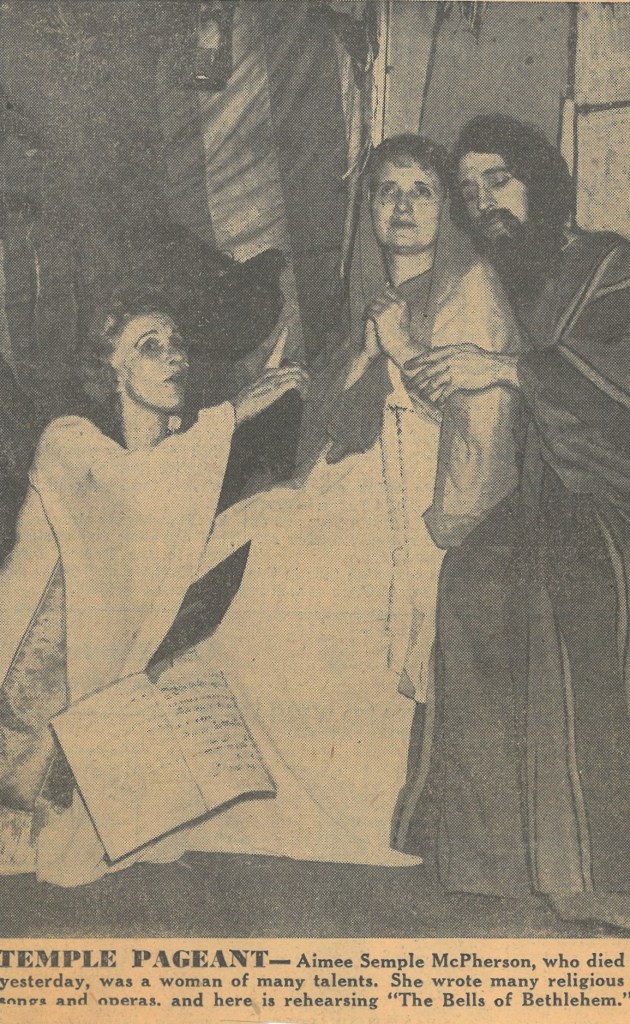
Her captivating synthesis of entertainment and religion reached its zenith in her “sacred operas,” which combined Hollywood-like productions with her direct and simple foursquare gospel message of “Christ as Savior, Healer, Baptizer, Coming King.”
The wonder and spectacle of the Nativity story – helpless infant and incarnate God, princely gifts and kingly rage, angelic choruses and abandoned stable, transcendent miracle and bed of straw – also provided fertile ground for Aimee Semple McPherson’s sacred theater. As she wrote in the introduction to her mid-1930s Christmas Opera Regem Adorate: The Oratorio Glorious, “But at Christmas-tide, even the humblest dweller in the valley may be pardoned for catching the contagion of those early angel carols and donning the gossamer wings of song” (CN 103, Folder 1-5).
Along with her musical efforts, her sermons during Advent skillfully wove together the sublime and the mundane of Christ’s birth, reminding her listeners of the hope and mystery at the heart of the season. Explore below three of McPherson’s Christmas sermons from CN 103: Aimee Semple McPherson Collection:
“Peace Convention,” December 18, 1938:
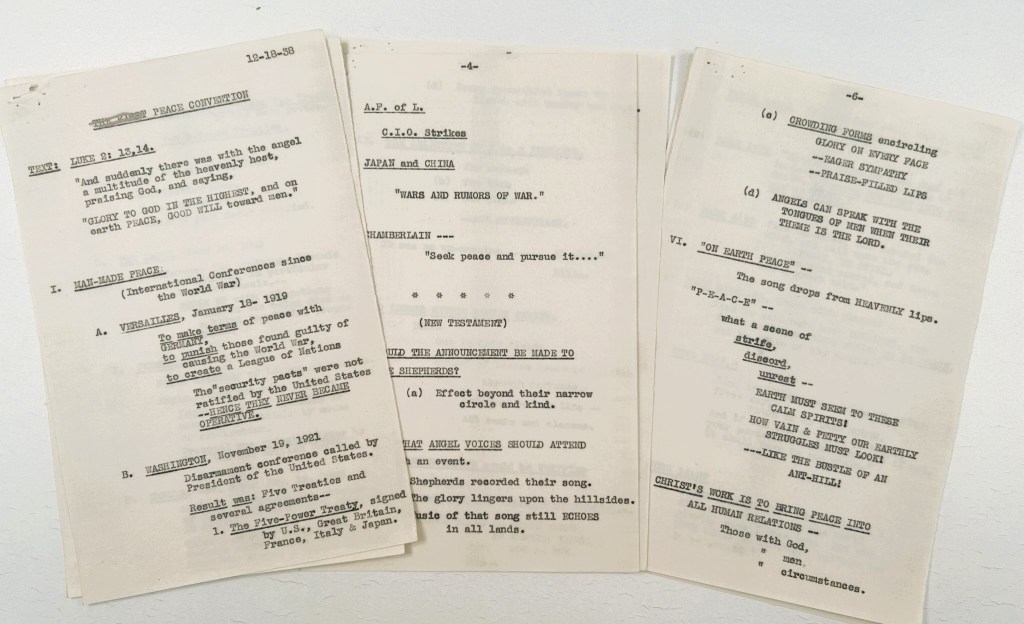
Building her ministry through the social and political earthquakes of Prohibition, the Great Depression, and the onset of World War II, Aimee Semple McPherson did not shy away from religious engagement with the secular world. During the heavily publicized Scopes Trial, she spoke out against the teaching of evolution in schools, and fought for similar anti-evolution legislation in California. After the economy crashed in 1929, she led efforts to feed and house thousands in metro Los Angeles. Following the U.S. entry into World War II, she also became one of the leading war bond sellers in the whole of California. In this 1938 sermon, Aimee Semple McPherson confronts the growing conflict in Europe in light of the Christmas message of peace. (Collection 103, Folder 25-3). Read full sermon outline here.
“Bethlehem or Blitzkrieg,” December 17, 1939:

Reflecting on the sudden and overwhelming Nazi advance of the fall of 1939, Aimee Semple McPherson returns to the miracle of Bethlehem, ending with the vivid imagery of “Shining Seriphens [sic] spilling silvery song across the star-strewn Asyrian sky and sweeping plains of Bethlehem with the flames of silvery light…Earth Dark…Sun low…No stars.” This sermon also places the contemporary trials of Communism and Nazism in the context of McPherson’s premillennial apocalyptic worldview, shared by many Pentecostals of the 20th century. (Collection 103, Folder 25-6). Read full sermon outline here.
“The Night of the Manger,” December 21, 1941:

Aimee Semple McPherson walks through the story of the Nativity with her characteristic flair for the innate human drama of Joseph and Mary’s journey. Although only an outline of the service, the manuscript also shows McPherson’s common use of sensory imagery in her sermons: “Hear their steps echo and re-echo across the silent desert road and rocky cliffs…first, like a mystic WHISPER — then, like STACCATO DRUM BEATS!!” (Collection 103, Folder 25-9). Read full sermon outline here.
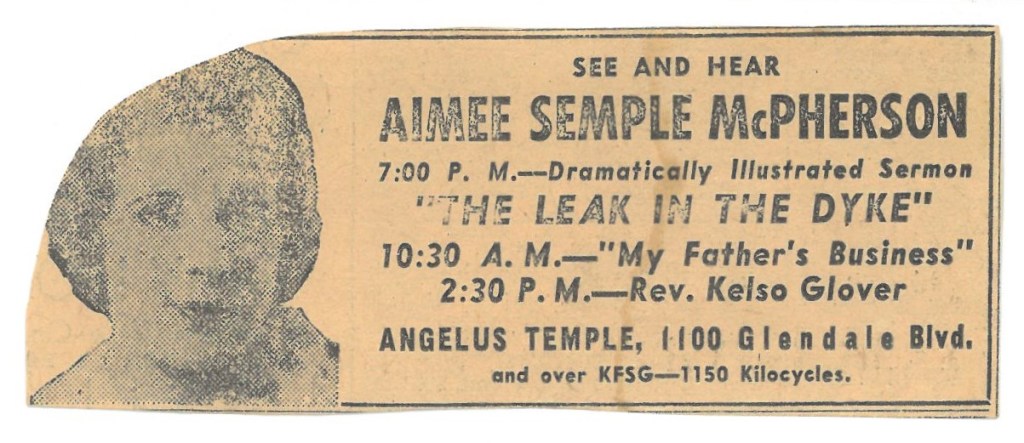
For more information on Aimee Semple McPherson’s sermons, correspondence, and clippings held in Wheaton Archives & Special Collections, browse the finding aid for Collection 103: Papers of Aimee Semple McPherson. Most of the collection consists of microfilmed copies of original documents held by The Foursquare Church. Additional materials on Angelus Temple and Aimee Semple McPherson can also be found in the Archives of Fuller Theological Seminary and the Flower Pentecostal Heritage Center.
 From the Vault