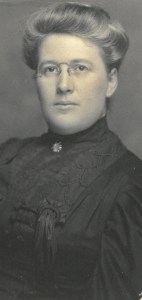
Scattered throughout the Evangelism & Missions Archives are paper fragments that tell the story of a remarkable woman – Virginia Healey Asher.
Virginia Healey was born to Irish parents in Chicago in 1869. Although her family was Catholic, she attended the church that had grown out of Dwight L. Moody’s Sunday School class and there gave her life to Christ during an evangelistic meeting when she was eleven. Her future husband, William Asher, was saved at the same meeting. When a few years later D. L. Moody called for workers, she volunteered. He assigned her to outdoor street meetings in Chicago where she sang and witnessed. She planned to go to Moody’s school in Northfield, Massachusetts when William, who had also volunteered for evangelism ministry, proposed. She was a teenage bride when they married on December 14, 1887.
The couple found many outlets for their calling to share God’s love. They ministered at open air meetings near the Chicago Ferris Wheel and served on the staff of the Jefferson Park Church, where they got to know fellow congregation member Billy Sunday. Then they moved to Duluth, Minnesota to work with some of the most marginalized groups in the city – lumberjacks, residents of Skid Row, prostitutes, and brothel owners. This woman from a sheltered background visited regularly with the “scarlet women,” praying, reading to them when they were sick, and writing letters to their parents for them. Part of the fervent temperance movement of the early 20th century, the Ashers also held meetings in saloons, with William preaching and Virginia singing.
During their ministry, the couple met traveling evangelist J. Wilbur Chapman. In 1904 Chapman invited them to join his team, which included Billy Sunday as the advance man. For the next seven years, the Ashers traveled around the world with Chapman holding large evangelistic meetings. With her gifted voice, Virginia became well known as a hymn soloist. However, even amidst the busyness and pressures of the evangelistic campaigns, the Ashers continued to visit prisons and the impoverished of every community.
Although a formidable looking woman with a large presence, the greatest impression Virginia left on those she encountered was her loving and kindly nature. Historian Margaret Bendroth uncovered a newspaper reporter’s description of Virginia during Chapman’s 1909 Boston meetings: “Almost every day she could be found in some corridor or corner…talking or praying with a sobbing girl or boy, man or woman…. If a man approaches her in a spirit of bravado or thinking to have some fun out of it, he soon finds that he has met a real woman, absolutely sincere, entirely convinced of the truth of her message and of the need for her hearer to receive and accept the Christ she follows. She is not to be turned away by any sophistries or argument but keeps right at her hearer until he drops his eyes, usually tear filled, and then she has him” [quoted in Bendroth’s article in the Journal of Presbyterian History, Winter 1997 “Men, Masculinity, and Urban Revivalism: J. Wilbur Chapman’s Boston Crusade, 1909”].
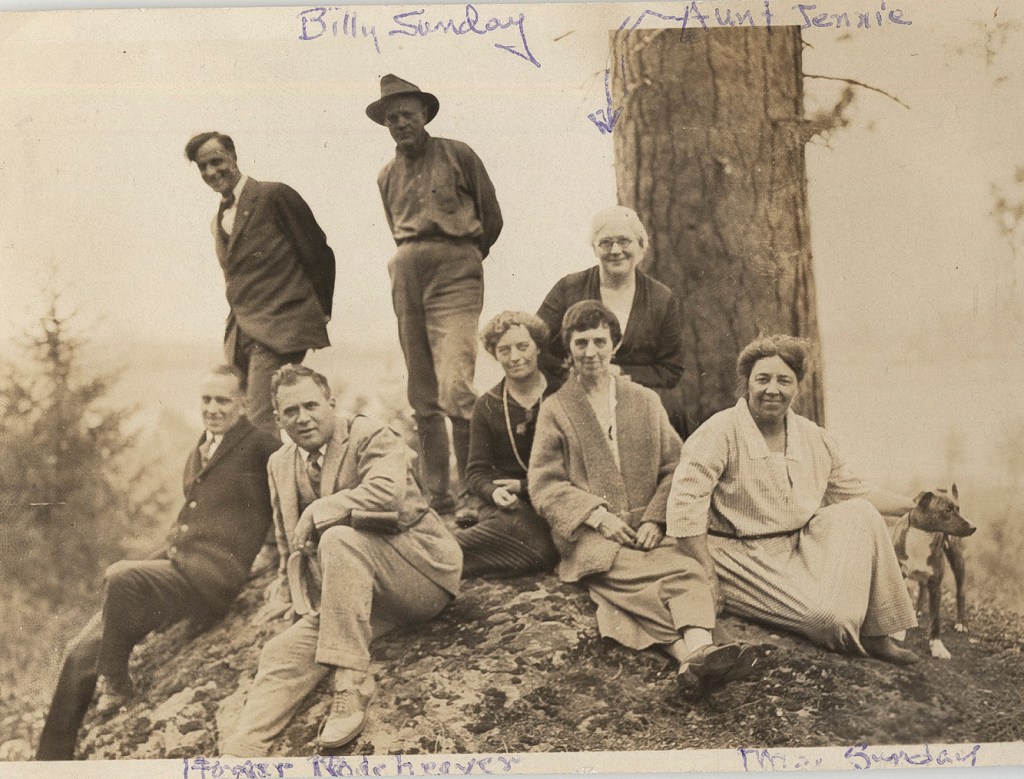
When Billy Sunday left Chapman’s team and began to hold his own meetings in the Midwest, the Ashers joined him in 1911. William worked as an advance man and Virginia was a soloist and sang duets with Homer Rodeheaver, Sunday’s song leader and master of ceremonies. They both also served as counselors for the campaign. Beginning in small Iowa towns, the Sunday campaigns soon moved to larger cities and finally to New York, Los Angeles, Boston, and Chicago. By the mid-1910s, a Sunday campaign’s arrival in a city was a major news topic for months.
Along with her work for the campaigns, Virginia began a ministry of her own. She was particularly interested in what she called the “business women” of each city. Women, usually single or widowed, who supported themselves as nurses, secretaries, or through some other trade. Recognizing the difficulty these women faced in finding the time or resources to attend the Sunday revival meetings, Virginia organized and led meetings in stores, offices, banks, factories, and laundries during each city’s campaign. A newspaper article during the 1917 Atlanta, Georgia campaign reported on her meeting in that city, “It was in every way an unusual meeting. There was not a man in sight, except the janitor, who came in occasionally to see that the windows were properly regulated. There were women ushers and women passed the plates for the offering.” When Virginia concluded her talk with a challenge, “Are you willing to lay your all on the altar of God?” 500 women came forward. “Mrs. Asher stood on a chair below the platform and shook the hand of every woman who came forward and she had a special word for the woman with the baby in her arms and for the gray-haired ladies who came slowly up the aisle.”
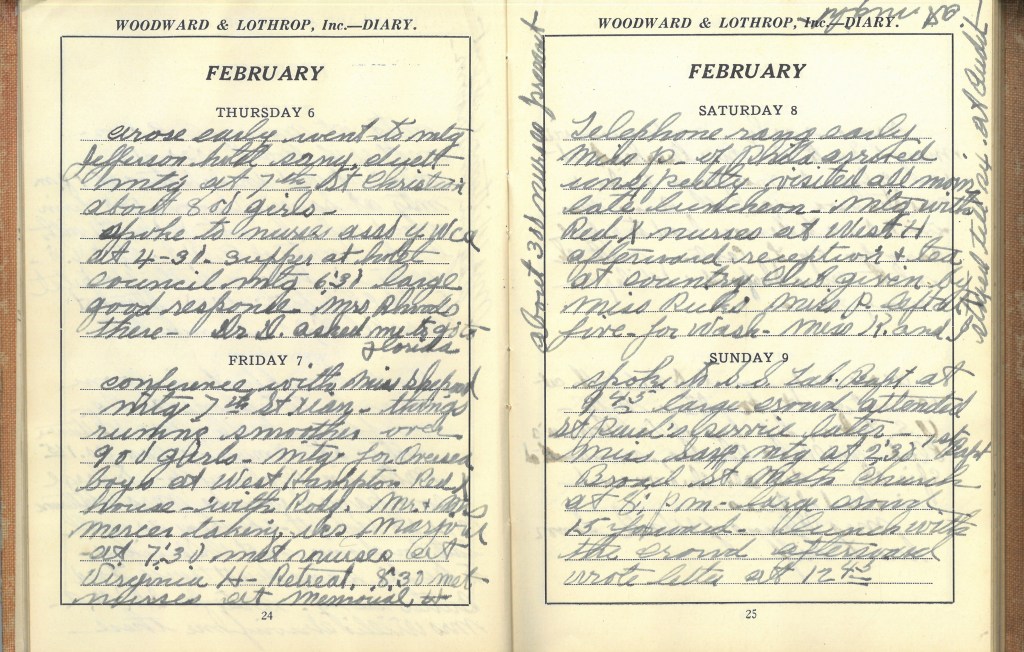
Virginia’s strong presence, her call for commitment, and the fellowship she brought into being made a deep impression on all her listeners, so much so that the women involved wanted to keep the fellowship going. In city after city, they formed Virginia Asher Business Women Councils that continued long after the Sunday campaign left town. The working women who made up the group would meet regularly to study the Bible, support each other, and do evangelistic and charitable work in their communities, as well as support foreign missions.
One report from the leader of the group formed after the 1914 campaign in Boston notified Virginia, “Several of the nurses have sent letters to me to forward to you. A great many nurses have expressed their appreciation to me in various ways for your thoughtfulness and kindness in making it possible for them to attend the Sunday meetings. Five of the Park Ave nurses have joined the church and many of them are attending the prayer meeting. Last Sunday night one of the gospel teams had charge of the evening service at Plymouth church…. A number of teams have been formed and there has been a demand for them for Sunday evening services…. I am sending you a clipping so you may know that the prayer meeting are [sic] continuing.” [Perrin letter, 197-1-3]
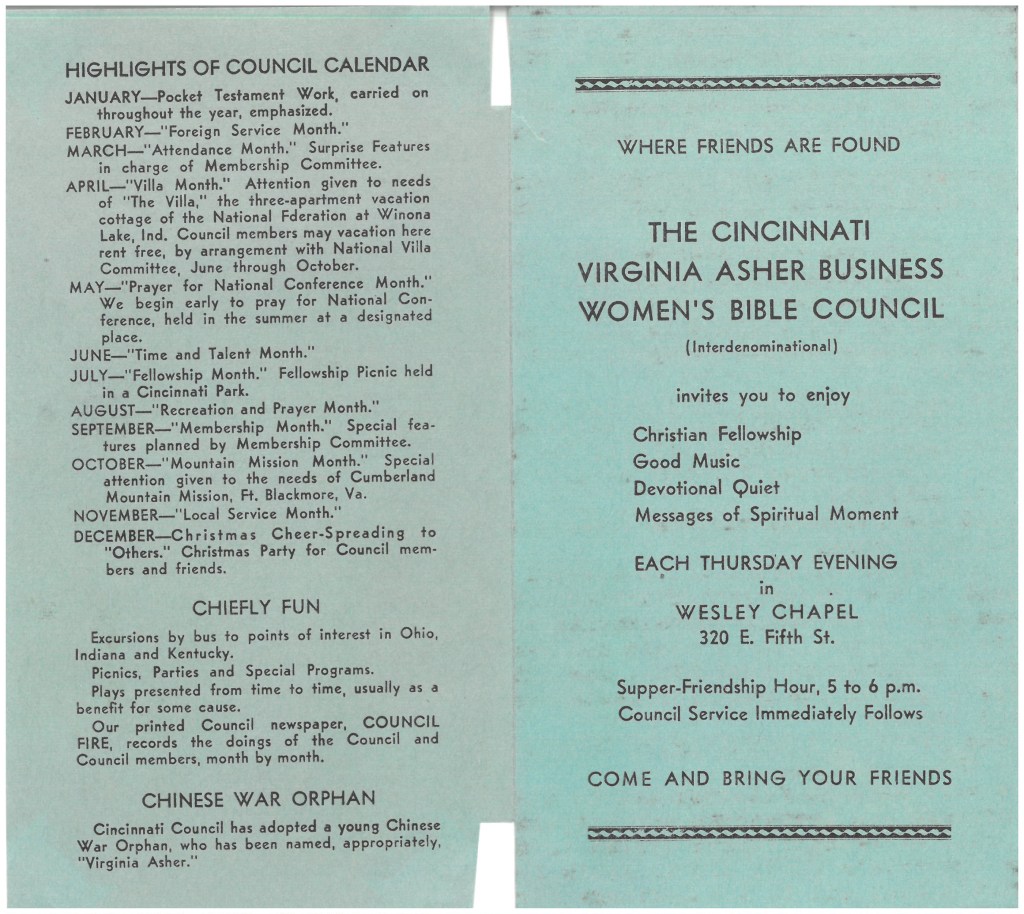
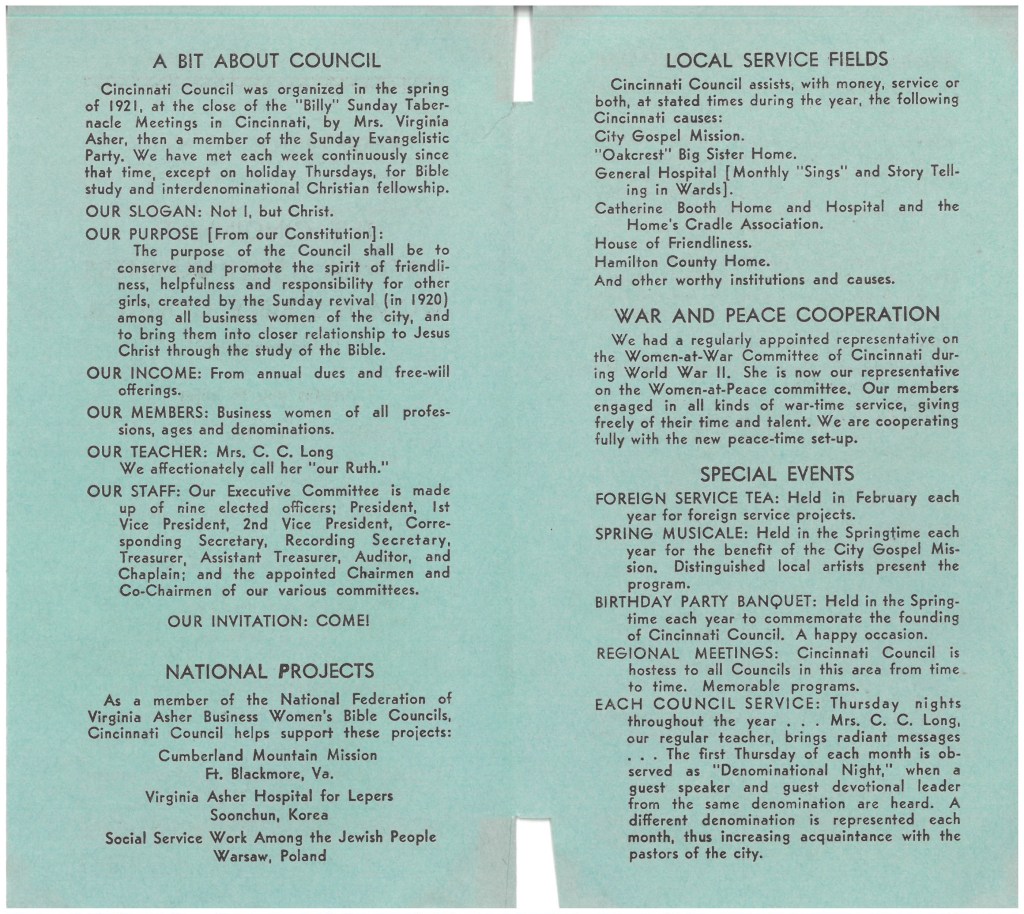
The dozens of clubs across the USA formed the National Virginia Asher Business Women’s Bible Councils in 1922 at a meeting in Winona Lake, Indiana. (The name was later changed to the National Federation of Virginia Asher Bible Councils). Virginia became the chaplain and honorary president of the group. She passed away in 1937, but the clubs and the national organization continued into the 21st century, with last national meeting in 2003. The purposes of the organizations were:
- To bring together in actual helpfulness all Virginia Asher Business Women’s Councils.
- To promote friendliness, service, and practical Christianity among all self-supporting girls and women.
- To win girls and women to Jesus Christ and to bring them into closer relationship with Him through the study of the Bible.
- To inoculate loyalty and cooperation with all evangelical churches.
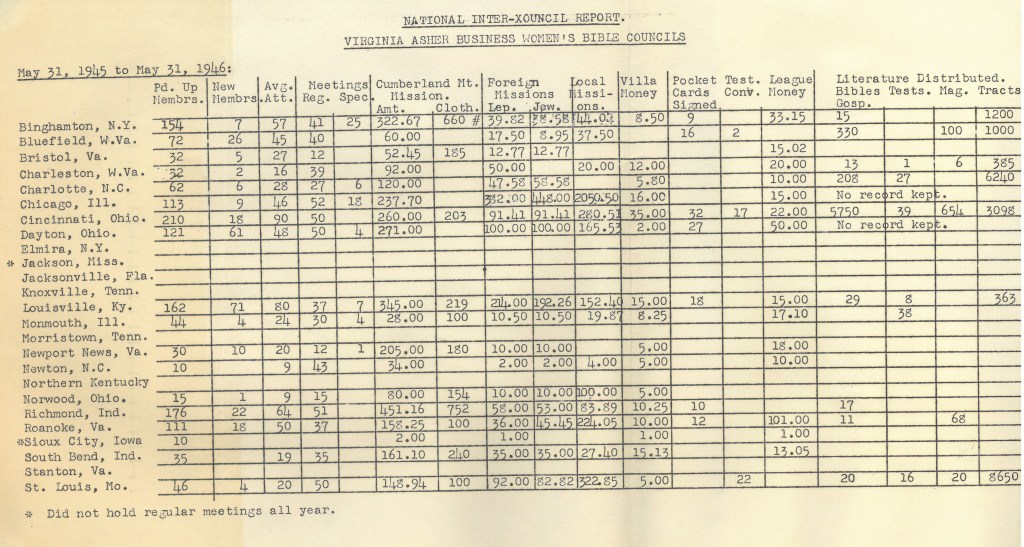
Throughout her life, she received tokens from the different Councils of the love and respect the members had for her and assurances of the impact she had on so many lives. After her death, many poems, heartfelt if not always literary, remembered her. One such was by Helen Hamill of the Cincinnati Council:
She sang a song of Jesus’ loving kindness-
A girl weary of crowded ways took heart
And at her desk back in the noisy office
Worked in an oasis of peace apart.
She spoke a word of gentle understanding.-
A girl torn between two courses paused.
And choosing the high oath of duty prayed, “Lord,
Forgive for the pain I might have caused.”
She lived a life of sweetness and valor-
A woman tired of sophistries took note.
And meeting Jesus in the streets of service
Exchanged her ermine for a queenlier coat.
She leaves us singing in the Master’s chorus,
She leaves us serving in the Master’s might.
Because she lived and spoke and sang and loved us,
In every light she touched, there is light.
The words she wrote in her niece Edna’s autograph book, quoting from novelist Sarah W. Stephen, perhaps apply best to her, “The soul within had so often lighted up her countenance with its own full happiness and joy that something of a permanent radiance remained upon it.”
The Evangelism and Missions Archives has a small collection of materials by and about Virginia in Collection 197: Papers of Virginia Healey Asher and scrapbooks and other materials about the Virginia Asher Business Women’s Bible Councils in Accession 2009-062. Additionally, Accession 1986-068 includes recordings of some of her duets with Homer Rodeheaver.
 From the Vault