The Shadow of a Modest Man

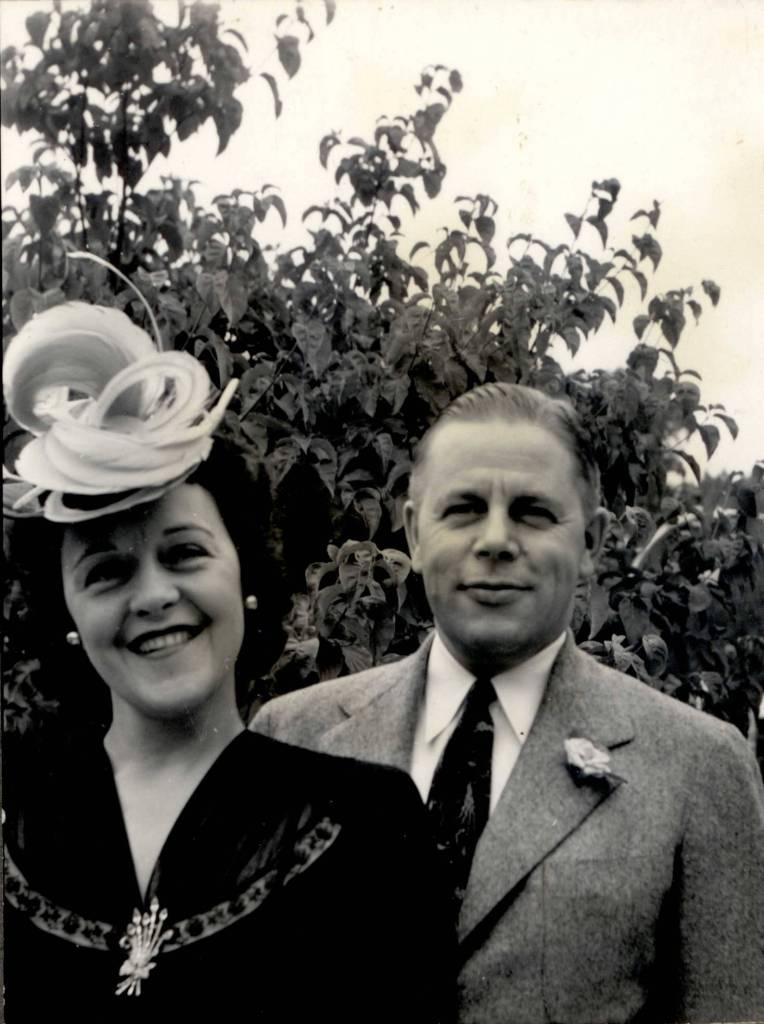
Stereo slide of Taylor and his wife Gloria, ca. 1930s. (Photo File: Taylor, Herbert J.)

One of the earliest collections opened by the Archives (in 1978) and one of the most heavily used (over 360 times at last count) is Collection 20, the papers of Chicago businessman and philanthropist Herbert John Taylor (1893-1978).

Taylor’s life was in many ways a typical American success story. He started out as a salesman in Oklahoma. After service with the YMCA in France, assisting servicemen during World War I and then a shore post in the Navy, he moved to Chicago and eventually became president of Club Aluminum Products, a near bankrupt company he rescued and made into a multi-million dollar enterprise.

Continue reading

Leafing through the Pages of China Inter-Varsity Christian Fellowship

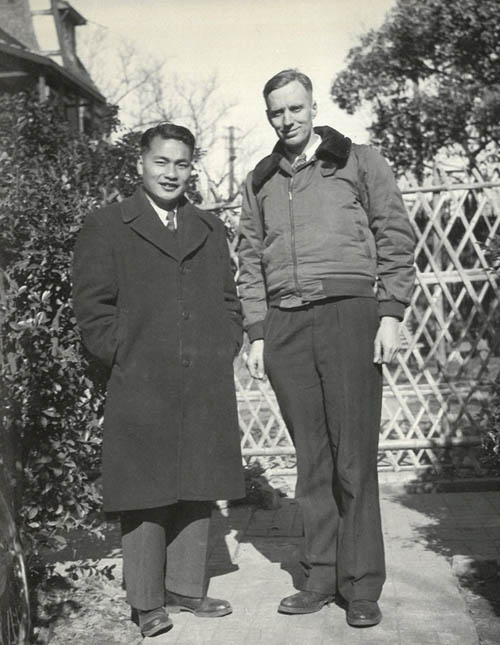
Mr. Chang & David Adeney, Shanghai, 1950. (Photo File: OMF-China II)

An archivist never knows what they will find as they begin opening boxes and folders in donated materials to arrange and describe a collection. And they don’t know what threads might appear that lead to other collections or lines of inquiry, or what gaps the new material might fill. For all they can’t anticipate, archivists can expect that there will be materials that will uncover or add to areas of interest for researchers. Sometimes new materials become their own puzzle to figure out — like who is the unidentified Western female in several of the photographs below? — while other times they provide the missing piece to a partially completed puzzle. A recent example of this is the photo album that Ruth Adeney donated to the Archives in 1997 along with the rest of the papers of her husband, David Adeney (CN 393), soon to be opened for researcher use.

Continue reading

“World Evangelism: Why? How? Who?” A Backward Look at Urbana ’70

A publicity poster for the 1970 Urbana Student Missionary Convention. CN 300, Box 344, Folder 12.

This December, the Wheaton College Billy Graham Center Archives highlights the ninth triennial InterVarsity Christian Fellowship (IVCF) Student Missionary Convention held 50 years ago this month. The traditional climax of IVCF’s ministry year, the five-day conference exists to mobilize college students for Christian evangelism, on university campuses across the globe. Since its first iteration in 1946, dubbed the “International Student Convention for Missionary Advance” held in Toronto, Canada, thousands of students from North America and around the world have dedicated themselves to the work of Christian evangelism and discipleship after hearing the likes of Billy Graham, John Stott, Stacey Woods, David Howard, Samuel Escobar, Elisabeth Elliot, and Francis Schaeffer describe the challenge and call of world evangelization. Today, significant numbers of men and women in full-time Christian service can trace their vocational inspiration back to an “Urbana” convention.

Continue reading

Introducing the Records of International Fellowship of Evangelical Students (IFES)

The summer months are a favorite season at the Wheaton College Billy Graham Center Archives, a noticeable shift from the marathon of the academic year to the sprint of summer research visits. This year, the manuscripts reading room is eerily dark and quiet, while dissertations, articles, monographs, documentaries, and other research projects wait on pause during the COVID-19 pandemic.

Processed Box

Providing access to collections, however, is only one of many archival tasks. Long before researchers can scroll through finding aids, dig through boxes, or submit duplication requests, collections must be processed—a meticulous procedure of arranging, describing, and preserving historical documents. Depending on staff resources and the size and physical condition of the materials, some processing jobs can require years of effort.

This silent summer in the manuscripts reading room provided one unanticipated benefit for archivists—uninterrupted time for processing—and allowed us to put the final processing touches on a significant new collection.

This August, the Wheaton College Billy Graham Center Archives is pleased to announce the opening of Collection 640: Records of the International Fellowship of Evangelical Students (IFES) for research.

Continue reading

Still “Geared to the Times, Anchored to the Rock”: Celebrating 75 Years of Youth for Christ

“‘What are you doing? Can’t we do it here? How do you get started?” And we did everything we possibly could to help everybody we possibly could. And they came here, and we sent people out there, and we were busy” (CN 285, Tape 3).

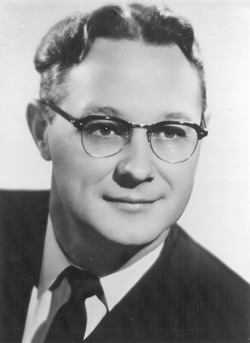
Johnson headshot
Torrey Johnson, founding member and first president of Youth for Christ.

“Busy” is how Torrey Maynard Johnson describes the explosion of interest in youth evangelism stemming from the runaway success of Youth for Christ evangelistic rallies in Chicago in 1944. In a 1984 oral history interview with Archives staff, Johnson recalls the rapid emergence of Youth for Christ during World War II, a movement that innovated evangelism practices—specifically targeting young people—launched the career of a young Billy Graham, and became an international phenomenon still ministering to young adults today.

This November, the Wheaton College Billy Graham Center Archives celebrates seventy-five years of Youth for Christ, and explores the origins and early rallies of Youth for Christ in Chicago prior to its formal establishment in November 1944.

Continue reading

Campus Ministry and Bird Watching: John Stott’s 1962 Africa Tour

In the spring of 1962, John Stott (1921-2011) returned to the African continent for a second series of campus missions at colleges and universities at the invitation of the Pan-African Fellowship of Evangelical Students (PAFES) that was made up of English-speaking movements of the International Fellowship of Evangelical Students (IFES).

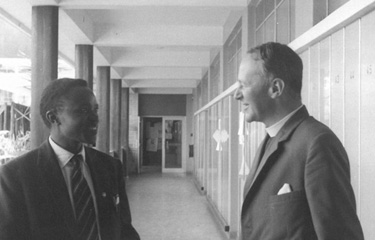
NAIROBI, KENYA. Stott with the GCU President at Nairobi.

This model of campus missions was repeated again and again in the 1960s when Stott also traveled to North America, Asia, Australia and New Zealand, and across Europe. Subsequent decades through the 1990s were marked by more travel and ministry. Known across the span of his life as an Anglican minister, Evangelical theologian, evangelist, and author, John Stott is described by his biographer, Timothy Dudley-Smith in the second volume of his two-part work, John Stott: A Global Ministry. “The start of the 1960s found John Stott an international figure in the field of student evangelism” (p. 105). During his Africa sojourn, Stott’s visits stretched from Sierra Leone to Ghana, Nigeria, Kenya, Uganda, and down to Rhodesia. Dudley-Smith captured glimpses of these stops (pp. 106-110). Stott’s first trip to the African continent in 1959 focused primarily on meetings in various cities of South Africa, but also added ministry and bird watching stops in Ruanda-Urundi, Uganda, and Kenya.)

Continue reading