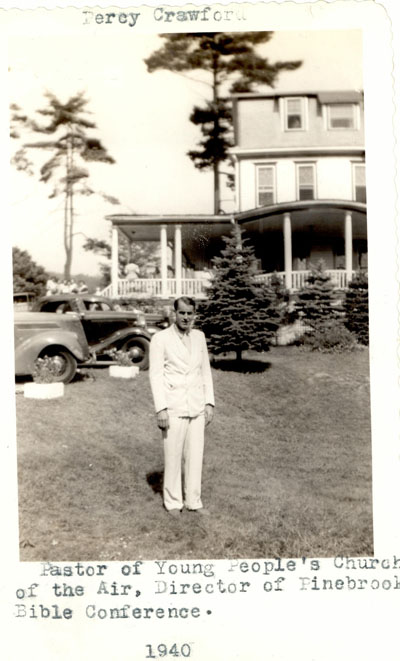
Known to friends as “The Pioneer,” Percy Crawford (1902-1960) was an American evangelist and entrepreneur, who founded, among other things, the Pinebrook Bible Conference, Pinebrook Christian camps for boys and girls, a radio ministry, King’s College, a mission, and a chain of Christian radio and televisions stations. He also produced the first nationwide evangelism television program. These were in addition to the evangelistic tours and “Youtharama” rallies he led across the United States. His restless energy, vision, and strong personality made a deep impression on those who knew or worked with him.
When Crawford committed his life to ministry at Los Angeles’ Church of the Open Door in 1923, radio was just beginning to emerge as a powerful national platform for entertainment, news, politics, and religion. Inspired by Christian radio pioneers like Paul Rader in Chicago and Walter Maier in St. Louis, Crawford began broadcasting in 1931 with The Young People’s Church of the Air. During the summer months, these broadcasts often came from Pinebrook in Pennsylvania’s Pocono Mountains.
Continue reading
 From the Vault