Memorial to a Friendship

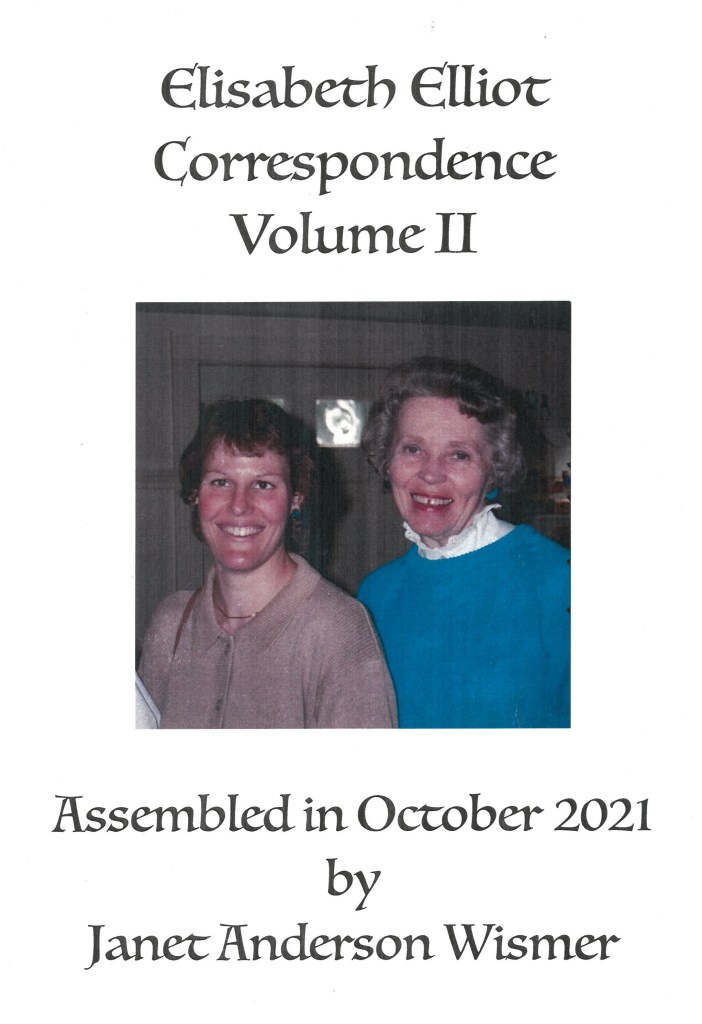
Front piece of the notebook, showing Wismer on the left and Elliot on the right.

One of the most interesting recent additions to Wheaton Archives & Special Collections arrived in 2021 when Janet Wismer gave the Archives a notebook that consisted of a quarter-century of letters, cards, photos, and a variety of ephemera. All were artifacts of her abiding friendship with missionary, author, and teacher Elisabeth Elliot.

Elliot had been a Plymouth Brethren missionary to Ecuador when her husband Jim and four other missionaries were killed by warriors of the Waorani people, a tribe they had hoped to tell about Jesus. Elisabeth wrote an enormously popular book about this, Through Gates of Splendor. Then she and Rachel Saint, sister of another one of the men who was killed, went to live among the Waorani at the tribal people’s invitation. The two began the work of Bible translation and evangelism, alongside the Waorani woman Dayuma, a Christian convert. The whole story has been told most recently and completely in Dr. Kathryn Long’s book, God in the Rainforest: A Tale of Martyrdom and Redemption in Amazonian Ecuador.

Continue reading

A Global Chorus Before the Lord: Remembering Ethnomusicologist Vida Chenoweth

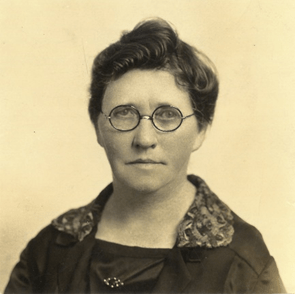
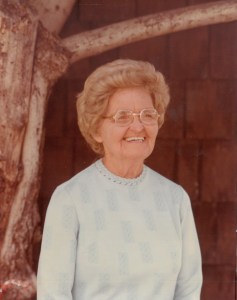
Vida Chenoweth
Portrait of Vida Chenoweth, c. 1950s. SC114, Photo-08.

This March, in honor of Women’s History Month, Wheaton Archives and Special Collections remembers Vida Chenoweth—a concert marimbist, Bible translator, and pioneering ethnomusicologist. From the glittering concert halls of Europe to the remote highlands of Papua New Guinea, Vida’s life and ministry combined a love of music with a deep commitment to the dignity of all peoples and a celebration of the unique traditions of diverse musical cultures. SC 114: Vida Chenoweth Papers showcase the breadth of her remarkable career, featuring recital and field recordings, photographs, press clippings, original research, correspondence, and diaries.

Continue reading

“Too Impractical to be a Missionary”: Remembering Missions Pioneer Joy Ridderhof

Joy Ridderhof, (Acc. 96-34, 3).

March is Women’s History Month! In celebration, the Wheaton Archives & Special Collections spotlights the stories, voices, and legacies of women who blazed trails as medical workers, linguists, preachers, evangelists, educators, CEOs, and more found in our collections. Today, we highlight missionary Joy Ridderhof (1903-1984), founder and director of Gospel Recordings, whose pioneering work in portable sound recording captured thousands of indigenous languages in remote corners of the globe. Today, these Gospel Recordings represent the preservation of oral cultures around the world and contain high research value for historians, missiologists, linguists, and anthropologists studying these cultures.

Joy Ridderhof’s story has been told in biographies like Phyllis Thompson’s Count It All Joy, and institutional histories of Gospel Recordings, like Faith by Hearing, but many of Ridderhof’s personal papers remain untouched in the archives’ holdings, and many of the documents and images featured here are located in unprocessed portions of the Gospel Recordings Records.

Continue reading

A Good Stenographer, Spirit-Filled, Can Always Be Used

In celebration of Women’s History Month, Wheaton Archives & Special Collections commemorates the many contributions from women whose unique voices and experiences are documented throughout our rich collections. This March, we highlight the life and missionary service of Hulda Stumpf, a missionary to Kenya from 1907-1930.

Hulda Jane Stumpf, ca. 1906. From Photo File: Stumpf, Hulda.

A native of Pennsylvania, Stumpf left the comforts of her middle-class, Midwestern life for the unknown challenges of missionary service as a single woman in British East Africa in 1907. During her two decades of service at the Kijabe Mission Station in Kenya, Stumpf became an outspoken advocate for the education and advancement of women and girls from the surrounding indigenous ethnic people groups. Her willingness to challenge the long-cherished cultural mores and religious rites resulted in her tragic murder at the age of 62.

Continue reading

“The Letter Kills but the Spirit Gives Life”: Julia E. Smith’s Bible Translation

From the first century onward, the form and text of the Bible has been a source of near-endless debate, review, reinvention, and artistry. Available in thousands of different translations, editions, and compilations, it is a text that is at once universal and individual.

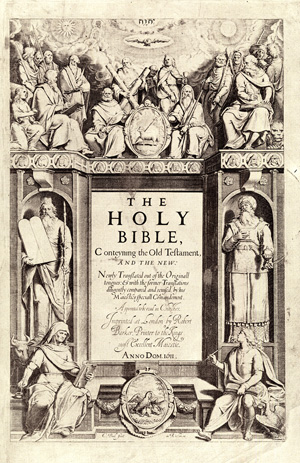
Title page for a King James translation, 1613. (SC-10)

Wheaton Archives & Special Collections holds more than five hundred whole or partial Bible monographs. Each of these instances carry forward the spirit of their common text and yet remain unique, with their own voices and particularities. Some of this variety comes from the different language translations available in the Archives (ranging from Hawaiian to Sanskrit), but remarkable diversity can also be found within the English translations alone.

The archive’s shelves include multiple printings, editions, and facsimiles of famous English translations, such as the Wycliffe Bible (1388), the Coverdale Bible (1535), and the King James version (1613), as well more modern classics, like the New International Version (1984) and the Living Bible (1971), among many others.   

Continue reading

“A Gal, A Plane & A Dream”

This March, Wheaton Archives & Special Collections celebrates Women’s History Month and commemorates the many women whose unique voices and stories are preserved in letters, diaries, recordings, and photographs scattered throughout our collections. Pieced together, these historical fragments offer a glimpse into the lives of faithful Christian women who fulfilled their unique vocations in a range of callings as missionaries, writers, doctors, preachers, educators, musicians, evangelists, and more.

Snapshot of Betty Greene (Printed in Mission Aviation, Summer 1948)

Today we remember the life and ministry of Elizabeth Greene (1920-1997), accomplished aviator and first pilot of Mission Aviation Fellowship, whose flying career spanned more than two decades and crisscrossed the globe from Peru to Sudan to Western New Guinea. Greene’s aviation adventures and single-minded focus on missionary service are documented in correspondence, articles, film footage, and photographs sprinkled throughout Collection 136: Records of Mission Aviation Fellowship.

Continue reading

Letters from Lisuland: The Ministry of Isobel Kuhn

In celebration of Women’s History Month, the Wheaton College Billy Graham Center Archives commemorates the many women whose unique voices and stories are preserved in our collections and who labored—in the public eye or in obscurity—in faithful Christian services as missionaries, writers, doctors, preachers, musicians, evangelists, and more. This March, the Archives highlights the ministry of Isobel Miller Kuhn, author and long-term missionary with her husband John to the Lisu people of southwest China and Thailand from 1928-1954 under the auspices of China Inland Mission. The Kuhns’ nearly three decade service with China Inland Mission is documented in the organization’s records, including the couple’s voluminous newsletters, a CIM-published biography of Isobel, and John’s report on missionary evacuations from China in 1951, following the Chinese Communist Revolution. Isobel Kuhn’s personal papers, including prayer letters, photographs, correspondence, and articles, are described in Collection 435: Ephemera of Isobel Miller Kuhn, and provide a glimpse into the daily struggles and joys of missionary service—the loneliness and isolation of rural evangelism and church planting, the breathtaking beauty of remote Yunnan Province, Lisu culture and customs, and her own deep Christian faith.

Continue reading

“This is My Story, This is My Song”: Celebrating Two Centuries of Fanny Crosby

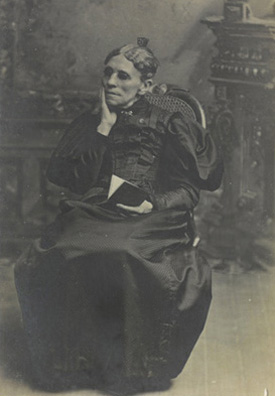
Fanny Crosby Portrait
Fanny Crosby in 1895. Accession 15-01.

When commemorating National Women’s History Month, the Wheaton College Billy Graham Center Archives could celebrate any number of extraordinary women represented in its collections: author and missionary Elisabeth Elliot, evangelist Helen “Ma” Sunday, prison preacher Rev. Consuella York, Mission Aviation Fellowship pilot Betty Greene, Holocaust-survivor and author Corrie ten Boom, faith-healer and evangelist Kathryn Kuhlman, and many others. But this March, the Archives remembers poet, hymnist, composer, social reformer, and public speaker, Fanny Crosby (1820-1915), born two hundred years ago this month.

Although she could print little more than her name, Fanny Crosby became the most prolific American hymnist of the nineteenth century, writing thousands of sacred songs, sometimes composing up to six or seven hymns a day. Her most famous works include “Blessed Assurance”, “To God be the Glory”, “Pass Me Not, O Gentle Savior”, and “Safe in the Arms of Jesus.” A household name in her lifetime, Fanny Crosby’s compositions still litter hymnals across American Protestant denominations today. Crosby’s enduring popularity is a testimony not only to the extraordinary volume of her musical corpus but also to the simplicity and power of her lyrics to convict, comfort, and inspire audiences around the globe.

In addition to photographs, song books, and memorabilia, the Archives holds nearly 2,400 original manuscripts of Crosby’s hymns and poetry, composed between 1862 and 1915. The majority of the manuscripts are numbered and dated, a helpful guide for researchers tracing Crosby’s immense literary output. The finding aid for Collection 35: Papers of Fanny Crosby provides more details about these materials.

Continue reading