Hidden In Plain Sight

The Evangelism and Missions Archives holds over seven hundred processed collections. Some correspondence in our purchased microfilm stretches back into the 1600s, but we also have documents and media from as recent as the current year. The predominant time frame for most of the evangelistic and missionary activity documented in these collections, however, is the 20th century. As the Archives’ name suggests, the topics that hold together all the collections are evangelism and missions.

But to assume that the Archives only reflects these two areas is to miss the depth and breadth that these primary sources offer. Many collections also document social movements, political events, cultural trends, and more in the countries where missionaries and evangelists happened to find themselves. It is still surprising to discover unexpected points of convergence between collections that we archivists never anticipated or noticed until a collection was arranged and described to be fully open to the public. Four examples come to mind:

Continue reading
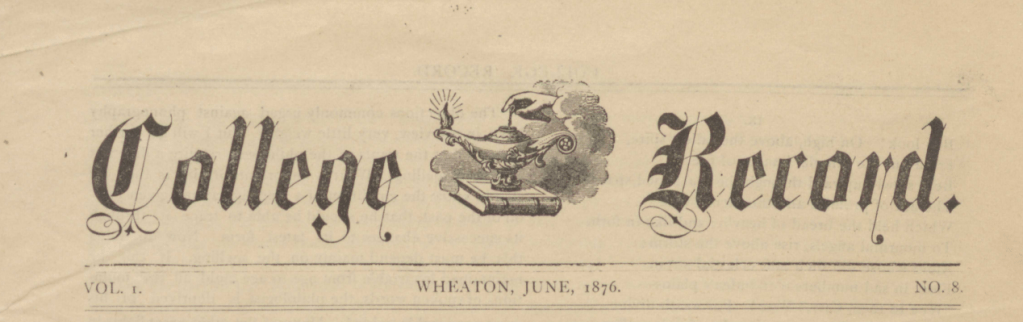
150 Years of The Wheaton Record

In November 1875, the Literary Union of Wheaton College published the first issue of the College Record, Wheaton’s student newspaper. Over the next 150 years, the Record became both a laboratory for student writing and journalism and a living chronicle of campus life. Its pages have documented student activities, campus developments, educational changes, social movements and conflicts, political campaigns, visiting speakers, chapels and mission work, theological debates, faculty projects, and countless other moments that trace the evolving history of Wheaton College.

Wheaton Archives & Special Collections holds only scattered records for the first twenty years of the paper’s publication. Among these, the earliest surviving issue of the Record dates from June 1876. Although the inaugural issue of the Record is lost to history, the June 1876 editorial provides a helpful update on the paper’s first eight months, including plans for an enlargement of the paper from eight to sixteen pages. To fill this new space, the editors appealed directly to the student body, urging Wheaton students to contribute writing:

Students write for your paper. Don’t say you haven’t time to write because you are so pressed with your studies, but take a few moments each day to write and you will soon find you are the gainer by it. Of what value will your education be to you unless you learn to apply what you learn? It may, indeed, be some satisfaction to you to know that you have a college education, but certainly it will be of very little benefit to others if you know not how to use it. And in our opinion, there is no better way of putting to practical use the knowledge we have gained than by writing.

Let us, then, improve the opportunities given to us, and thus be enabled to benefit ourselves and our fellows. A college paper furnishes one of the means of improvement, and it is to be hoped that the students in future will improve the advantages thus offered to them more than they have in the past.

Continue reading