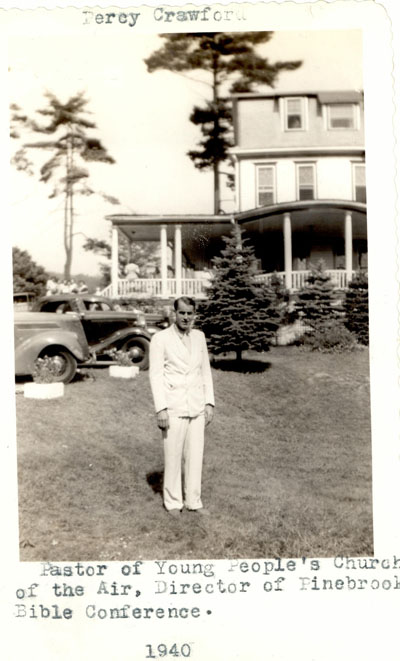
Known to friends as “The Pioneer,” Percy Crawford (1902-1960) was an American evangelist and entrepreneur, who founded, among other things, the Pinebrook Bible Conference, Pinebrook Christian camps for boys and girls, a radio ministry, King’s College, a mission, and a chain of Christian radio and televisions stations. He also produced the first nationwide evangelism television program. These were in addition to the evangelistic tours and “Youtharama” rallies he led across the United States. His restless energy, vision, and strong personality made a deep impression on those who knew or worked with him.
When Crawford committed his life to ministry at Los Angeles’ Church of the Open Door in 1923, radio was just beginning to emerge as a powerful national platform for entertainment, news, politics, and religion. Inspired by Christian radio pioneers like Paul Rader in Chicago and Walter Maier in St. Louis, Crawford began broadcasting in 1931 with The Young People’s Church of the Air. During the summer months, these broadcasts often came from Pinebrook in Pennsylvania’s Pocono Mountains.
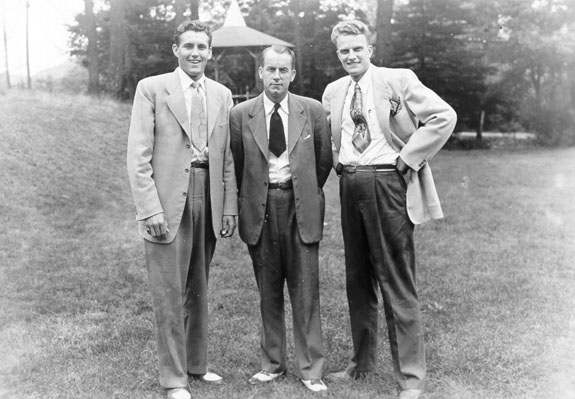
The thirty-minute program was focused on youth evangelism, formatted as variety show. Crawford served as the master of ceremonies and usually gave a brief prayer early in the program. There were several musical numbers, with acts recruited and developed by his wife, Ruth Duvall Crawford. There were also short testimonies from teenagers or young people who attended his services or camps, readings from listeners’ mail, appeals for support, and a ten-minute evangelistic appeal usually from Crawford, although occasionally there were guest speakers.
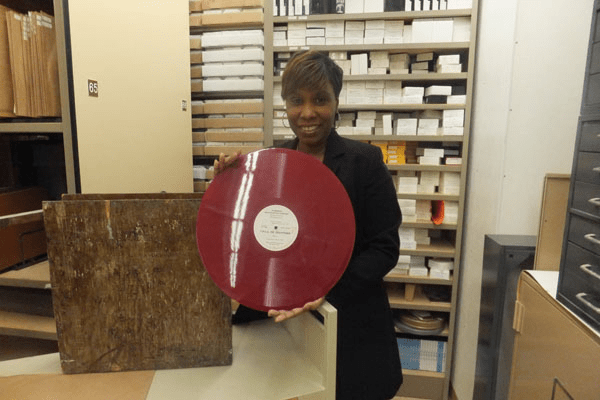
Listen to a recording of the July 14, 1946 broadcast held in Collection 357: Papers of Percy and Ruth Crawford. The program includes Crawford’s sermon on John the Baptist, along with a prayer by Billy Graham, and contributions from Cliff Barrows and Royal Grubb.
Although radio dominated nationwide communication through the 1920s and 1930s, by the late 1940s the new medium of television began to make an increasing impact on American society. Growing numbers of Americans avidly watched the small flickering black and white screen for political commentary on Meet the Press, for baseball games and roller derby, and for entertainment with Milton Berle, Hopalong Cassidy, and Kraft Theatre.
Many American churches and religious leaders greeted the exploding interest in television with a great deal of skepticism and concern over the nature and tone of programming. However, some saw a potent new means for mass communication of the Gospel. In a 1949 article in Christian Life, HCJB radio pioneer Clarence W. Jones boldly charged all Christians to “Get a Television Set,” writing:
It is obvious that any phenomenon making as important an impact as TV upon our families cannot be set aside lightly by Christians. It enters too deeply into the pattern of the way we do things, and this is vital to the church. The meteoric rise of television, its unusual and undeniable appeal, as well as its social and spiritual implications make TV something which the church must seriously and urgently consider while video is still in its formative stages. If evangelical Christianity misses the boat with TV as we so largely did with radio, it will be entirely our own fault, and an unforgivable lack of vision and courage…. What Christians can do to make television a force for Christianity is not a closed issue. The medium is too new, and we have yet to gain sufficient experience in handling it both in the home and in the studio. But the fact remains, television is here to stay for good or bad. It is not presumption to challenge ourselves now with the belief that our present attitude toward TV will help decide for the future how good or bad television programs will be.
Right now, video is influencing millions of people in the United States and in other parts of the world. Is the Christianity we profess and preach virile and alert enough to make those decisions, in the home and as a Church, that will take the spiritual question mark out of this rising potential, making television a mighty force for good and the gospel?
Clarence W. Jones, “Get a Television Set” from Christian Life, August 1949. Read full article here.
Christian evangelists, pastors, and educators soon began experimenting with programming on the new medium. On January 1, 1949, Walter Maier, the popular Lutheran radio evangelist, made a television broadcast of The Lutheran Hour at a local station in St. Louis. Bob Jones University broadcast Christian music in South Carolina through their Vesper Hour programming. A few other preachers also made local broadcasts, going out to the audience of a single station.
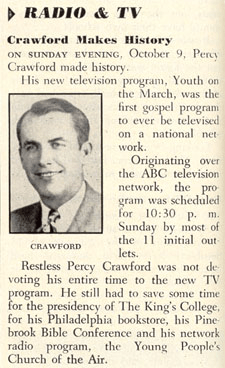
However, the costs and the still-developing technical requirements of the new medium discouraged any nationwide broadcast of a Christian evangelistic program until October 9, 1949, when Percy and Ruth Crawford launched Youth on the March. On that Sunday evening, Youth on the March went on the air over the ABC network, broadcast from the WFIL-TV station in Philadelphia and carried by “most” of its eleven affiliates.
Watch the full recording of the premier of Youth on the March from Percy and Ruth Crawford’s Collection at the Evangelism & Missions Archives, or explore a playlist of program highlights.
Replicating their earlier radio broadcasts, the Crawfords featured a variety-type format anchored by engaging musical performances, as well as skits and dramatic presentations. It proved as popular a formula on television as it had been on radio. By the end of the first year, Youth on the March was carried by twenty-two stations and had an estimated viewing audience of fifteen million people.
Contemporary reviews of the program highlight the attraction of the youth-based programming and the dynamism of Crawford’s direct preaching style:
“The program shows the real American youth, relieved of the psychological wraps of toughness modern environments have garbed them in. The young people do not perform with over-sentimental expression; in their eyes are the good, clean expressions of the young. To them their program is one of the finer experiences of their lives. Yet it is religion…. Dr. Crawford is a fiery preacher, direct and to the point. He doesn’t hold with a lot of learned adjectives. THAT is what makes him appeal to kids. Crawford looks right into the camera and looks at no one but you. Folks get all red in the face and look out of the corner of their eyes to make sure no one else can see their embarrassment. Why does the network let him talk to the public as if they were all a bunch of chronic criminals? They do it because three fourths of the television audience turn to him to be told off. At first you think, “So who is he to tell me I am going to hell, already??” After listening to him you think, “Who is the character who that told this guy about me?” Crawford isn’t necessarily talking to you although he aims it right at you. He deals with faults that are common to all people, everyone. You can’t get perturbed at him because deep down you know it is true…. He is preaching to a congregation he can’t see, which sees him. His sincerity, however, is so great that no matter what you believe you know that what he saying is aimed at a common fault that can be overcome with a little work on our part.
Carl F. Odhner, feature writer for the Allentown (Pennsylvania) Beacon, 1949
“Four thousand were reported outside a Pittsburgh auditorium and 3,000 inside it, when Percy Crawford, the television-radio preacher, and his associates presented a program of preaching and religious music last Saturday night. People began arriving hours before the program time and waited patiently while the seats filled, a second auditorium room was opened and filled and as the crowd began milling outside the doors. [sic] The Rev. Dr. Percy Crawford had his family with him – the youngsters who sing in harmony and the three-year-old Donna Lee swinging her arms as conductor and Mrs. Crawford, who plays the piano and occasionally sings herself – in the pleasing voice of a church choir soprano. Whether the Crawfords could have drawn this attention in a city as outwardly materialistic as Pittsburgh before the age of television is questionable. Nevertheless, they did draw the crowd with little advance promotion, and it was one of the biggest crowds ever to attend such an indoor affair in the steel city…. The Crawford and [Fulton] Sheen programs have confounded those who sit in the seats of the TV mighty and attempt to diagnose the intelligence and receptivity of the American public. Both have been accidental successes in the so-called entertainment world, starting out as incidental presentations and making the top on their merits.”
Pittsburgh Sunday Sun-Telegraph, Editorial, ca. 1952
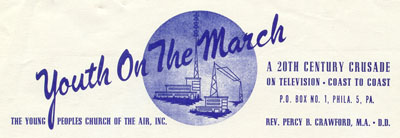
Youth on the March continued on the ABC network until the spring of 1953. For a time, during the 1951-1952 season, YOTM followed evangelist Billy Graham’s new television program, The Hour of Decision, to form a very popular Sunday evening hour (10-11pm, EST). YOTM never ran commercials but relied on viewer contributions, with individual program costs varying from $5,000 to $20,000. By the spring of 1953, the high costs and the pressure of the Crawfords’ other projects caused the program to go off the ABC network.
Undeterred, Crawford, in an early instance of syndication, put together contracts with independent television stations and continued to broadcast over this homemade network from 1953 to 1956. After 1956, the program was only broadcast over a few stations, mainly WHYY-TV in Wilmington, Delaware, and went off the air entirely in 1958. Seeking to circumvent the growing difficulty and expense in obtaining time for Christian programming on the established networks, Percy Crawford bought station WPCA in Philadelphia in 1960 and turned it into the country’s first functional Christian television station.
Only a few months later, on October 31, 1960, Percy Crawford died of a heart attack while driving to a Youth for Christ meeting. Encapsulating a lifetime of passionate and inventive ministry, Billy Graham, who preached at Crawford’s memorial service, said of him, “He could communicate the Gospel to young people as few men I’ve ever known. In fact, I don’t know anyone who could communicate the Gospel of Christ in such a short time as Percy Crawford.”
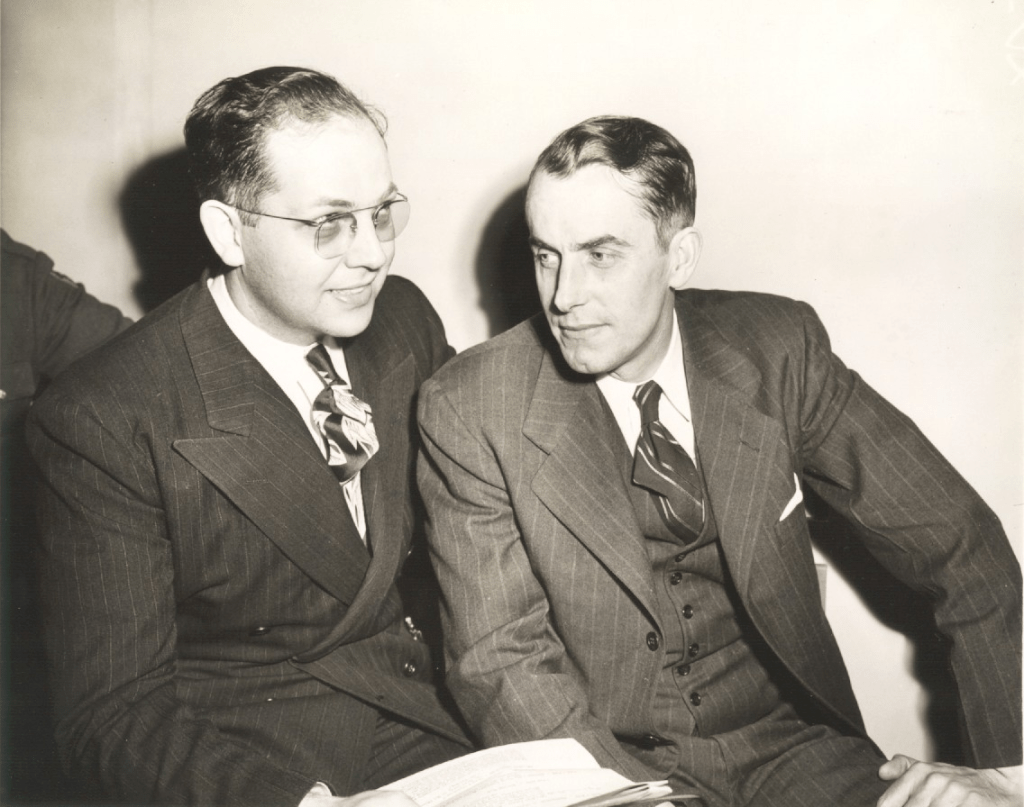
More information about the life and ministry of Percy and Ruth Crawford, including recordings of many of their radio broadcasts, are available at https://percycrawford.com/. Along with the papers, recordings, and photographs held in Collection 357: Papers of Percy and Ruth Crawford, additional recollections of Percy and Ruth Crawford can be found in the Evangelism & Missions Archives’ oral history collections for Jack Wyrtzen, William A. Drury, Dan D. Crawford, Perry Straw, Marie H. Little, Arthur Rorheim, Richard Rung, and Paul Snezek.
 From the Vault