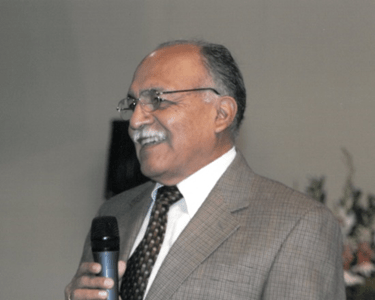
The Wheaton Archives & Special Collections is pleased to announce the recent acquisition of a significant research collection documenting the life and ministry of Peruvian missiologist and theologian Dr. Samuel Escobar. Spanning more than five decades of Dr. Escobar’s life and ministry, the papers are a valuable addition to the Evangelism & Missions Archives and will significantly expand our collections representing the Global South, especially voices from Latin America.

A prolific writer, leading missiologist, and theologian of Latin American evangelicalism, Samuel Escobar’s influence today extends around the world. Born in 1934 in Arequipa, Perú, Escobar earned his undergraduate degree from San Marcos University in Lima and later relocated to Madrid, Spain in 1966 for doctoral studies at the Complutense University.
Over the course of his seven-decade ministry, Escobar served in a wide range of evangelical institutions and parachurch organizations crisscrossing the globe. For more than 20 years, he worked as a traveling evangelist for the International Fellowship of Evangelical Students (IFES), focused on reaching young adults in Latin American contexts. In 1972, Escobar began a three-year term as the General Director of InterVarsity Christian Fellowship, Canada (IVCF).
In addition to his work with university students, Escobar was a leading member, alongside Pedro Savage, C. René Padilla, Emilio Antonio Núñez, of the Fraternidad Teológica Latinoamericana (FTL), which traces its beginnings to a meeting of Latin American theologians and pastors held in Cochabamba, Bolivia in 1970. Escobar served as the first president the FTL from 1970 to 1984.
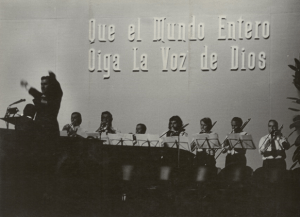
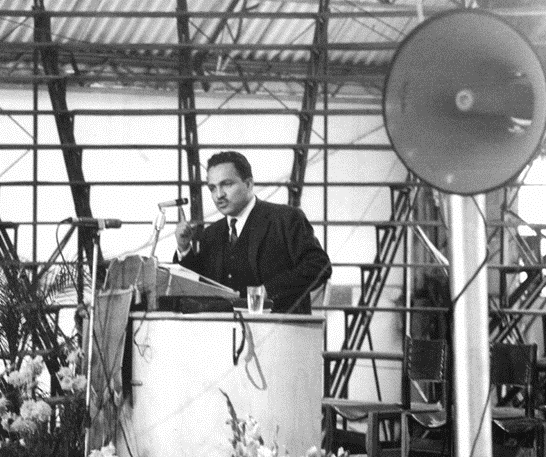
In 1974, Padilla, Escobar, and other Latin American Theologians introduced their conception of misión integral or integral mission—a holistic vision of the gospel comprising both evangelism and social responsibility—to a global audience at the International Congress on World Evangelization in Lausanne, Switzerland. During the Congress, Escobar worked to enshrine “Christian Social Responsibility” as the fifth pillar of the Lausanne Covenant, which proclaimed, “The message of salvation implies also a message of judgment upon every form of alienation, oppression and discrimination, and we should not be afraid to denounce evil and injustice wherever they exist. . . . The salvation we claim should be transforming us in the totality of our personal and social responsibilities.” Following the inaugural congress, Escobar served as a leading participant in Lausanne II in Manilla (1989) and on the Advisory Council for Lausanne III in Cape Town (2010).
Leaving IFES in 1985, Escobar became the Thornley B. Wood Professor of Missiology at Eastern Baptist Theological Seminary (now Palmer Theological Seminary) and taught at the Facultad Protestante de Teología of the Spanish Baptist Union in Alcobendas in Madrid, Spain until his retirement in 2019. In the final decades of his career, Escobar continued to have an active ministry, preaching and teaching to international audiences and regularly publishing for both academic and lay markets. Today, Dr. Escobar lives in Valencia, Spain, near his family.
Dr. Escobar has published on a variety of topics relating to Christian evangelism, missions in Latin American contexts, Liberation Theology, Paulo Freire, and Christology. Many of his works exist in both Spanish and English. A few of his notable publications are: Samuel Escobar: An Anthology: Collected Essays on Mission, Culture and Theology (2022); People in Mission: An Autobiographical Reflection (2021); The New Global Mission: The Gospel from Everywhere to Everyone (2003); In Search of Christ in Latin America: From Colonial Image to Liberating Savior (2019); Teología Evangélica Para El Contexto Latinoamericano (2004); Servir Con Los Pobres En America Latina: Modelos De Ministerio Integral (1997); Paulo Freire: Una Pedagogia Latinoamericana (1993); and Le Fe Evangelica Y Las Teologias De La Liberacion (1987).
An International Acquisition
Samuel Escobar’s personal papers became an early collection of interest for archivists at the Billy Graham Center Archives (now the Evangelism & Missions Archives). Due to his prolific writings and ministry experience, Escobar material already appeared in multiple collections held at the Archives, including the International Fellowship of Evangelical Students Records, the InterVarsity Christian Fellowship Records, the Lausanne Movement Records, the Primer Congreso Latinoamerica de Evangelizacion (CLADE) Records, oral history interview series, like René Padilla’s, and even the Wheaton College Archives, which holds the records of Escobar’s visits and messages, like his 2011 lecture given at the Wheaton Theology Conference, Liberation Theology and the Development of Latin American Evangelical Theology.
While archivists had approached Dr. Escobar about the possibility of donating his personal papers as early as 2004, conversations did not begin in earnest until 2019, after Escobar had relocated to Valencia, Spain, moving his personal papers and research library along with him. Despite Dr. Escobar’s enthusiasm for the project, the donation process encountered significant hurdles. In 2020, many archival donation initiatives were scuppered by the COVID-19 pandemic as staff members worked remotely. Further, the significant investment of time and resources required for a successful international acquisition prompted the archives team to find new collaboration partners. In 2023, archivists applied for a Globalization of the Curriculum Grant offered through Wheaton College’s Global Programs and Studies. The grant exists to “build or strengthen inter-cultural competence or provide a geographic or cultural perspective which is absent or under-represented in the current curriculum.” While the Evangelism & Missions Archives holds significant collections from organizations and individuals involved in missions and evangelism based out of North America, there are currently few collections representing voices that originate from the Global South. This lacuna has resulted in a significant under-representation of large geographic areas of evangelical Christianity within the archival holdings. The Samuel Escobar Papers, with their international scope but focus on Latin America, would be a significant step in closing this gap and could serve to lay the groundwork for acquiring other collections of leading theologians and practitioners from the Global South.
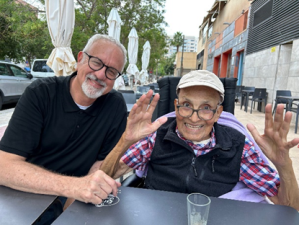
In June 2024, Dr. Daniel Carroll R. (Rodas), Scripture Press Ministries Professor of Biblical Studies and Pedagogy at Wheaton College and a personal friend of Samuel Escobar, flew to Valencia, Spain to sort and ship the materials stored in Escobar’s apartment. With deep roots in Latin American theology due to his Guatemalan heritage, Dr. Carroll relied on his fluent Spanish to decipher and inventory the Escobar files. The project concluded on July 1, when 10 boxes of historical documents, photographs, books, and more were delivered to the international shipping company in Valencia to be transported more than 4,000 miles to Wheaton, Illinois.


After the boxes arrived in Wheaton, archivists re-housed the materials into acid-free, archival boxes, and added the donation to our collections database. While the papers await a more thorough organization and description process, they are now have a brief description and are searchable in ArchivesSpace. A box-level inventory, created by Dr. Carroll, is available here.

Although the Samuel Escobar Papers have only been on-site at the Wheaton Archives & Special Collections for 10 weeks now, they have already been accessed by researchers, eager to be among the first to mine the new collection. In addition to plans for more thorough organization and description, the archives team, along with Dr. Carroll, are also planning an event in spring 2025 in honor of Samuel Escobar, featuring significant artifacts from the collection.
Exploring the Collection
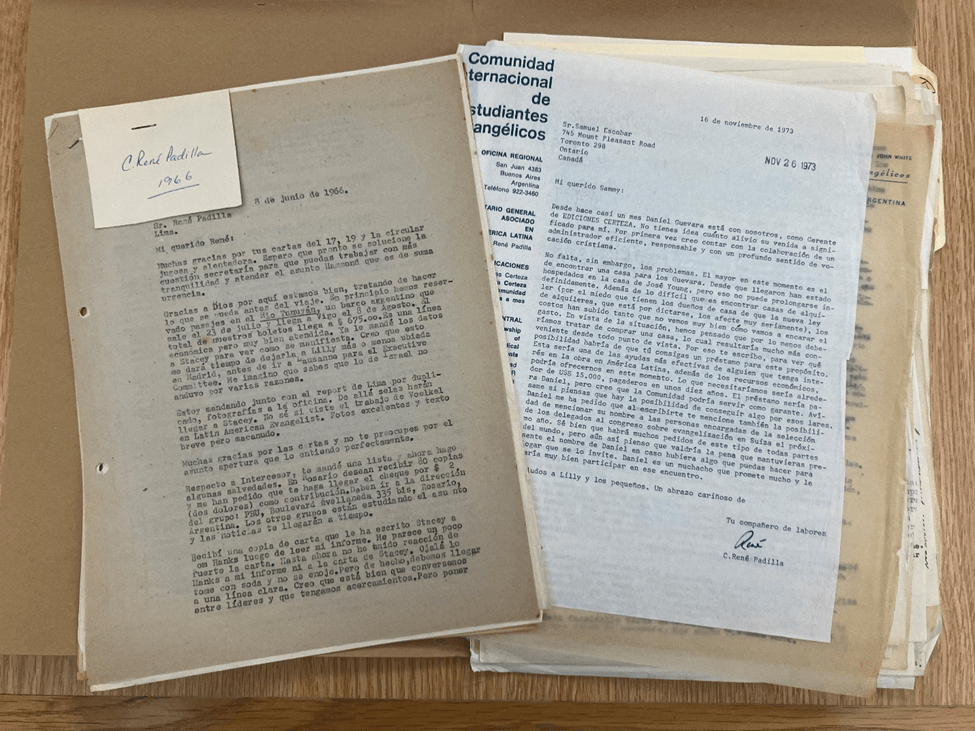
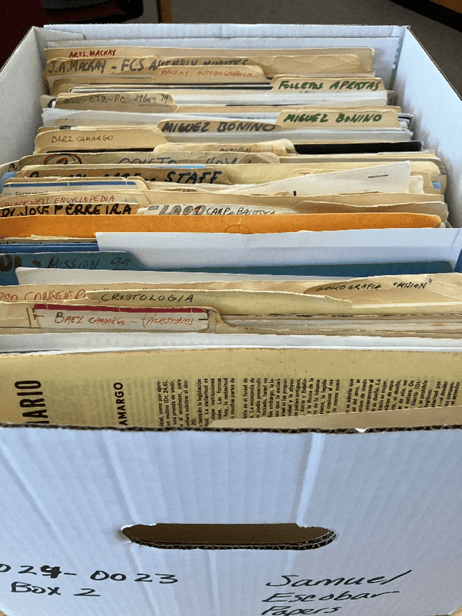
The Samuel Escobar Papers provide a comprehensive overview of his professional and ministerial development from the late 1950s to the present. Overwhelmingly composed of paper materials, the collection also contains photographs, negatives, and published journals and books. When re-housing the materials, the archivists chose to retain their original order, and researchers can expect to open boxes and find files and loose papers stored as they were in Samuel Escobar’s personal filing cabinets in Valencia. Folders of correspondence, research notes, syllabi, and lectures are interspersed with sermons, unpublished manuscripts, and personal greetings cards.

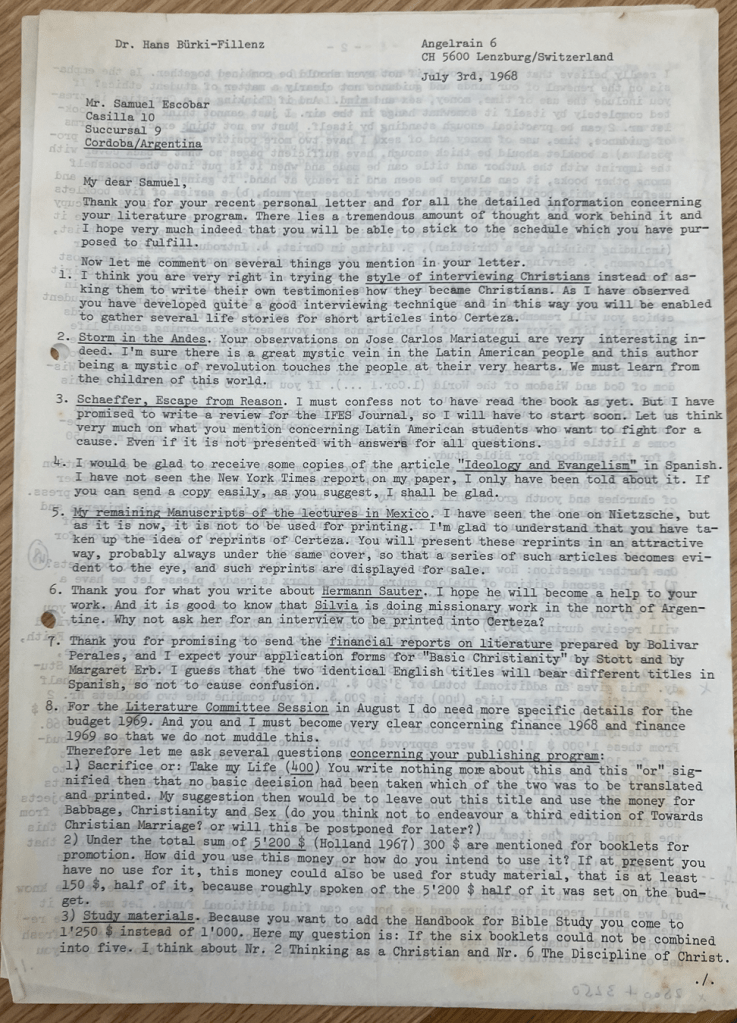
Researchers may be particularly interested in Escobar’s rich correspondence files, documenting friendships and professional collaborations across decades and around the globe. While some correspondence files are more extensive, like those for Hans Bürki, John Stott, or René Padilla, other files contain letters from the likes of John Howard Yoder, Tito Paredes, Stacey Woods, José Míguez Bonino, among others. The bulk of Escobar’s correspondence, however, documents his service in various positions with IFES, IVCF, FTL, and the Lausanne Movement.
Escobar’s voluminous writings, both for publication and for presentation, reflect the development of his academic and ministerial interests. Box 3 contains research files and notes on the doctrine of Christology, documenting Escobar’s exploration of a Latin American Christology. Box 2 especially contains works by and about John MacKay, a Scottish Presbyterian theologian and missionary who published The Other Spanish Christ in 1932 and remained a long-time research interest for Samuel Escobar.
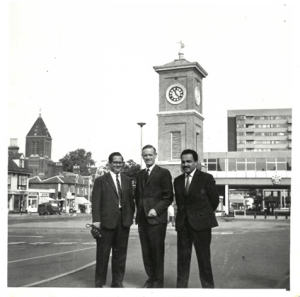
Particularly well-documented is Samuel Escobar’s involvement with the International Congress on World Evangelization in 1974 in Lausanne Switzerland. The papers contain Escobar’s handwritten planning notes for the congress, photos, press clippings, and more.

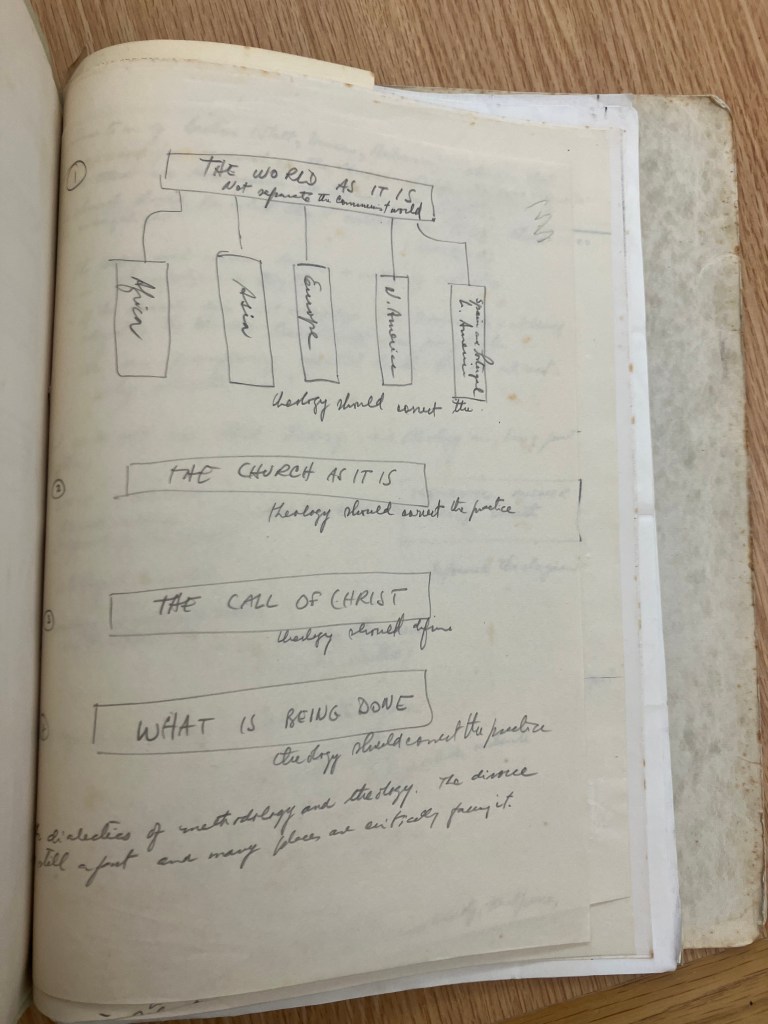
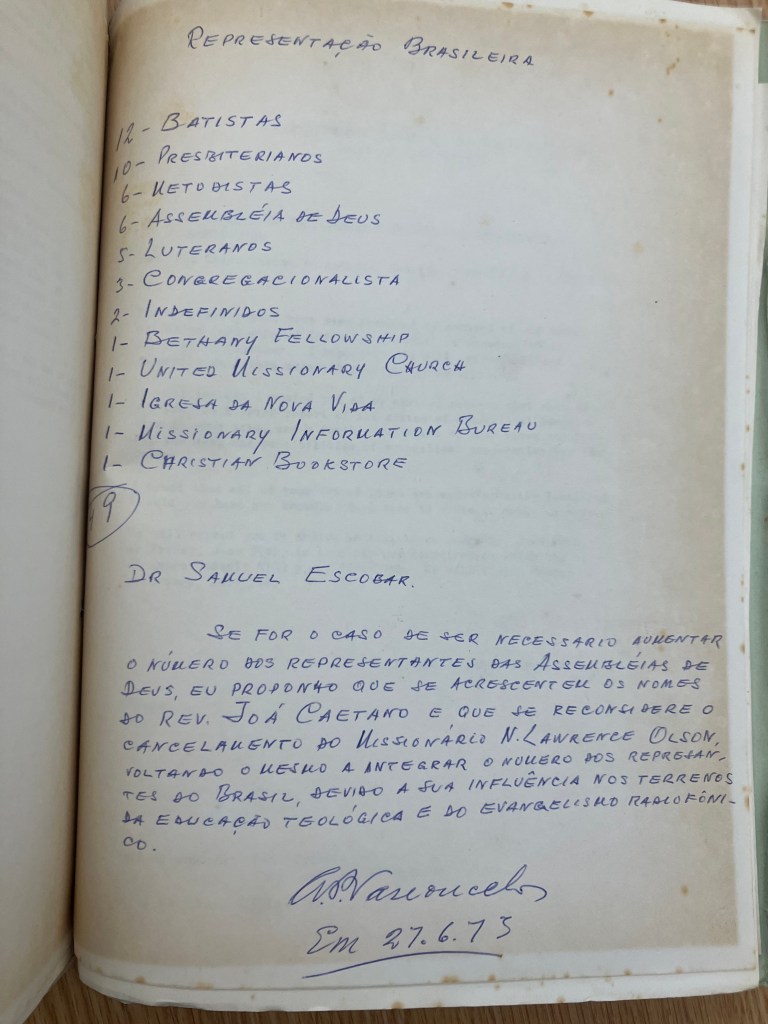
Other significant topics of note in the collection are the development of evangelicalism in Latin America; relations between evangelicals and the Roman Catholic Church; liberation theology; seminary education for Latin America students; and the history and role of Protestant missions in Latin America.
The Samuel Escobar Papers also include several boxes of books and journals from Escobar’s personal library, in both Spanish and English, chiefly copies of his own publications but also works on missiology, global evangelicalism, history, Christian devotional practice, and the novels of Peruvian Nobel Prize Winner, Mario Vargos Llosa, an author whom Escobar particularly cherished.

While it may be months before the Samuel Escobar Papers are fully processed, the materials remain open for research now, and the Wheaton Archives & Special Collections welcomes visitors to access the papers in their current form. The full inventory here provides details on contents of each of the collection’s 10 boxes.
The Archives & Special Collections team acknowledges our ongoing gratitude for the support of Global Programs and Studies and for the personal expertise and generosity of Dr. Danny Carroll , without whose assistance this acquisition would have been possible.
 From the Vault