In his history of the Wheaton College literary societies, former Wheaton College communications professor, Edwin Hollatz, aptly stated that “the development of the American college is a story that can hardly be told without some consideration of Literary Societies” (Wheaton Alumni Magazine, September 1967). These student-led organizations, which thrived at Wheaton College from the mid-nineteenth century until World War II, played a pivotal role in shaping the college life and education of Wheaton students.
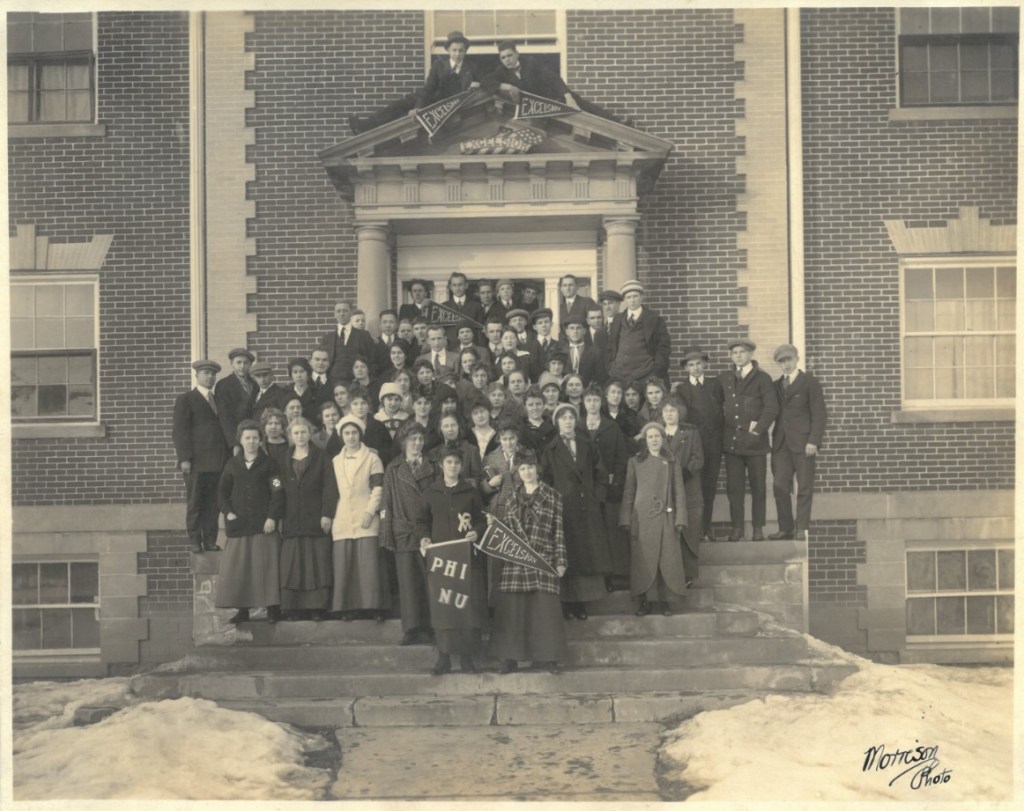
Literary societies, often bearing Latin-based names such as Beltionian and Philalethian, provided a space for students to hone their skills in rhetoric, persuasive argumentation, parliamentary practice, and the art of discourse. The roots of the societies in the United States trace back to Harvard University, where the first student literary and debate society was founded in the early eighteenth century. Similar groups quickly appeared at colleges across the eastern United States.
Wheaton College’s first literary society was the Philomatheans, founded in 1854 under the college’s predecessor, the Illinois Institute. Declaring their mission as “the improvement of all connected with it in debating, social and moral advancement, and general literature,” the Philomatheans began holding regular meetings on Friday evenings in the college chapel.
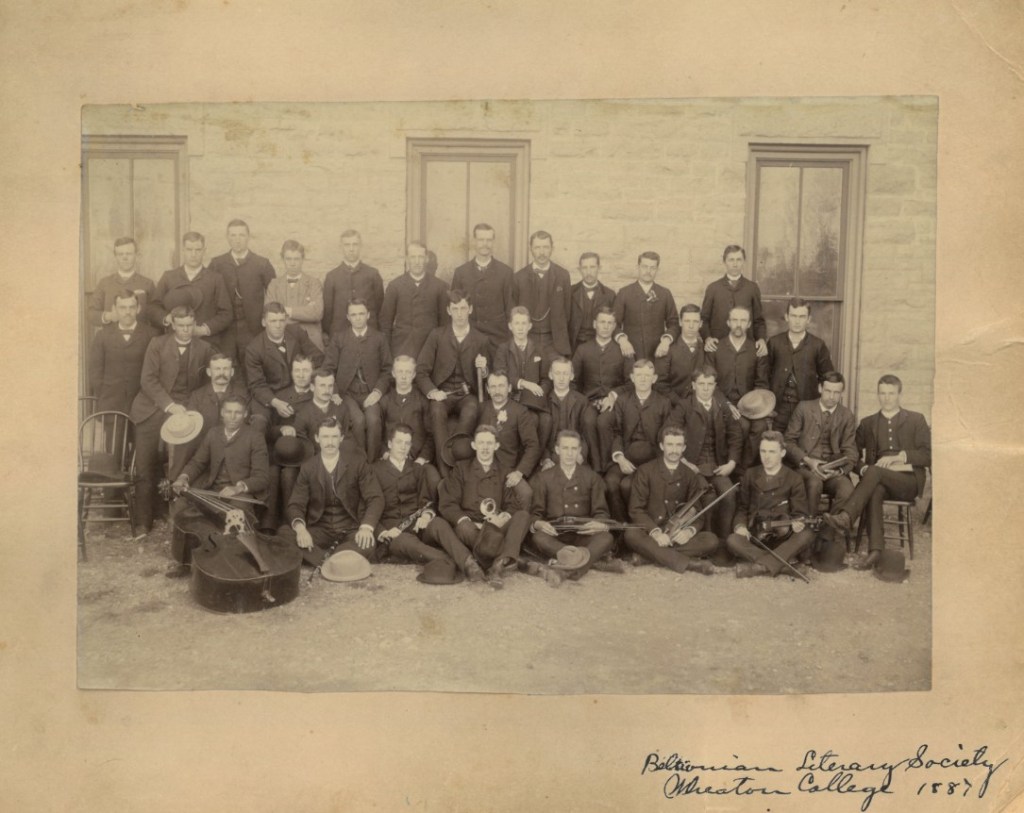
Beltonian Literary Society, 1887. (College Archives Photograph B6140) 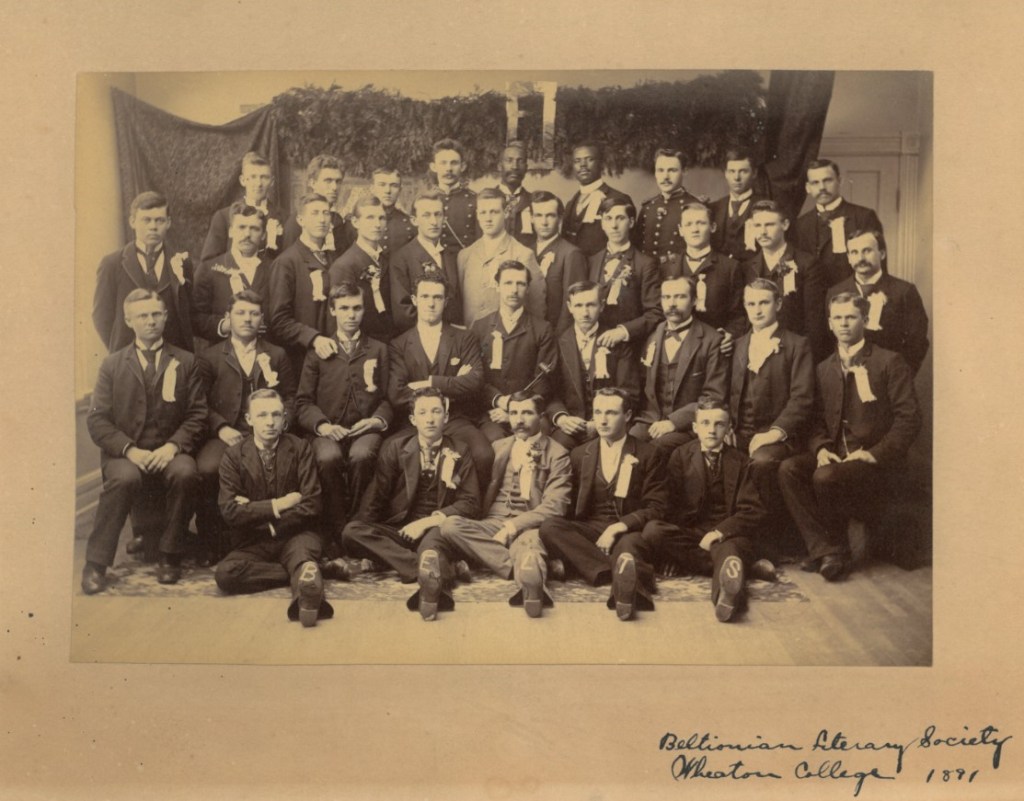
Beltonian Literary Society, 1891. (College Archives Photograph B868) 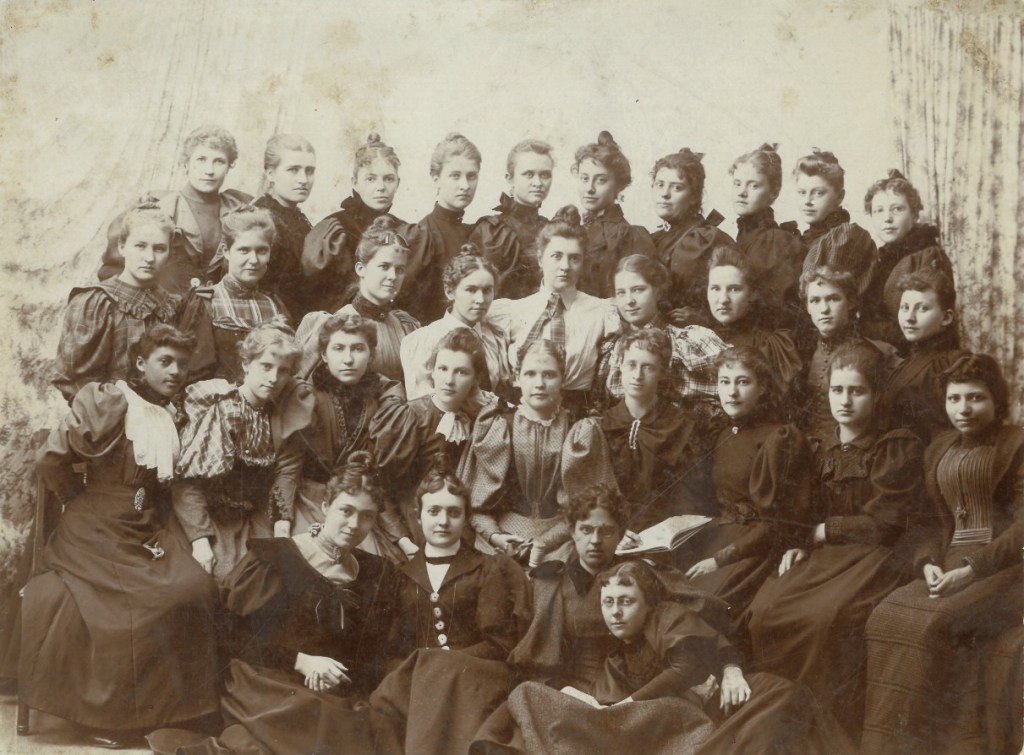
Aeleoian Literary Society, 1894. (College Archives Photograph B40) 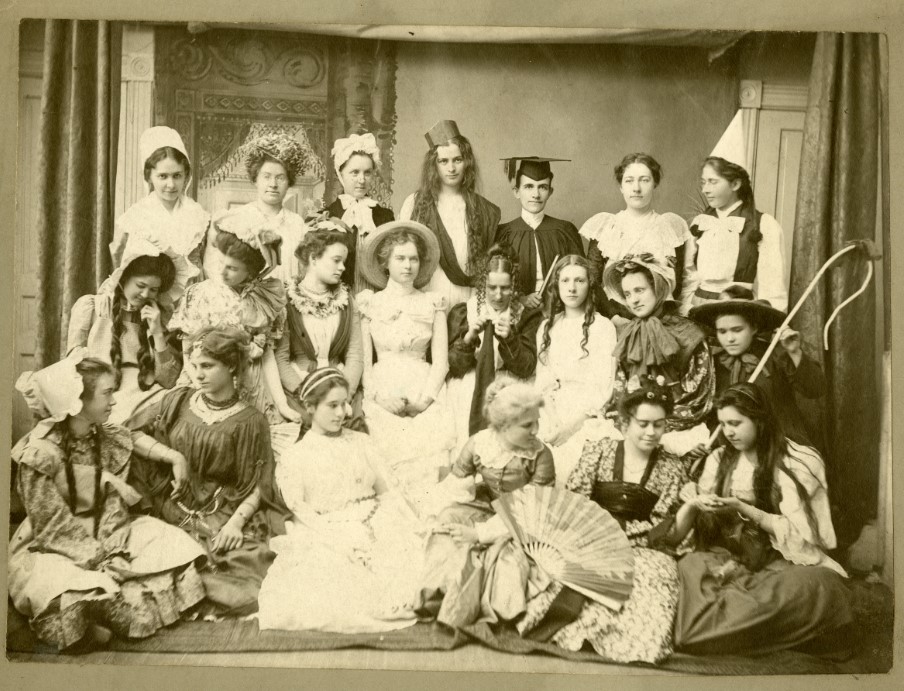
Philalethian Literary Society, 1901-1902. (College Archives Photograph B4157) 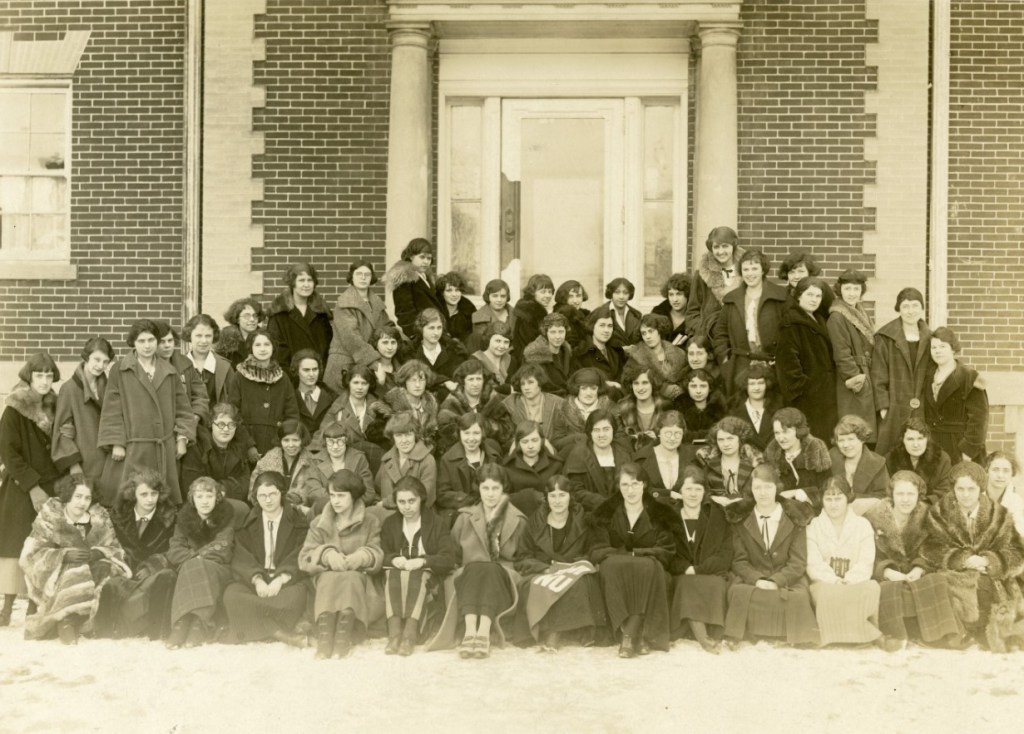
Philalethian Literary Society, 1920. (College Archives Photograph B4158) 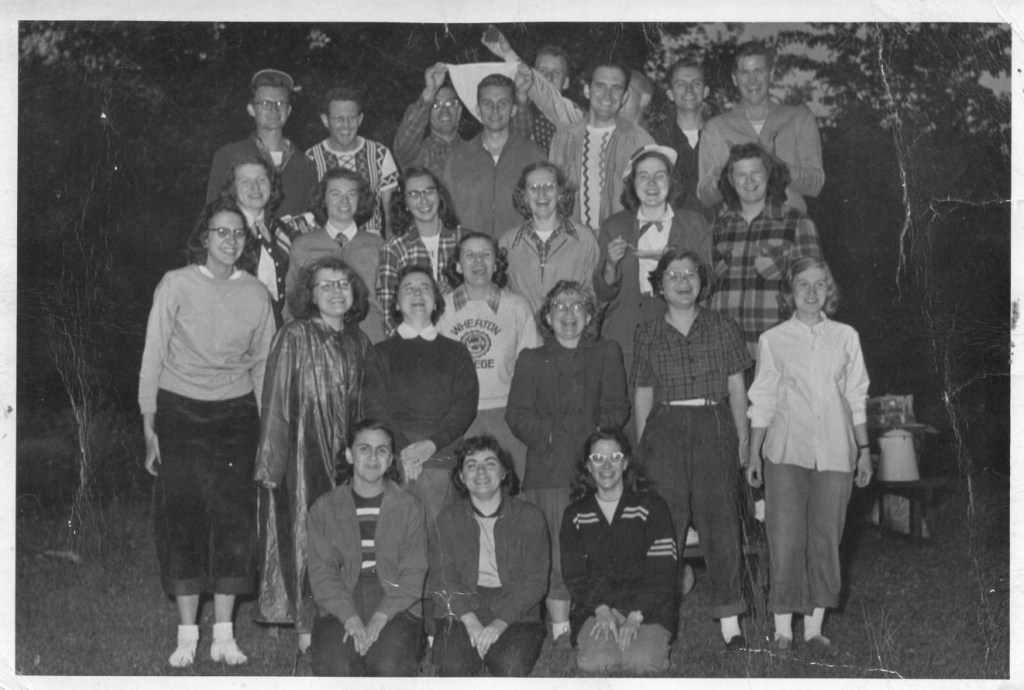
Ladosian Literary Society Social, 1950. (College Archives Photograph B15250)
After the Civil War, fraternities and sororities gradually replaced literary societies on many campuses across the country. However, Wheaton’s ban against student participation in secret societies prohibited fraternities and sororities because of their history as secret oath-bound organizations. This ban helped preserve the literary societies at Wheaton for long after they had disappeared from most collegiate life.
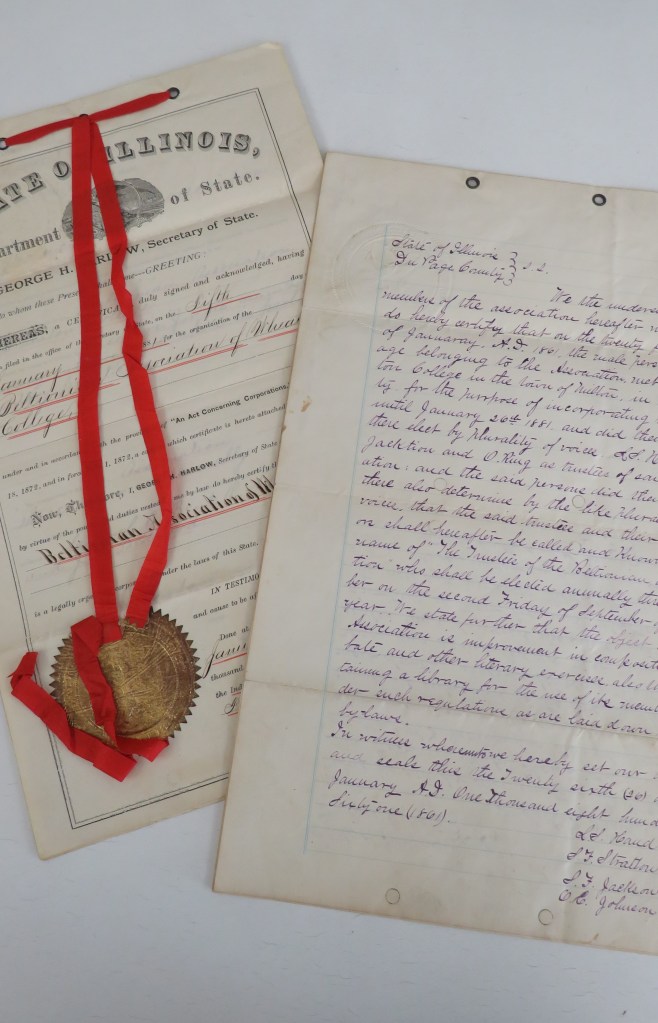
In 1856, the Philomatheans reorganized as the Beltionians and applied for an official charter from the State of Illinois, making it the oldest such society in the state.
While the Philomathean society had been open to both men and women, the co-ed nature of the society came to an end under President Jonathan Blanchard. Blanchard’s concern over the propriety of a co-ed student association, as well as the late hours of society meetings, prompted the separation of the societies into male and female groups. The first women’s literary society at Wheaton, the Aelionians, was officially established in 1862. Although students protested this separation throughout the 1860s, most subsequent societies at Wheaton continued to be divided by gender. Nonetheless, cooperation between literary societies thrived through the Literary Union (and later the Inter-Society Council), which coordinated joint projects and organized co-ed banquets and exhibitions throughout the academic year.
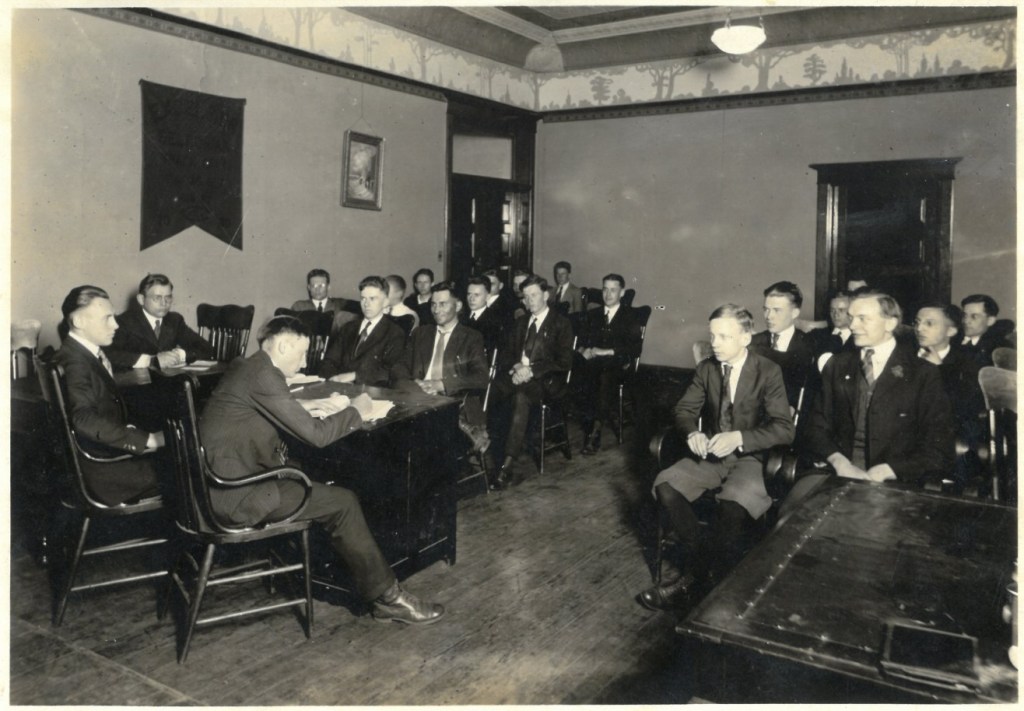
At Wheaton, the literary societies operated as independent student organizations, each with its own hall, governance, and administrative structure. Meetings, typically held on Friday evenings, offered a diverse array of activities, including debates, speeches, poetry readings, and other literary pursuits. While also social gatherings, the meetings were strictly run under the rules of parliamentary procedure, with the elected chair expected to have memorized Robert’s Rules of Order. Topics of discussion spanned history, religion, ethics, politics, and current events. The societies provided an avenue for students to engage with the burning issues of their time, including the contentious topic of slavery.
Debate topics from the Excelsior Literary Society’s 1890 meeting minutes (held in Folder 26-3) illustrate the wide variety of moral, political, economic, and social issues discussed:
- Resolved: That theater-going is injurious to character.
- Resolved: That Canada should be annexed to the United States.
- Resolved: That there be a tax on old bachelors
- Resolved: That the vegetable diet is best for man (Judges decided two in the affirmative)
- Resolved: That anarchists should be denied the right of public utterance on the subject of anarchism (Judges decided in favor)
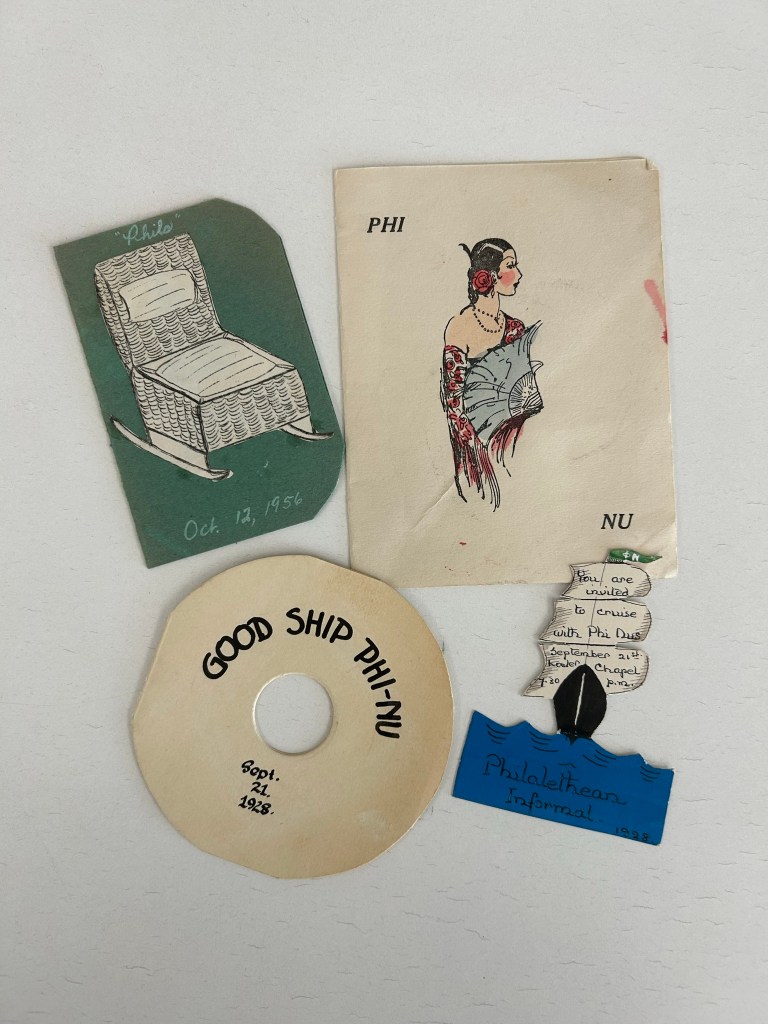
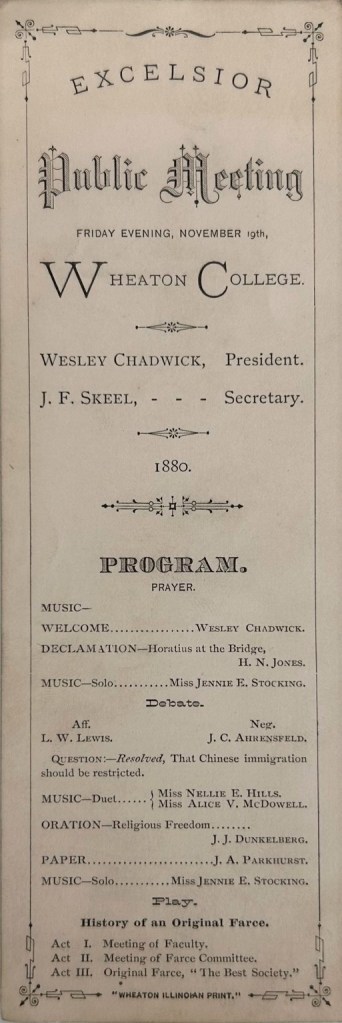
In addition to their regular meetings, literary societies at Wheaton College held public exhibitions throughout the year, showcasing speeches, musical performances, tableaux, pantomimes, and even student-authored dramas. They also organized the first annual lecture course at Wheaton and hosted the first judged collegiate debate competition in the country, which pitted the Wheaton Beltonians against the Natural Science Association of North-Western College.
Although much of the business of the societies concerned their weekly meetings and programming, they were also instrumental in the founding of two Wheaton institutions:
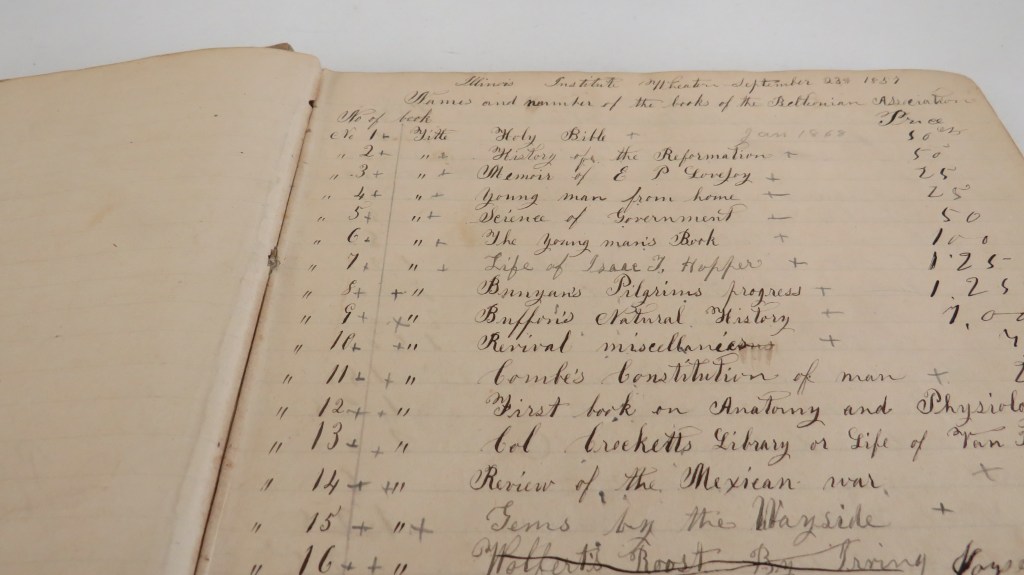
The Beltionian Literary society organized the first lending library on Wheaton’s campus, active from the late 1850s through the 1870s. One of the most valuable benefits of early society membership was access to this library, available for a 25-cent subscription. The society libraries were eventually combined with other book collections to form the Fischer and Frost Libraries in Blanchard Hall, which were opened to all students regardless of society membership.
Through the cooperative Literary Union, members of the literary societies also published the first college newspaper, Voice of our Young Folks, in 1868. Although the paper only one lasted one year, in 1875 the Literary Union led the publication of a new periodical, the Wheaton Record, which has continued as Wheaton College’s student newspaper to the current day.
During the 1920s and 1930s, Wheaton College boasted over half a dozen thriving literary societies, with participation rates often exceeding 80 percent of the student body. These societies played a vital role in the campus’s social fabric, fostering a sense of camaraderie and shared purpose among students.
James O. Palmer Jr., ‘47, reflected on the importance of the societies in Wheaton’s social and academic life during the 1940s:
“Lits did play an important role socially on campus… The meetings themselves were conducted with an emphasis on developing the fellows in areas not covered by classroom studies. For instance, I was in the room just about 10 minutes when I went to my first meetings of Celts as a freshman, and the president called on me for a five-minute ex-temp on some subject I knew something but not too much about. He insisted that I make the speech or leave the meetings. I made it, enjoyed the experience, learned by my mistakes, and later joined the Lit. As soon as I joined, I was given various assignments and each one made me work – often in areas in which I would not otherwise have been even slightly active. My assignments definitely helped me develop poise and confidence in public speaking, climaxing in my bringing the chapel message in a combined program with our sister lit. Wheaton campus life in 1943-47 was pretty much self-contained. We had few cars and gasoline was not readily available until the end of the war. College rules were tighter, and it wasn’t easy to go off campus for social activity. Thus, we found we had to learn to live together and make our own social life.”
Personal Letter, 1975. Literary Society Records (8.01), Folder 37-4.
Carolyn Gillies, ‘47, highlighted the role of literary societies in creating community at Wheaton:
“I personally feel it satisfied a basic human need to be closely identified with others. Even on as small a campus as Wheaton, people tend to subdivide into even smaller units with closer relationships based on similar interests and concerns. Our Lit societies were an approved form of such clubs…each attracting students with different basic interest…. One Lit attracted the more athletic sports-minded students, another, the party good-time gals; etc. Lits filled a need to “belong,” to identify oneself with a set of other human beings, to share experiences of various natures together, to play together, to be human! Once could gain recognition and status, gain poise and confidence, learn leadership, use talents, within the smaller unit that would go unnoticed on a grander scale. It is really very difficult to evaluate these societies for their impact on the campus…but I believe they were of tremendous worth to the individuals, in his own search for identity, for friends, for a philosophy of life, for recreation!”
Personal Letter, 1975. Literary Society Records (8.01), Folder 37-4.
During the 1940s and the 1950s, the disruption caused by World War II, along with increased access to off-campus entertainment and the development of the Wheaton College Student Union, led to a gradual decline in literary society attendance. The College’s curriculum had also expanded over the first half of the 20th century, diversifying the options available to students and reducing the importance of the activities provided by the societies. As a result of the declining interest and attendance, all of Wheaton College’s literary societies disbanded within a year or so of each other in 1958-1959.
The history of literary societies at Wheaton College and other American institutions of higher learning is a testament to the transformative power of student-led organizations. These societies, with their emphasis on debate, public speaking, leadership development, and intellectual exploration, left an indelible mark on the lives of countless students, as well as the traditions and culture of the College.
Explore more meeting minutes, programs, and publications from the Wheaton College Literary Societies through the Literary Societies Records (RG 8.01). Digitized photographs from the 100-year history of the societies at Wheaton can also be found on the College Archives’ Digital Collections.
 From the Vault